








Intellect Design Arena Ltd identifies 25 under-Rs 50 crore cells
MAX Plan at ₹4,999/yr

Find your next multibaggerBe a Pro Investor
Research stocks and track your picks on the go. Download the app.
Key highlights
- Intellect classified 25 of 45 FY26 product-region cells as Opportunity positions with headroom below Rs 50 crore.
- The FY26 grid has 4 Anchor cells above Rs 200 crore, 7 Established cells at Rs 100 crore to Rs 200 crore, and 9 Emerging cells at Rs 50 crore to Rs 100 crore.
- MEA has 6 Opportunity cells, while the Americas, Europe and India each have 5 and APAC has 4.
- Intellect says MSOCK can make implementations 40% faster and reduce change-request delivery cycles by 30%.
powered by IRIS
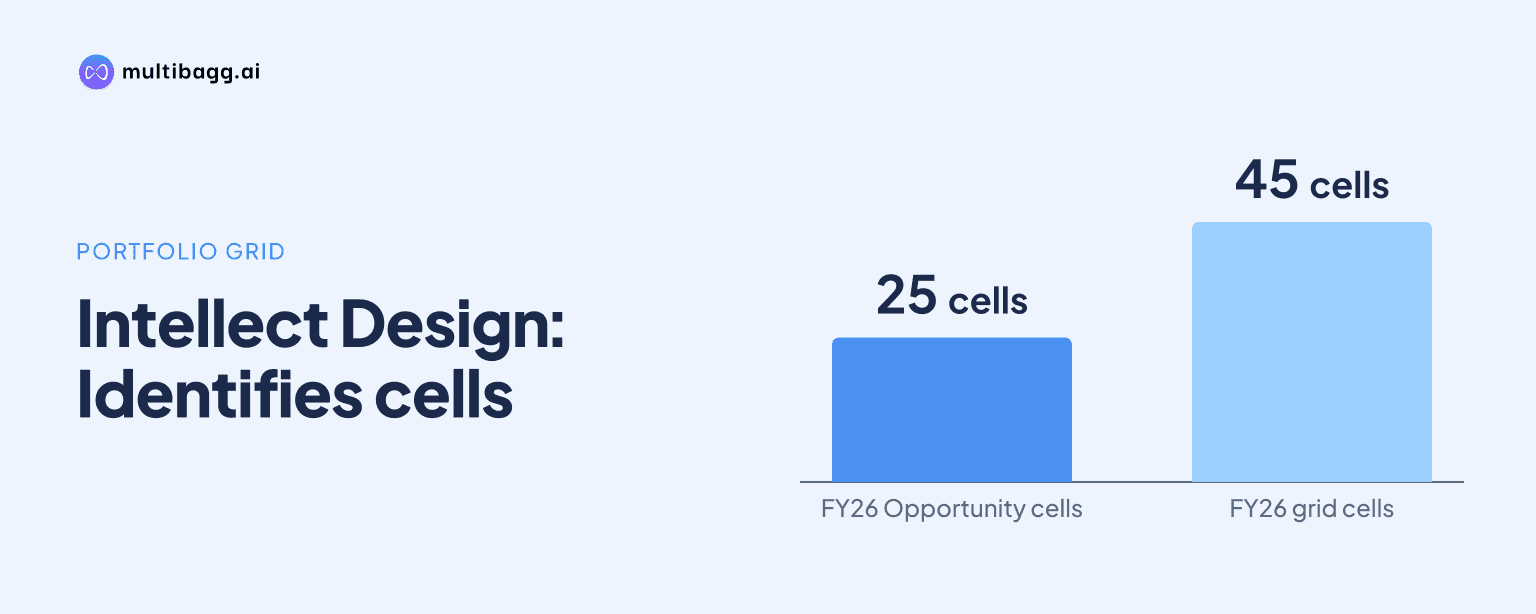
Intellect Design Arena Ltd classified 25 of its 45 product-region cells as FY26 Opportunity positions, each carrying stated headroom below Rs 50 crore. The Opportunity band is the largest in Intellect’s grid, compared with four Anchor cells above Rs 200 crore, seven Established cells at Rs 100 crore to Rs 200 crore, and nine Emerging cells at Rs 50 crore to Rs 100 crore.
Know Intellect Design Arena inside out
Results, valuation, peers and who's buying, in one view.
How is Intellect’s FY26 growth grid distributed?
Intellect’s FY26 grid contains 25 Opportunity cells, or more than half of the 45 product-region combinations across nine products and five regions. The framework covers Wholesale Banking products CTX, Payments, DTB and TSC; Consumer Banking products DEP, Core and Lending; and Wealth & Insurance products Wealth and Insurance.
The 25 Opportunity positions compare with 11 cells in the Anchor and Established categories combined and nine in Emerging. Intellect describes an Anchor as a leading position in a region, an Established cell as a proven position, an Emerging cell as a foothold with room to scale, and an Opportunity cell as having significant future headroom.
The grid is a classification of product-region positions rather than a company-wide revenue target or a forecast for each of the 25 cells. Its Rs 50 crore threshold separates Opportunity cells from Emerging cells, while the Rs 100 crore and Rs 200 crore thresholds distinguish the higher three bands.
Which regions contain Intellect’s Opportunity cells?
The Middle East and Africa, or MEA, has six Opportunity cells, the highest number among Intellect’s five regions. The Americas, Europe and India each have five Opportunity cells, while Asia-Pacific, or APAC, has four, spreading the under-Rs 50 crore positions across every region in the FY26 matrix.
MEA’s six Opportunity positions are CTX, Payments and TSC in Wholesale Banking; Lending in Consumer Banking; and Wealth and Insurance. Its remaining three cells comprise DTB as an Anchor and DEP and Core as Emerging, meaning MEA has no Established position in the displayed nine-product grid.
The Americas has five Opportunity cells despite having CTX and Insurance classified as Established and Payments and DEP classified as Anchor. Its Opportunity positions are DTB, TSC, Core, Lending and Wealth, showing that Intellect’s framework can identify expansion room within a region that already has higher-band products.
Europe also combines mature and lower-band positions. Wealth is an Anchor, while CTX, Payments and Core are Established; DTB, TSC, DEP, Lending and Insurance are Opportunity cells. India has Established positions in DTB and Core, Emerging positions in Lending and Wealth, and five Opportunity positions, while APAC has four Emerging and four Opportunity positions alongside no Anchor or Established cells.
How does Intellect plan to fill the product-region grid?
Intellect plans to use two linked levers: more products per market, abbreviated as MPM, and more markets per product, abbreviated as MMP. MPM is cross-selling additional portfolio products into markets and customer relationships already served, whereas MMP takes proven products into new geographies, financial institutions and customer segments.
Under MPM, Intellect says an existing customer or market can adopt more products from its portfolio. The company identifies cross-selling, a bigger wallet share with each customer, stronger relationships that are harder to replace, and more revenue potential in established markets as the intended effects of this lever.
Under MMP, Intellect says proven products can be extended to new geographies, institutions and segments through localisation and regulatory investment. Its stated mechanism is to draw on platform architecture and reusable capabilities, seeking more value from existing intellectual property without a proportionate rise in product-development investment.
The Europe illustration sets out an MPM example. Intellect says Wealth, CTX and Core lead in Europe, while DEP, Lending and TSC can potentially be expanded there; the FY26 grid separately classifies Wealth as Anchor and CTX and Core as Established. For MMP, Intellect identifies DEP as mature in the Americas and says MEA, Europe and APAC retain potential to grow.
Got a follow-up? Ask IRIS
What products show different positions across regions?
DEP shows how the same Consumer Banking product can occupy different FY26 bands by region: it is an Anchor in the Americas, an Opportunity in Europe, Emerging in MEA, an Opportunity in India and an Opportunity in APAC. This five-region pattern is the basis for Intellect’s distinction between selling more products within a served market and extending a product into other markets.
Wholesale Banking product DTB has a different distribution. DTB is an Opportunity in the Americas and Europe, an Anchor in MEA, Established in India and Emerging in APAC, giving it one position in each of the four bands. Payments, by contrast, is Anchor in the Americas, Established in Europe, Opportunity in MEA and India, and Emerging in APAC.
Wealth & Insurance also demonstrates the grid’s differing regional starting points. Wealth is an Opportunity in the Americas, MEA and APAC, an Anchor in Europe and Emerging in India; Insurance is Established in the Americas and Opportunity in the other four regions. The presentation does not expand the CTX, DTB, TSC or DEP product labels, but it treats each as a separate product column in the 45-cell model.
What will indicate whether Intellect’s grid strategy is progressing?
Intellect identifies new deal wins as its primary lead indicator, measured through four factors: the number and quality of new customer wins, large strategic and multi-product deal momentum, expansion of existing customer relationships, and geographic diversification of deal wins. Customer expansion is relevant to MPM, while geographically diversified wins are relevant to MMP.
The company says more than 500 global, regional and challenger financial institutions trust its products. Its footprint includes 9 of the top 15 North American banks, 9 of the top 15 European banks, 18 of the top 20 Middle Eastern banks, 16 of the top 20 Indian banks, 10 of the top 15 APAC and Australian and New Zealand banks, and 6 of the top 10 African banks.
Intellect also presents MSOCK as an artificial intelligence, or AI, native product-development lifecycle system across products including CTX, DEP, DTB, Payments, Lending, Core Banking and Wealth. MSOCK is designed to support impact analysis and design, build and code, test and regression, and release, with stated outcomes of faster release cycles, lower build effort and better quality.
For customer deliveries, Intellect says MSOCK can make implementations 40% faster and cut change-request delivery cycles by 30%. These are stated operational outcomes rather than FY26 revenue guidance, but they are relevant to MMP because the model calls for localisation, regulatory work and implementation of proven products in additional markets.
Conclusion
Intellect’s FY26 grid puts 25 of 45 product-region combinations in the under-Rs 50 crore Opportunity band, compared with 11 Anchor or Established cells and nine Emerging cells. The distribution spans all five regions and all three business groups, with MEA holding six Opportunity positions and DEP, DTB, Payments, Wealth and Insurance showing different maturity levels across markets.
What to watch next is the new-deal evidence Intellect identifies as its primary lead indicator: new customer wins, strategic and multi-product deal momentum, expansion within existing relationships and geographic diversification. Progress will also depend on the MMP plan’s localisation and regulatory investments, alongside the delivery improvements Intellect attributes to MSOCK, including 40% faster implementations and 30% shorter change-request cycles.

