








Intellect Design Arena Ltd. says MSOCK cut rebuild time 78%
MAX Plan at ₹4,999/yr

Find your next multibaggerBe a Pro Investor
Research stocks and track your picks on the go. Download the app.
Key highlights
- Intellect says a 20-year-old trading-platform rebuild fell from 18 months to four months, a 78% time reduction.
- A corporate-payments service was handed over for testing in under two weeks versus more than two months under the usual approach.
- A regulatory review examined 33,443 files across 27 repositories and caught one likely failure before code changed.
- A wealth incentive-engine rebuild used 301 working days versus 685 planned, or 56% less effort.
powered by IRIS
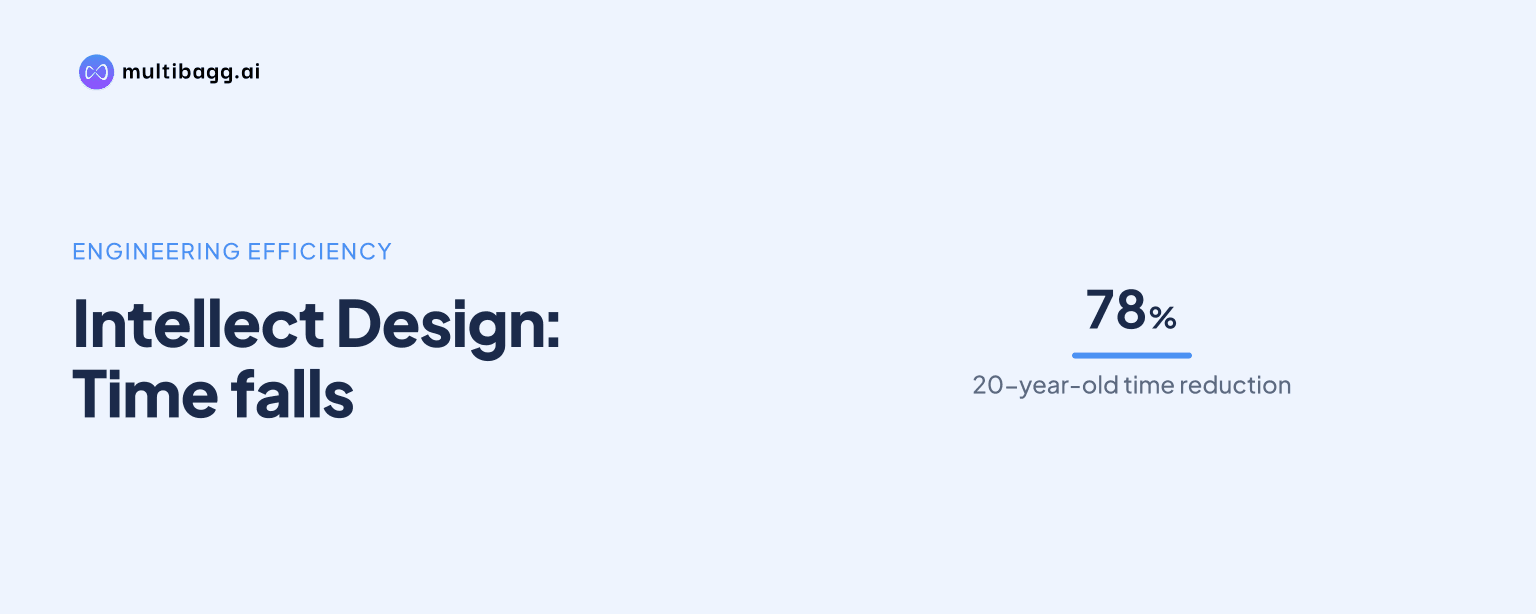
In a client implementation, Intellect Design Arena Ltd. says its Multi-Dimensional Multilayer System of Connected Knowledge (MSOCK) cut a 20-year-old trading-platform rebuild from 18 months to four months, a 78% reduction in time. Intellect also reported a corporate-payments build in under two weeks, a review of 33,443 files and a wealth-engine rebuild using 56% less effort.
Know Intellect Design Arena inside out
Results, valuation, peers and who's buying, in one view.
What did Intellect report across its four MSOCK client cases?
Intellect reported four cases covering speed to market, regulatory change, legacy modernisation, and cost and productivity, with the largest stated time reduction being 78% on a trading-platform rebuild. The customers are described only as a large commercial bank, a financial institution, a leading bank in Asia-Pacific, and a large bank, with the trading-platform client specifically anonymised.
The four results measure different outcomes, so they are not a single comparable delivery benchmark. The regulatory case, for example, is measured by the examination of 33,443 files across 27 code repositories and the identification of one likely failure before code was changed, rather than by elapsed project time.
Intellect attributes the results to reuse of captured system knowledge rather than faster coding alone. Its MSOCK model connects code repositories, database schemas, product documents and tacit knowledge, and maps a system across 21 dimensions for activities including building, changing, running and modernising applications.
How quickly did Intellect build the corporate payments service?
Intellect says the large commercial bank built a new corporate-payments service and handed it over for testing in under two weeks, compared with a usual approach of more than two months. The presentation describes this as four times faster and says more than six weeks were saved while the bank’s high-volume corporate channel remained undisrupted.
The case concerned a new service for corporate clients on a live channel that could not be disrupted. Intellect says artificial intelligence, or AI, worked from the bank’s own rules and code, and that the speed came from understanding the bank’s system knowledge in context rather than from code generation by itself.
The comparison is based on the time to build and hand over for testing, not on a stated production-launch date or post-launch performance measure. The disclosed evidence therefore shows a shorter development and testing hand-off cycle, with zero disruption reported for the high-volume channel during the work.
Got a follow-up? Ask IRIS
How did Intellect assess the regulatory calendar change?
Intellect says MSOCK checked 33,443 files across 27 code repositories and found one likely failure before any code changed after an urgent regulatory directive altered the working calendar. The assessment found that the calendar rule appeared in about 26 places, making a simple configuration change insufficient.
The presentation says settings alone would have resulted in incorrect interest calculations, while daily batch runs would also need changes and payments could use separate calendars. Intellect reported zero lines of code changed to identify the issue, framing the result as an evidence-backed change plan agreed before implementation.
This case differs from the other three because it demonstrates impact analysis rather than an elapsed-time or effort reduction. Intellect’s stated mechanism is a blast-radius assessment that separates what is affected from what is not affected before a build, change, incident response or modernisation task proceeds.
Why was the trading-platform rebuild reported as 78% faster?
Intellect says a leading Asia-Pacific bank rebuilt its 20-year-old trading platform in four months, rather than the 18 months associated with its usual approach. That represents 14 months saved, or 78% less time, and the presentation labels the result as 4.5 times faster.
The central challenge was that few people still knew how the 20-year-old platform worked. Intellect says MSOCK reduced the time needed to understand the legacy system to weeks rather than months, after which the rebuilt platform reached user testing on modern technology.
The source does not disclose the platform’s transaction volumes, budget, code size or eventual production deployment. It does disclose that the case had reached testing with users, which is a different milestone from a completed live migration.
What productivity result did Intellect report for the wealth incentive engine?
Intellect says a large bank rebuilt the incentive engine in its wealth system in 301 working days against a plan of 685 working days. The 384-working-day difference equates to the reported 56% reduction in effort, and the project was delivered 3.5 months ahead of the original plan.
The project followed three years of deliberation over the incentive-engine rebuild. Intellect reports that all five of five releases arrived ahead of plan, while bank-wide testing found one defect and generated zero escalations.
This is the only case that provides planned and actual working-day effort figures. The case therefore gives a direct productivity comparison, whereas the corporate-payments and trading-platform examples compare delivery durations and the regulatory case measures analysis coverage before a code change.
Conclusion
The four cases show the range of outcomes Intellect associates with MSOCK: a reported four-times-faster corporate-payments build, one likely regulatory failure identified from 33,443 files before changes, a 78% reduction in a legacy rebuild timeline, and 56% lower effort on a wealth-system component. The common factor, according to Intellect, is the use of connected institutional knowledge rather than coding speed alone.
What to watch next is Intellect’s disclosed research with Columbia University and hyperscalers on how far AI agents can safely act. The presentation also says Intellect has filed 39 patents on its 21-dimension model and serves more than 500 financial institutions in 62 countries.

