








Kaytex keeps bulk sales to offset costs of unused capacity
MAX Plan at ₹4,999/yr

Find your next multibaggerBe a Pro Investor
Research stocks and track your picks on the go. Download the app.
Key highlights
- Kaytex's own brands represented 60% of FY26 revenue, versus 20% from brand enablement.
- Non-branded bulk sales accounted for 12% of FY26 revenue and are used for unallocated capacity.
- Management said own-brand working-capital days are 30 to 60 days higher than brand enablement.
- An analyst cited Kaytex sales volume rising from 43 lakh metres in FY23 to 132 lakh metres in FY26.
powered by IRIS
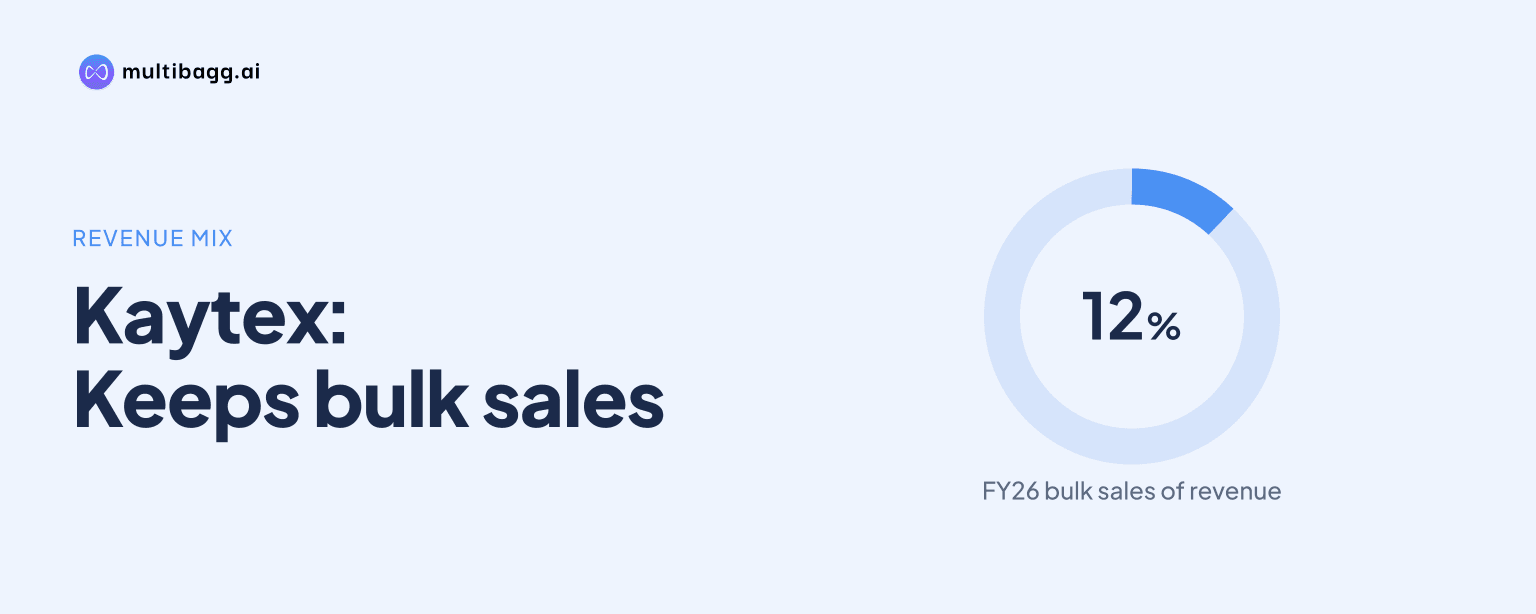
Kaytex retained non-branded bulk sales at 12% of FY26 revenue because it sells capacity not absorbed by its own brands or brand-enabler orders rather than leaving machinery idle. Management said this swing capacity helps offset fixed costs while own brands contributed 60% of revenue, against 20% from brand enablement and 8% from services.
Know Kaytex Fabrics inside out
Results, valuation, peers and who's buying, in one view.
Why does Kaytex still sell non-branded bulk fabric?
Kaytex still sells non-branded bulk fabric because it uses unallocated production capacity rather than allowing machines to remain idle. Management said the company has multiple production capacities, products and capabilities, meaning spare capacity can arise in particular product lines even as demand grows for own-brand or brand-enabler products. Bulk sales therefore act as swing capacity and help offset fixed costs.
Management described the 12% non-branded bulk portion as a conscious but declining part of the business, rather than its intended long-term mix. It said the share of non-branded bulk business has reduced drastically over the last four years, although it did not provide annual percentages for that period. Kaytex also said this channel is sold at a relatively decent margin but did not disclose a separate profitability measure.
What is Kaytex's revenue mix across its businesses?
Kaytex reported that its own brands accounted for 60% of FY26 revenue, followed by brand enablement at 20%, non-branded bulk sales at 12% and services at 8%. Management said the H1 FY27 mix was similar to FY26, but it did not provide a separate half-year revenue split.
The 60% own-brand share includes the company-owned Rasiya, Kaytex and Darbaar brands. Management described brand enablement as broadly similar to white-label production for established brands, while the bulk channel takes capacity not used by own brands or brand-enabler orders. The three channels therefore address different demand and production requirements.
Can brand enablement replace Kaytex's bulk sales?
Kaytex said brand enablement could absorb more of the capacity now used for non-branded bulk sales, but it has not yet received enough orders to make that shift. Responding to a question about moving the 12% bulk share into brand enablement, management agreed that it was lagging in obtaining such orders and said it was working to expand that business.
Management nevertheless said brand enablement has growth potential and that Kaytex is pursuing all three channels as production increases. It is not waiting for the brand-enabler order pipeline to mature before using its machinery. Until own-brand and brand-enabler demand takes a greater share of available capacity, bulk sales remain the outlet for surplus output.
Got a follow-up? Ask IRIS
Why is Kaytex prioritising its own brands despite higher working capital?
Kaytex is prioritising own brands because management said they have directionally higher embedded margins, although they require more inventory and working capital. Kaytex does not report segment-level margins, so the difference between own brands and brand enablement cannot be quantified. Management said own-brand working-capital days are about 30 to 60 days higher than those of brand enablement.
The additional inventory reflects the seasonal model, particularly the winter range, which must be ready before customer demand arrives. Rasiya introduces a new seasonal range every three months and sells through distributors, rather than online or company-owned stores. Management said Kaytex is expanding both its distributor network and markets while holding stock for ready sales.
Kaytex said brand enablement follows a different cycle because it receives an order and then executes production. That order-led model needs less inventory than own brands, where seasonal goods must be ready before orders are received. Management did not specify a target such as 30% or 40% of revenue for brand enablement, saying the mix will result from separate teams expanding both businesses.
How has Kaytex's product mix affected volume and revenue growth?
Kaytex said a shift toward cotton fabrics has caused sales volumes to rise faster than revenue. An analyst cited volume of 43 lakh metres in FY23, 88 lakh metres in FY24 and 132 lakh metres in FY26, while revenue increased from Rs 98 crore in FY23 to Rs 161 crore in FY26. Management agreed that the product-mix change was the principal explanation for this divergence.
Management said Kaytex earlier produced more festive products but now makes more cotton fabrics, which remain in demand for longer periods. It said the major part of sales is value-added rather than plain grey fabric, including fabric and unstitched suit sets. These sets contain dupatta, shirt and salwar material, with printing, dyeing or embroidery completed before sale.
Kaytex is not currently in garmenting because the unstitched suit still requires tailoring to the consumer's measurements. Management said it is considering further forward integration, but not at present. It also said there is no single production bottleneck because capacity is added ahead of time, while revenue depends on design, marketing, distributor placement and retailer sell-through.
Conclusion
Kaytex's 12% non-branded bulk business is a capacity-utilisation mechanism rather than a change in its preference for own brands and brand enablement. The company is seeking to grow the 60% own-brand business and obtain more brand-enabler orders, while using bulk sales to prevent surplus capacity from remaining idle. The trade-off is that own brands need seasonal inventory and a working-capital cycle management said is 30 to 60 days longer than brand enablement.
The next issue to watch is whether brand-enabler orders grow enough to absorb capacity currently directed into bulk sales. Management also plans to expand Rasiya's distributor coverage and introduces a new Rasiya range every three months. It is considering garmenting in the future, although it said there is no immediate move into that activity.

