








Kaytex Fabrics Limited H1 growth lengthens cash cycle
MAX Plan at ₹4,999/yr

Find your next multibaggerBe a Pro Investor
Research stocks and track your picks on the go. Download the app.
Key highlights
- Kaytex's H1 FY27 revenue rose 34.42% year on year to Rs 100.26 crore.
- Inventory days rose to 130 from 120 at March 2026, while debtor days increased to 105 from 93.
- Kaytex reported negative cash flow from operations of Rs 18.98 crore in H1 FY27.
- Net debt was Rs 44.14 crore at September 30, 2026, and the debt-to-equity ratio was 0.41 times.
powered by IRIS
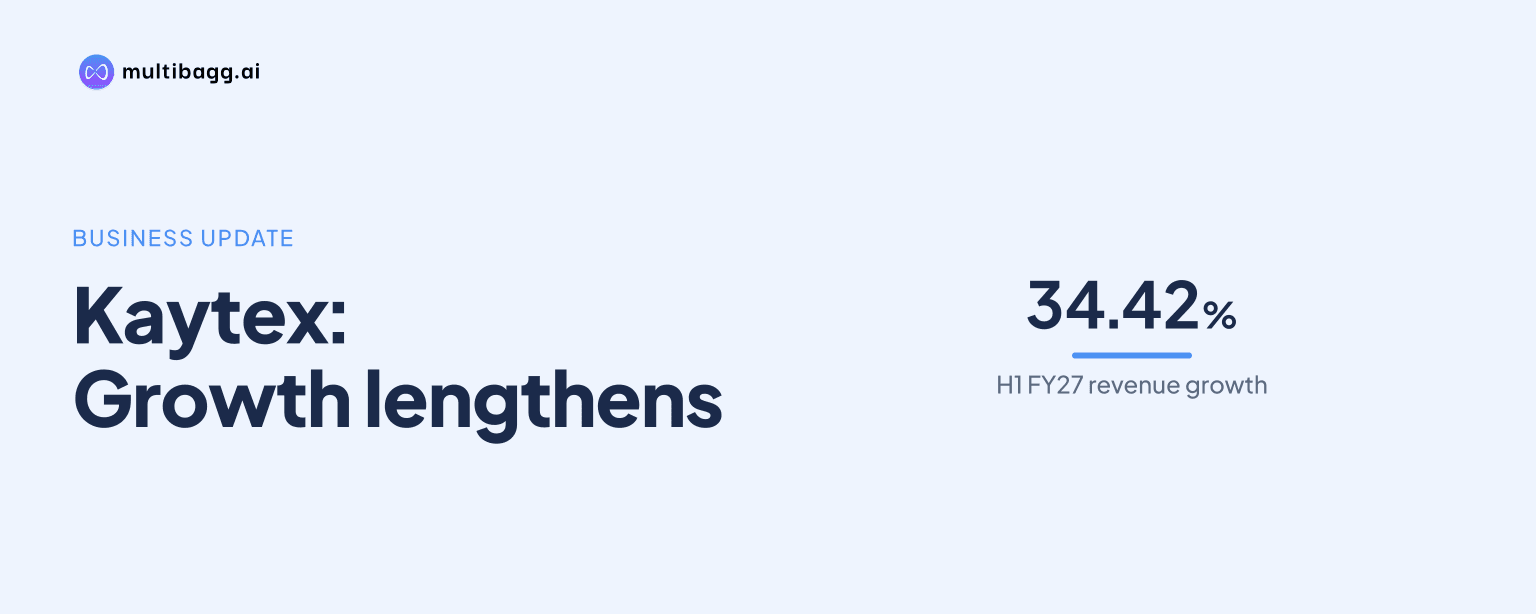
Kaytex Fabrics Limited reported H1 FY27 revenue growth of 34.42% to Rs 100.26 crore, but inventory days rose to 130 and debtor days to 105, resulting in negative cash flow from operations of Rs 18.98 crore and net debt of Rs 44.14 crore at September 30, 2026.
Know Kaytex Fabrics inside out
Results, valuation, peers and who's buying, in one view.
Why did Kaytex's working-capital cycle lengthen in H1 FY27?
Kaytex's working-capital cycle lengthened because inventory and receivables grew faster alongside sales. On an annualised basis using average balances, inventory days rose to 130 in H1 FY27 from 120 at March 2026, while debtor days increased to 105 from 93. The two measures therefore rose by 10 days and 12 days, respectively.
The inventory balance reached Rs 79.46 crore at September 30, 2026, up Rs 15.55 crore from Rs 63.91 crore at March 2026. Trade receivables increased by Rs 21.87 crore to Rs 68.72 crore from Rs 46.85 crore. Management attributed the build-up to higher sales, seasonal stocking and the requirements of its integrated manufacturing operations.
Kaytex said its model requires stocks of yarn, grey fabric, dyes, inks and finished goods across in-house weaving, processing, digital printing and finishing. It also said it had purchased raw materials in advance during FY26 as yarn prices rose, when inventory days had already climbed from 86 to 120. Management said trade sales are made on credit and that receivables increased during the high-demand season.
How fast did Kaytex's revenue and production grow in H1 FY27?
Kaytex's revenue grew 34.42% year on year to Rs 100.26 crore in H1 FY27 from Rs 74.59 crore in H1 FY26. Revenue was also 15.7% higher than Rs 86.65 crore in H2 FY26, making this the company's first half-year with revenue above Rs 100 crore.
Domestic revenue rose 34.36% to Rs 95.38 crore, while export revenue increased 35.28% to Rs 4.87 crore. Domestic sales represented the larger revenue stream in H1 FY27, and management said it intends to extend distribution beyond Punjab into Chandigarh, Delhi, Haryana and Jammu while building exports selectively.
Fabric production reached 82.83 lakh metres in H1 FY27, about 62% of the output reported for the whole of FY26. Capacity utilisation increased to 75.9% from 63.62% in FY26. Kaytex had total installed capacity of 208 lakh metres in FY26, including digital-printing capacity of 141.5 lakh metres.
Higher output did not prevent a year-on-year gross-margin decline. Gross margin was 29.59% in H1 FY27, down 261 basis points from 32.2% in H1 FY26, although it improved from 28% in H2 FY26. Management linked the annual decline to higher yarn prices following the Middle East conflict and said a higher share of digital printing partly offset the cost increase.
Got a follow-up? Ask IRIS
What did the longer cash cycle mean for Kaytex's debt and cash flow?
Kaytex reported negative cash flow from operations of Rs 18.98 crore in H1 FY27 because working capital absorbed cash. The Rs 37.42 crore combined increase in inventories and trade receivables from March 2026 was funded mainly through short-term borrowings, according to management.
Short-term borrowings were Rs 39.15 crore at September 30, 2026, while total borrowings were Rs 51.83 crore. After cash of Rs 7.69 crore, net debt was Rs 44.14 crore. The debt-to-equity ratio was 0.41 times, compared with 0.21 times at March 2026.
Kaytex remained profitable despite the operating cash outflow. Earnings before interest, tax, depreciation and amortisation, or EBITDA, rose 17.24% to Rs 17.39 crore, while profit after tax increased 16.36% to Rs 10 crore. EBITDA margin fell to 17.34% from 19.88% in H1 FY26, and finance costs declined 19.24% to Rs 1.72 crore because average borrowings were lower than in the previous-year half.
How does Kaytex plan to improve cash conversion?
Kaytex said it plans to reduce inventory levels and lower debtor days without raising additional debt. In the earnings call, management said it was adjusting inventory so that the existing debt would be sufficient and described the H1 working-capital increase as seasonal, expecting debt and working capital to decline over the following six months.
Management did not provide numerical targets for inventory days, debtor days or cash flow. It said Kaytex is improving raw-material purchasing and production planning and investing in systems, data and reporting. Management also asked investors to assess cash conversion over a full year because a half-year can be affected by the timing of purchases and seasonal inventory accumulation.
Kaytex identified two main selling periods: September to December 15 and April 15 to May 15. Management said inventory had already been built for the season under way, while receivable days were expected to come down over the next season even if the absolute receivables balance remains elevated as sales grow.
The company is also adding output capacity. Kaytex bought a digital-printing machine for Rs 3.2 crore in September 2026 that is expected to add about 56.2 lakh metres of annual capacity, with commercial production expected around late December 2026 or early January 2027. Management said it will also expand embroidery and other finishing to increase value addition in printed products.
Conclusion
Kaytex's H1 FY27 results show that revenue expansion and accounting profit were accompanied by a greater cash requirement. Revenue rose 34.42% to Rs 100.26 crore and profit after tax reached Rs 10 crore, but inventory days increased to 130, debtor days rose to 105 and operating cash flow was negative Rs 18.98 crore as inventories and receivables expanded.
The next disclosure should show whether management's plan to reduce stock, improve purchase and production planning, and lower debtor days reduces borrowing needs. Investors can also watch commissioning of the 56.2 lakh-metre digital-printing machine around late December 2026 or early January 2027 and completion of the Amritsar office and warehouse by March 2027.

