








Kaytex adds embroidery as digital-print competition pressures margins
MAX Plan at ₹4,999/yr

Find your next multibaggerBe a Pro Investor
Research stocks and track your picks on the go. Download the app.
Key highlights
- Digital printing represented 68% of Kaytex’s FY26 installed capacity, compared with 40% in FY24.
- Kaytex reported H1 FY27 revenue of Rs 100.26 crore, up 34.42% year on year.
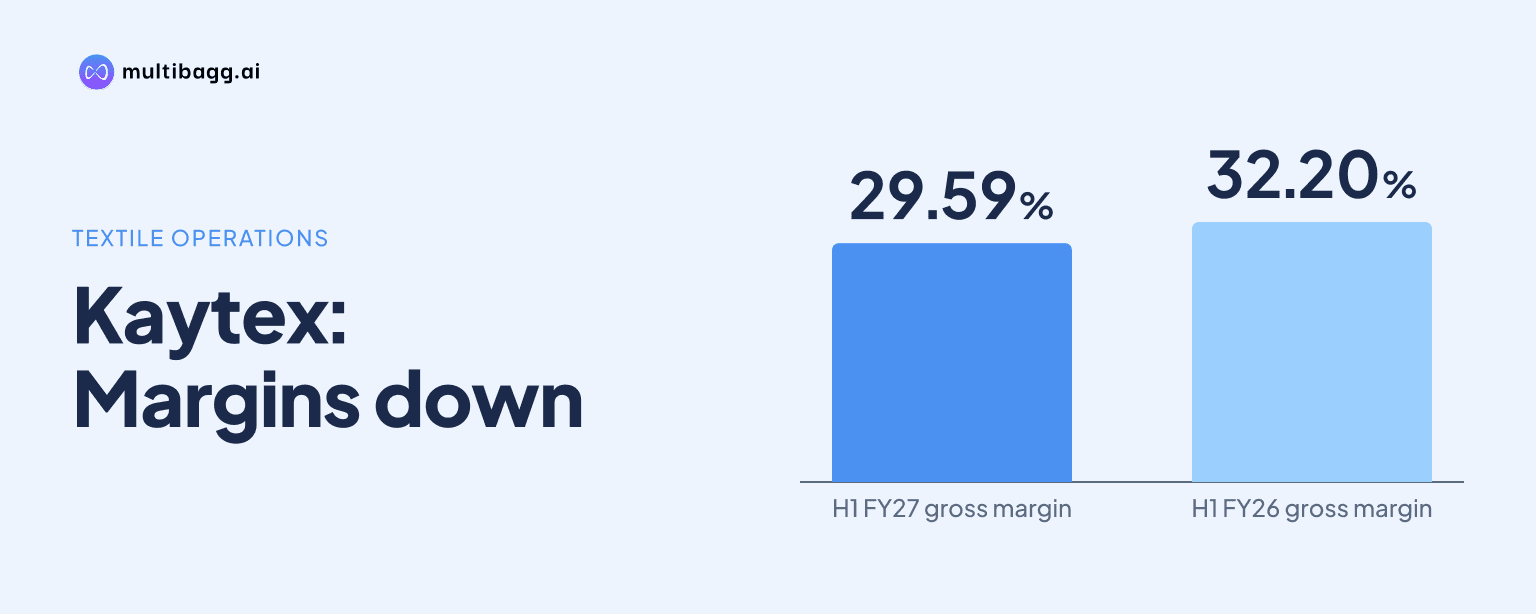
- H1 FY27 gross margin was 29.59%, compared with 32.20% in H1 FY26.
- Kaytex bought a Rs 3.20 crore digital-printing machine in September 2026 with planned annual capacity of 56.2 lakh metres.
powered by IRIS
Kaytex Fabrics Limited (Kaytex) is expanding embroidery and other finishes to protect value per product as new entrants pressure digital-print unit margins. Digital printing reached 68% of installed capacity in FY26, up from 40% in FY24, and management outlined the response during its November 18, 2026 H1 FY27 earnings call.
Know Kaytex Fabrics inside out
Results, valuation, peers and who's buying, in one view.
Why is Kaytex adding embroidery to digital prints?
Kaytex is adding embroidery because management said new digital-printing entrants have put per-unit margins under pressure. Its response is to add embroidery and other finishes over printed fabric, so it competes on the completed product rather than on printing alone. Management disclosed this strategy while describing digital printing as its largest and fastest-growing product line in FY26.
Kaytex added an Aari embroidery line in FY26 and plans to broaden both the scale and range of embroidery. Management said embroidery and finishing convert printed fabric into a higher-value product and support its role as a single-stock supplier. The call did not disclose the Aari line’s production capacity, capital cost or separate revenue contribution.
The approach follows a sharp expansion from digital-printing capacity of 3 lakh metres a year in 2020 to 141.5 lakh metres in FY26. Management said the market is shifting from traditional printing because digital printing accommodates shorter runs, customisation and faster turnaround, while using less water and creating less waste. The company also said fashion customers increasingly require smaller and quicker seasonal orders.
How much has Kaytex shifted toward digital printing?
Kaytex shifted decisively toward digital printing, which increased from 40% of installed capacity in FY24 to 68% in FY26. Total installed capacity was 208 lakh metres in FY26, including 141.5 lakh metres of digital printing and about 44 lakh metres of Jacquard capacity, the line underlying its Kaytex and Darbaar-e-Khaas offerings.
Kaytex continued to invest in printing capacity despite the competitive pressure. In September 2026, it bought a digital-printing machine for Rs 3.20 crore for installation at its Amritsar unit. Management said the machine would add about 56.2 lakh metres of annual capacity, but did not provide a commissioning date or utilisation target.
Rasiya is central to this capacity strategy because management described it as the company’s strongest growth driver, built around digitally printed and embroidered unstitched suits. Kaytex is used for Jacquard suits and shawls, while Darbaar-e-Khaas, launched in 2024, serves the value segment. Management said it may add Jacquard capacity selectively where demand supports it.
Got a follow-up? Ask IRIS
What do H1 FY27 results say about Kaytex’s margins?
Kaytex’s H1 FY27 gross margin fell to 29.59% from 32.20% in H1 FY26, while earnings before interest, tax, depreciation and amortisation (EBITDA) margin declined to 17.34% from 19.88%. Management attributed the 261-basis-point gross-margin decline to higher yarn prices following the Middle East conflict, and said higher-value products partly offset the cost inflation.
The sequential comparison was different. Gross margin improved to 29.59% in H1 FY27 from 28.00% in H2 FY26, although EBITDA margin edged down from 17.49% to 17.34%. Revenue from operations grew 34.42% year on year to Rs 100.26 crore, but EBITDA increased 17.24% to Rs 17.39 crore, causing the operating margin to narrow year on year.
Kaytex produced 82.83 lakh metres of fabric in H1 FY27, equivalent to about 62% of production for all of FY26, and capacity utilisation rose to 75.9% from 63.62% in FY26. Employee costs rose 3.8% to Rs 3.57 crore and fell to 3.56% of revenue from 4.61%, while other expenses increased to Rs 8.71 crore from Rs 5.75 crore.
Which channels and cash-cycle measures matter for the plan?
Kaytex’s brands generated 60% of FY26 revenue, making branded sales its largest channel as it develops digitally printed and embroidered products. Brand-enabler sales accounted for 20%, non-branded sales for 22%, and services for 8%. Management said the non-branded wholesale and retail business helps maintain capacity utilisation.
In its brand-enabler channel, Kaytex supplies fabrics and designs to apparel brands, mainly in larger cities, and manages product development and execution. Its own brands are sold through distributors, principally in Tier-2, Tier-3 and Tier-4 towns in Northern India. H1 FY27 domestic revenue rose 34.36% to Rs 95.38 crore, while exports increased 35.28% to Rs 4.87 crore.
Working capital rose alongside sales and production in H1 FY27. Inventory increased to Rs 79.46 crore from Rs 63.91 crore at March 2026, and trade receivables rose to Rs 68.72 crore from Rs 46.85 crore. On an annualised average-balance basis, inventory days increased to 130 from 120 and debtor days rose to 105 from 93.
Kaytex reported negative operating cash flow of Rs 18.98 crore for H1 FY27 because of the working-capital build-up. Short-term borrowings rose to Rs 39.15 crore, total borrowings were Rs 51.83 crore, and net debt was Rs 44.14 crore after cash of Rs 7.69 crore. Management said it considers improving inventory and receivable management a priority, while noting that its integrated production model requires holdings of yarn, grey fabric, dyes, inks and finished goods.
Conclusion
Kaytex is responding to digital-print competition by increasing value addition rather than stepping back from printing capacity. Its 68% digital-printing capacity share in FY26 gives it a larger platform for Rasiya and brand-enabler products, but H1 FY27 results show why the strategy matters: revenue reached Rs 100.26 crore while gross and EBITDA margins were below H1 FY26 levels.
The next disclosed milestones are installation of the Rs 3.20 crore digital-printing machine, which is expected to add 56.2 lakh metres annually, and the planned expansion of embroidery. Management also identified capacity utilisation, inventory days, receivable days and export share as measures to track, and it has not provided numerical financial guidance.

