










KFIL targets 250,000-tonne casting capacity as demand tops plan
Key highlights
- KFIL said annual customer commitments for castings exceed 300,000 tonnes, versus planned capacity of 250,000 tonnes.
- KFIL reported Q2 gross casting sales of 50,000 tonnes and net sales of 48,000 tonnes.
- KFIL is seeking 100,000 tonnes of gross casting sales over the next two quarters.
- KFIL expects annual machining value to cross Rs 100 crore within one or two years.
powered by IRIS
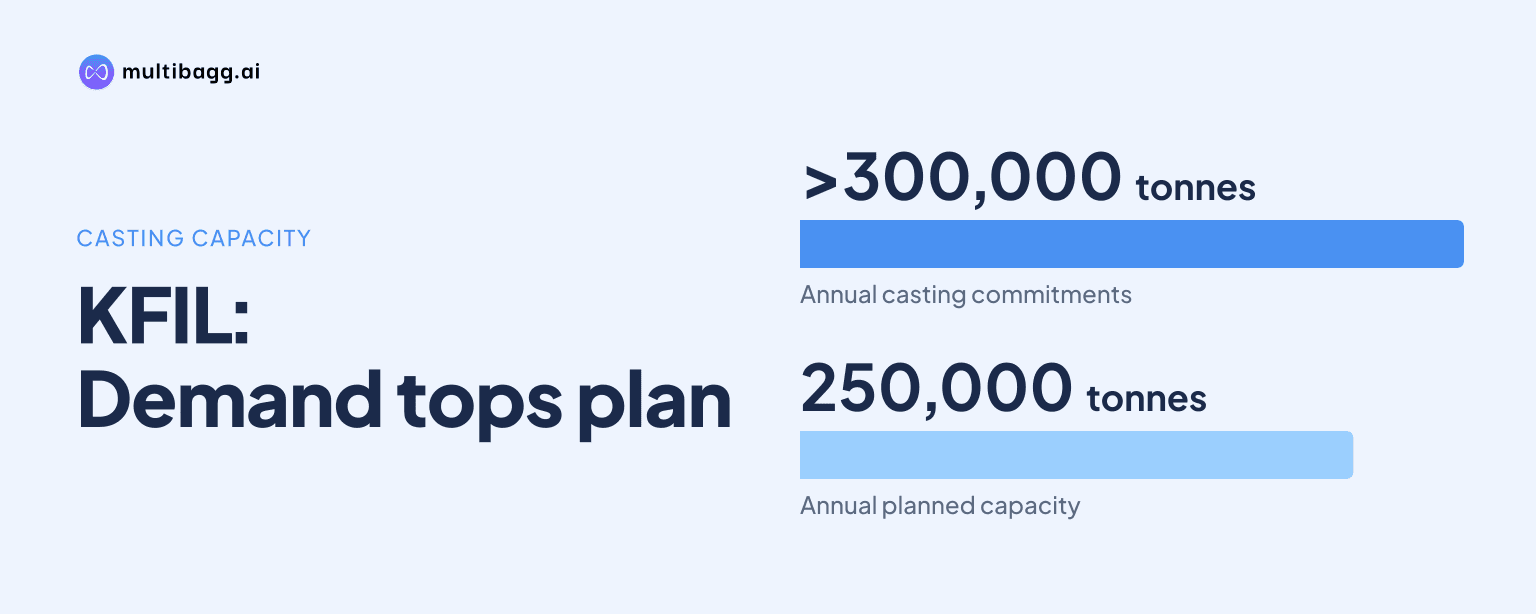
Kirloskar Ferrous Industries Limited said customer commitments for castings exceed 300,000 tonnes a year, more than its planned 250,000-tonne capacity, prompting management to consider further quality capacity or acquisitions. KFIL reported 50,000 tonnes of gross casting sales in Q2 and is seeking 100,000 tonnes over the following two quarters.
Know Kirloskar Ferrous Industries inside out
Results, valuation, peers and who's buying, in one view.
What casting capacity is KFIL targeting?
KFIL is targeting 250,000 tonnes of annual casting capacity after improving utilisation at Solapur and completing Rajpura phase 2 and phase 3. Management said Solapur needs to move towards 70,000 tonnes a year and Rajpura phase 2 and phase 3 are intended to take that facility to 70,000 tonnes a year. It described the combined programme as the route to 250,000 tonnes.
The target is above the latest quarterly sales base. KFIL recorded gross casting sales of 50,000 tonnes in Q2 and net sales of 48,000 tonnes after customer rejections. Management said it was looking for stabilisation at 100,000 tonnes of gross sales across the next two quarters, rather than suggesting that the Q2 level represented the final operating run rate.
KFIL also stated that its installed two-part foundry capacity for large castings is 15,000 tonnes a year, or 1,250 tonnes a month. Management said large-casting foundries typically produce about half the volume of high-pressure moulding lines and therefore require greater value addition per tonne. It did not provide a sales or profit forecast for the 15,000-tonne capacity.
Why do KFIL customer commitments exceed planned casting capacity?
KFIL said castings under development and programmes about to enter development represent customer commitments exceeding 300,000 tonnes annually, against the 250,000-tonne capacity plan. The stated gap is therefore more than 50,000 tonnes a year, assuming these development programmes progress into serial production as management expects.
Management said the 250,000-tonne plan would not be enough for all customer programmes. It said KFIL would need to create additional quality capacity, either at a location it selects or through an acquisition. These remain options rather than an announced project, because management did not disclose an acquisition target, site, investment amount or timetable.
The pipeline includes new customer additions and components for existing customers that are at the development stage. In Q2, management said Rajpura delivered more than 6,000 tonnes of quarterly sales volume, while Oliver and Solapur also contributed to the improvement. Solapur’s quarterly volume had moved beyond 15,000 tonnes, according to management, which also identified further scope for cost reduction and value addition at the site.
Can KFIL maintain its recent casting sales volumes?
KFIL is seeking 100,000 tonnes of gross casting sales in the next two quarters, but gross and net volumes differ because customer rejections are deducted. Management said Q2 gross sales of 50,000 tonnes translated into net sales of 48,000 tonnes, while gross-sales deductions could be about 2,000 to 3,000 tonnes a quarter, or around 3% to 4%.
Management did not expect meaningful volume from the new foundry line in the current year. It said some sales may arise this year because certain parts are already made through makeshift arrangements, but the meaningful contribution should come next year as those arrangements are formalised and components under development move into production.
KFIL is targeting 15% year-on-year volume growth in castings, according to management. It identified castings, tubes and alloy steel as its growth drivers, while saying pig iron hot-metal output would increase but part of it would subsequently be converted into steel. Management said it would be satisfied with long-term pig iron sales of 500,000 tonnes, placing the casting expansion within a broader shift towards other businesses.
Got a follow-up? Ask IRIS
How will quality improvements support KFIL's casting expansion?
KFIL expects lower rejection rates to increase usable output from existing operations. At Solapur, management said it was addressing challenges with thin-walled and critical castings and expected rejections to fall to 7% to 8% in the next quarter from 10% to 11%. It said early heat-code trends had shown progress.
At Rajpura, KFIL said operations had stabilised at 2,200 tonnes of monthly production and that rejection levels were declining. Management is targeting rejections below 5% at Rajpura, which it said would support margins and customer satisfaction. These targets matter because Q2 net sales were 2,000 tonnes below gross sales of 50,000 tonnes.
Machining is also part of KFIL’s plan to raise value addition beyond supplying raw castings. Annual machining value has reached about Rs 50 crore to Rs 60 crore, equivalent to around Rs 5 crore a month, and Rajpura’s machine shop has reached around Rs 1.5 crore a month. KFIL said it is expanding machine-shop operations at all three locations.
What is KFIL doing to increase machining value?
KFIL said it has invested around Rs 200 crore in machining and believes this base should generate Rs 90 crore to Rs 100 crore of annual machining value. Management attributed the gap from the present Rs 50 crore to Rs 60 crore level partly to auto and tractor customers purchasing only 50% to 60% of the volumes for which machining capability had been created, as well as customer model changes.
Management expects annual machining value to cross Rs 100 crore within one or two years without major investment. Its roadmap includes customer participation in investment, specialised-purpose machines and additional machining programmes. KFIL also said it is assessing high-value machining opportunities through either acquisitions or internal development, including thread cutting for special or premium couplings in tubes.
Conclusion
KFIL’s disclosed casting pipeline is larger than its stated 250,000-tonne capacity plan: customer commitments exceed 300,000 tonnes annually. The company is pursuing the initial capacity build-out through Solapur and Rajpura, while attempting to raise saleable output through lower rejections and increase value addition through machining. Q2 gross sales of 50,000 tonnes and net sales of 48,000 tonnes show the scale from which the expansion must progress.
The next measures to watch are management’s target of 100,000 tonnes of gross casting sales over the next two quarters, Solapur’s expected rejection range of 7% to 8%, and Rajpura’s below-5% rejection target. Management’s potential creation of further quality capacity, including through an acquisition, remains unresolved, while it expects the new foundry line to provide meaningful volume next year rather than this year.