










KFIL’s Solapur foundry targets January two-tonne ramp
Key highlights
- KFIL expects the Solapur two-part foundry to be fully operational by January and capable of making castings up to two tonnes.
- KFIL has booked an order for a 480-kilogram non-automotive S.G. iron component for one customer.
- Q2 FY27 net casting sales rose 20% year on year to 47,888 metric tonnes.
- Q2 FY27 casting realisation increased 6.8% year on year to Rs 1.30 lakh per tonne.
powered by IRIS
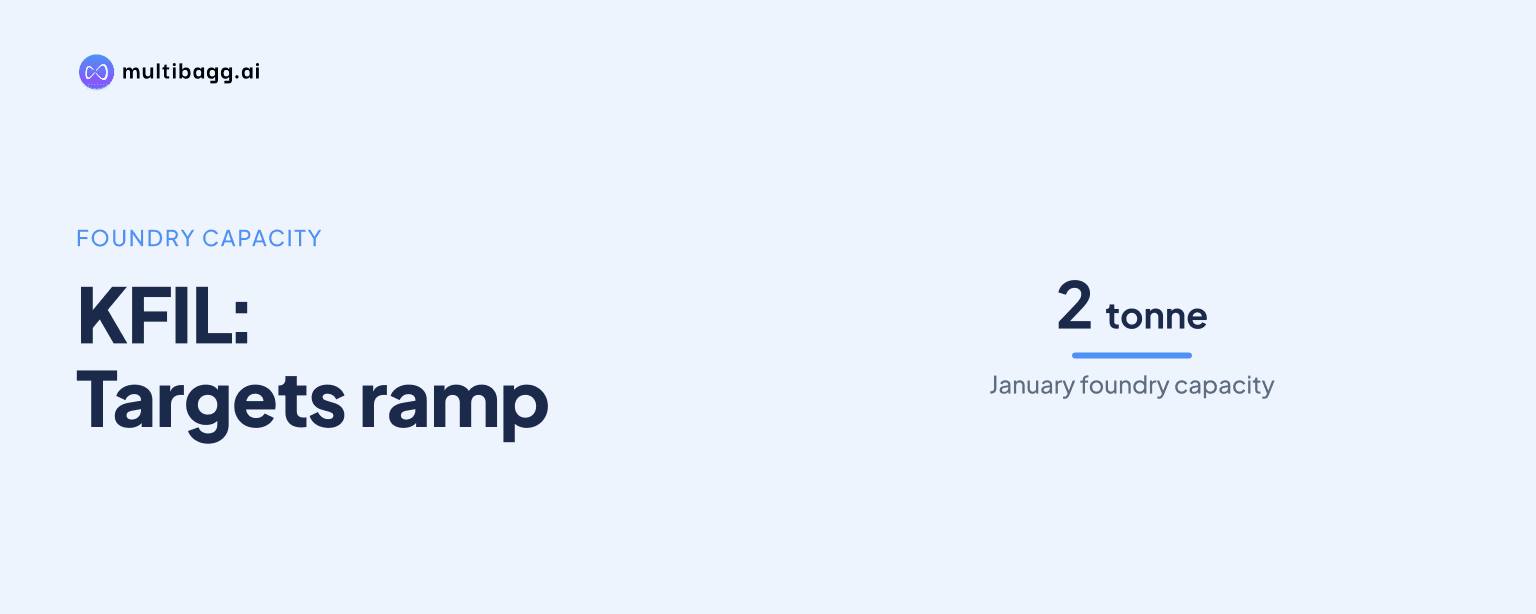
Kirloskar Ferrous Industries Limited (KFIL) expects its Solapur two-part foundry to be fully ready by January, expanding its casting capability from components weighing up to 300 kilograms to castings of up to two tonnes. KFIL has booked an order for a 480-kilogram non-automotive S.G. iron component, but management expects meaningful volumes only next year.
Know Kirloskar Ferrous Industries inside out
Results, valuation, peers and who's buying, in one view.
When will KFIL’s Solapur two-part foundry begin operating?
KFIL expects to complete commissioning in another two to three months and operate the Solapur two-part foundry fully by January. Management described the unit as a No-Bake foundry that will extend the company’s existing product capability, rather than simply add capacity for its current sub-300-kilogram casting range.
KFIL does not expect meaningful volume from the facility in FY27. Asked about the likely FY27 contribution, management said it expects some volume this year but is planning for meaningful volume next year, as components now made through makeshift arrangements are formalised and new parts move through development.
The new line comes alongside the ramp-up of Solapur’s existing foundries. Management said phase one and phase two of the second Solapur foundry line were almost complete, with production and sales at about 5,200 metric tonnes a month and more than 15,000 metric tonnes a quarter. Its utilisation objective is to exceed 6,000 metric tonnes a month, or 18,000 metric tonnes a quarter, across both Solapur foundries.
What castings will KFIL’s new Solapur foundry produce?
KFIL says the new Solapur foundry will make castings weighing up to two tonnes, compared with cylinder blocks, cylinder heads and other S.G. iron components of up to 300 kilograms at its existing foundries. The disclosed maximum capability is therefore more than six times the previous 300-kilogram limit.
The unit can manufacture both grey iron and S.G. iron castings, including engine blocks and other large components, according to management. KFIL said it has booked orders from one customer for a 480-kilogram S.G. iron, non-automotive component. It did not identify the customer, disclose an order value or specify annual volumes.
The 480-kilogram component is 180 kilograms above the previous 300-kilogram range but remains below the two-tonne capacity stated for the new foundry. Management also said certain parts are under development and must be converted into orders before the facility reaches a material production ramp.
How is KFIL’s casting business growing before the new line ramps up?
KFIL’s net casting sales volume rose 20% year on year to 47,888 metric tonnes in Q2 FY27, from 39,980 metric tonnes in Q2 FY26. Casting production for the first six months increased 20% to 93,000 metric tonnes from 78,000 metric tonnes, while casting sales value rose by almost 30% to Rs 633 crore from Rs 487.8 crore.
KFIL said all three foundry locations were fully loaded during Q2 FY27 and October. Management put Koppal’s contribution at about 9,000 metric tonnes, Solapur’s at about 5,000 metric tonnes and Oliver’s at roughly 2,000 to 2,200 metric tonnes, while Rajpura delivered more than 6,000 metric tonnes in the quarter.
Rajpura has a separate phase-two expansion planned by the March 31 financial year-end. KFIL expects that phase to lift Rajpura capacity to close to 4,000 metric tonnes a month and add another 24,000 metric tonnes, with management targeting readiness by the first quarter of next year to serve northern customers.
Got a follow-up? Ask IRIS
What does KFIL expect from large-casting economics?
KFIL has not disclosed a margin target, annual revenue target or per-tonne profitability figure for the Solapur large-casting line. Management said high-value casting development and machining value addition could improve realisations, but stated that development programmes must first convert into orders before they provide financial benefits.
Casting realisation reached Rs 1.30 lakh per tonne in Q2 FY27, up 6.8% from Rs 1.21 lakh per tonne in Q2 FY26. An analyst noted that casting margins had contracted despite higher volume and realisation from the prior quarter. Management said casting customers use a quarter-to-quarter pricing mechanism, so cost increases in one quarter may be reflected in customer pricing in the next.
KFIL also cited unfinished cost initiatives. It said 35 megawatts of windmills at Solapur had been commissioned, but not all planned windmills were operating. Management identified productivity and quality improvements as further cost-reduction measures and said the benefit of commodity-price increases had not yet fully flowed through casting prices.
What could affect KFIL’s large-casting ramp-up?
KFIL said casting demand was good in Q1 FY27 and Q2 FY27 across tractor, automotive, earth-moving and stationary-engine markets. Management cautioned that tractor demand could see small corrections, although it said automotive and earth-moving equipment demand remained strong during the October period.
The Solapur ramp depends on completing commissioning, formalising parts now made through makeshift arrangements and converting development projects into serial production. KFIL said new customer additions and components being developed with existing customers are intended to support casting-volume growth in coming years, but it gave no separate volume forecast for the two-tonne foundry.
KFIL is also executing other capacity projects. Management said it was moving ahead with a Jejuri rolling-mill expansion, a Baramati expander-mill project and small piercing mills at Ahmednagar after market-assessment and technology-finalisation delays. These tube and steel projects are separate from Solapur, but they add to the company’s project execution agenda.
Conclusion
KFIL’s January target for full operation at the Solapur two-part foundry represents a defined move from castings of up to 300 kilograms to components of up to two tonnes. The booked 480-kilogram S.G. iron component demonstrates an initial order beyond the previous range, while Q2 FY27 net casting sales of 47,888 metric tonnes show that the wider casting business is already growing.
The next disclosed milestones are commissioning within two to three months, full operation by January and management’s expectation of meaningful volume next year rather than FY27. Progress in converting large-casting developments into serial orders, lifting Solapur utilisation above 6,000 metric tonnes a month and completing Rajpura phase two by the first quarter of next year will be the next operating markers.