










Kirloskar Ferrous sees machining revenue topping Rs 100 crore
Key highlights
- KFIL expects annual machining value to exceed Rs 100 crore within one to two years, from Rs 50 crore to Rs 60 crore currently.
- Management estimated machining and machine-shop investment at about Rs 200 crore and said Rs 90 crore to Rs 100 crore is needed for a decent return on investment.
- Rajpura is generating about Rs 1.5 crore of monthly machining value after starting its machine shop alongside the foundry.
- KFIL said some customers buy only 50% to 60% of the volumes for which machining capacity was created.
powered by IRIS
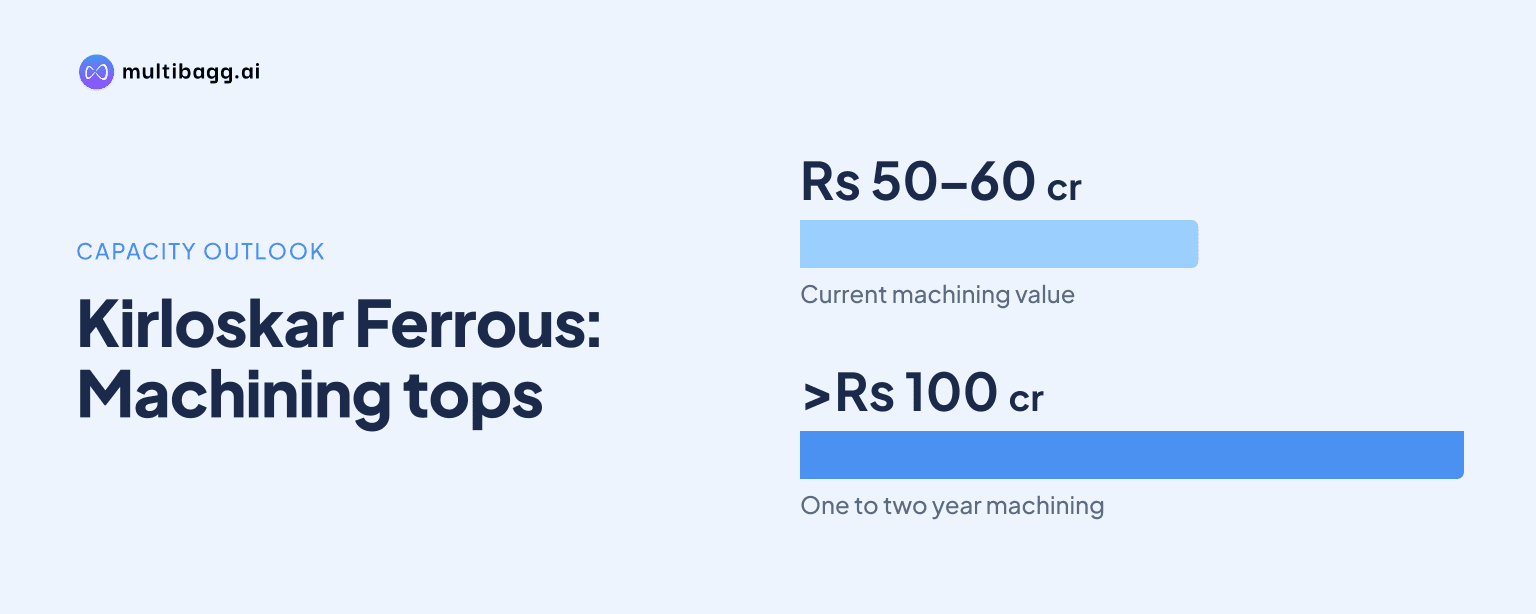
KFIL expects annual machining revenue to exceed Rs 100 crore within one to two years, from a current Rs 50 crore to Rs 60 crore run rate, after roughly Rs 200 crore of investment in machine shops. Management said the target depends on raising utilisation of the existing base without major additional investment.
Know Kirloskar Ferrous Industries inside out
Results, valuation, peers and who's buying, in one view.
Why is KFIL targeting more than Rs 100 crore of machining revenue?
KFIL is targeting more than Rs 100 crore of annual machining revenue to make machining a larger value-addition activity alongside its casting business. Management put current annual machining value at Rs 50 crore to Rs 60 crore, or about Rs 5 crore a month, and said it expects to cross Rs 100 crore within a year or two. It also said it expects 60% of that level to be contribution, without defining that measure further during the call.
KFIL has machine shops at all three locations and is expanding machining at each site. Rajpura, where the machine shop began alongside the foundry, is generating about Rs 1.5 crore of machining value a month. Management said customers are seeking more machining work from KFIL and cited thread cutting for special or premium tube couplings as one potential higher-value process.
Why is KFIL's machining investment underutilised?
KFIL said its roughly Rs 200 crore investment in machinery and machine shops is yielding Rs 50 crore to Rs 60 crore of annual machining value, while Rs 90 crore to Rs 100 crore would be needed for what management called a decent return on investment. The investment included buildings and other infrastructure, not only machining equipment, which contributed to capital being deployed ahead of revenue.
The principal challenge is that customers do not always take the volumes for which KFIL created dedicated machining capacity. Management said customers in auto, tractors and tractor components can ultimately purchase only 50% to 60% of the initially expected volume. Customer model changes can also alter component demand after KFIL has made the capability investment.
The difference between the Rs 50 crore to Rs 60 crore current run rate and the Rs 90 crore to Rs 100 crore threshold is therefore linked to customer offtake and utilisation rather than a lack of installed machining capacity. KFIL said the plan to approach Rs 100 crore without major investment relates to the existing base, while new customer-specific component facilities could still require fresh capital expenditure.
What will KFIL change to improve machining utilisation?
KFIL plans to improve machining utilisation through customer participation in investment, more special-purpose machines and additional senior machining expertise. Management said senior people had joined the teams as it develops a roadmap to mitigate the effects of model changes and lower-than-forecast customer purchases.
Customer participation is intended to change the earlier arrangement in which KFIL could create capacity against expected volumes that later did not materialise. Management also identified special-purpose machines for defined processes or components as part of the future approach. It expects customer-specific facilities to offer better return on investment, though it did not disclose a capital budget, machine-level utilisation or customer commitments.
KFIL is also examining high-value machining opportunities through either acquisitions or internal development. Management described that work as an option rather than an announced transaction, with no acquisition target, cost or timing disclosed. The stated operational milestone remains moving the installed machining base from about Rs 5 crore a month towards more than Rs 100 crore annually.
Got a follow-up? Ask IRIS
How can KFIL's casting operations support machining growth?
KFIL expects casting growth and new component programmes to provide more work for its machining operations. In the second quarter, net casting sales were 48,000 metric tons, compared with gross sales of 50,000 metric tons before deductions for customer returns and rejections. Management said it was seeking to stabilise 1 lakh metric tons of casting sales over the next two quarters.
Solapur had moved beyond 15,000 metric tons of quarterly sales, while Rajpura contributed more than 6,000 metric tons during the quarter. Management said Solapur produces more intricate, value-added components and has further scope to reduce cost and increase value addition. Casting programmes now in development and approaching serial production could increase the available component flow for machining, although KFIL did not quantify the proportion that will be machined.
Management said commitments for castings under development and planned development exceed 3 lakh metric tons annually. It outlined a route to 2.5 lakh metric tons of capacity through improved Solapur utilisation and completion of Rajpura phases 2 and 3, with each site expected to reach 70,000 metric tons a year. This creates a potential larger casting base for machining, but the timing of programme conversion remains an execution variable.
What execution issues could delay KFIL's machining target?
KFIL's main execution issue is whether customer demand fills capacity after model changes and lower realised purchases. Management said certain customers have taken only 50% to 60% of the volumes underlying the original machining investment. Achieving more than Rs 100 crore with no major investment therefore relies on converting customer demand into higher use of existing machines.
Casting quality and production stability are related operating factors. KFIL expects Solapur's rejection rate to decline to 7% to 8% in the next quarter from 10% to 11%, after work on thin-walled and critical castings. At Rajpura, management said production had stabilised at 2,200 metric tons a month and it was targeting rejection below 5%; it also said machining has no direct relationship with casting rejections.
Conclusion
KFIL's machining plan centres on increasing revenue from Rs 50 crore to Rs 60 crore annually to more than Rs 100 crore within one to two years, against roughly Rs 200 crore already invested. The company is seeking to close the utilisation gap through greater customer offtake, revised investment participation and more specialised machining capability, while using casting growth to expand component opportunities.
The next point to watch is whether machining value rises from about Rs 5 crore a month, including growth beyond Rajpura's current Rs 1.5 crore monthly level. Management's planned evidence points also include Solapur's targeted 7% to 8% rejection rate next quarter, Rajpura's below-5% target, and progress in obtaining customer participation for specialised future machinery.