










Kirloskar Ferrous Industries Limited sees tube mix recovery
Key highlights
- KFIL said tube volume recovered to about 48,000 metric tons in the second quarter.
- KFIL is looking for better than 100,000 metric tons of tube volume in the second half.
- Tube realisation rose 1.6%, compared with 12.5% for pig iron and 6.8% for castings.
- KFIL said anti-dumping duty has been extended for another 5 years.
powered by IRIS
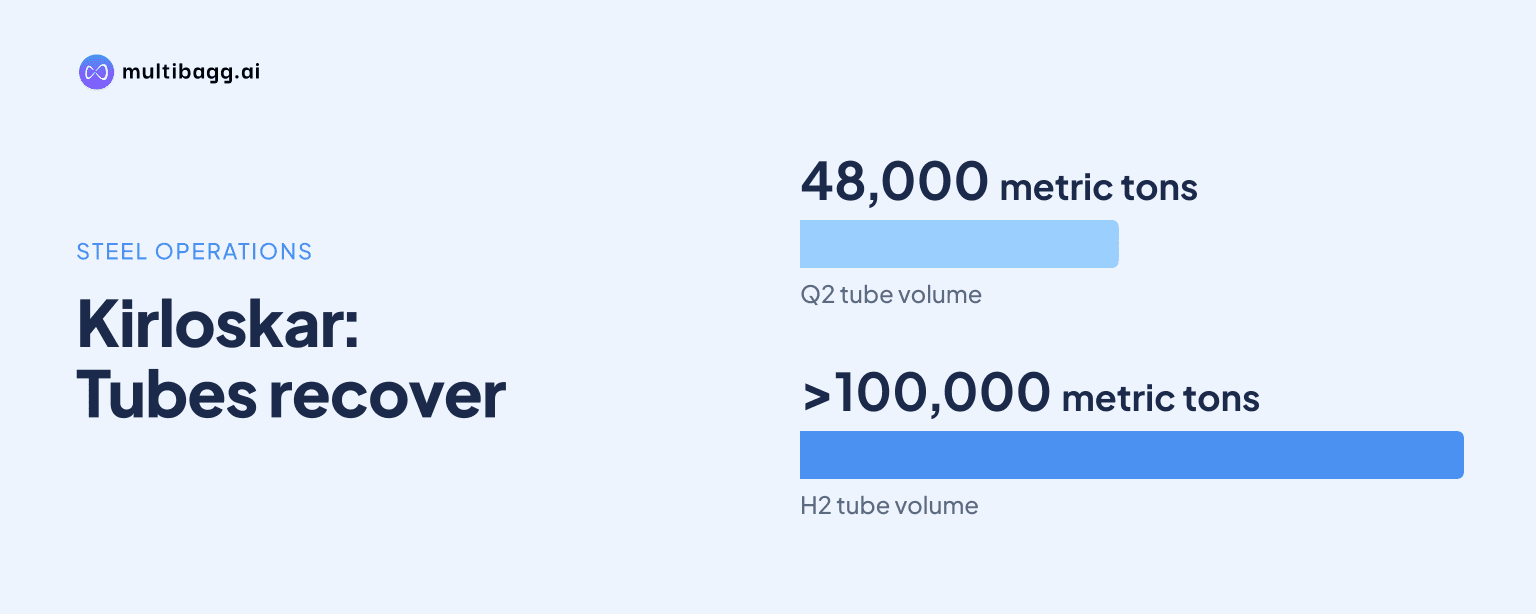
Kirloskar Ferrous Industries Limited, or KFIL, said tube margins could improve in the third and fourth quarters if oil-and-gas and boiler projects resume and lift the share of higher-value products, after second-quarter tube volume recovered to about 48,000 metric tons while tube realisation rose only 1.6%.
Know Kirloskar Ferrous Industries inside out
Results, valuation, peers and who's buying, in one view.
Why are KFIL's tube margins under pressure?
KFIL's tube margins are under pressure because delayed projects reduced first-quarter volume and forced production towards lower-margin line tubes. Management said its prime tube products are oil-and-gas-related tubing and pipe orders, alongside high-alloy, high-pressure boiler tubes, but many projects in these categories were delayed.
KFIL said it then had to manufacture line tubes and products that trading partners stock and sell, which management described as carrying very low margins. This shift in mix persisted into the second quarter, when management said margins remained under pressure even though tube volume improved to about 48,000 metric tons.
The gap in pricing movement illustrates the tube segment's issue. Tube realisation increased 1.6%, compared with a 12.5% improvement for pig iron and a 6.8% improvement for castings. Management linked the difference to the mix of tubes sold and to confirmed-price orders that must be supplied before newer prices can affect reported realisation.
KFIL also said oil-and-gas and export orders were lower during the quarter. A large consignment moved near the end of the month, with its realisation expected in October, meaning some pricing benefit was expected to be recognised in the third quarter rather than the second quarter.
What does KFIL expect for tube sales in the second half?
KFIL is looking for better than 100,000 metric tons of tube volume in the second half, conditional on improved project execution and market demand. Management said this would help the business recover from being almost 7.5% below the prior-year level at that point and could enable tube-volume growth for the year.
The objective follows what management called a bad first quarter, when delayed oil-and-gas projects affected tube volumes, and a recovery to about 48,000 metric tons in the second quarter. An analyst noted that tube volumes had been around 40,000 to 50,000 metric tons a quarter over the preceding eight quarters, placing the second-half target above that two-quarter run rate.
KFIL said it is seeking settlements with customers and is booking subsequent orders at higher prices reflecting newer commodity and steel-price conditions. Management expects these new orders, rather than contracts already confirmed at older prices, to support further improvement in tube realisation and margin.
Management did not give a tube-margin target or commit to the 100,000-metric-ton objective. It said the tube market was not very strong and that it needed market improvement and progress in delayed projects to achieve the expected volume and mix change.
Which tube products would improve KFIL's sales mix?
Oil-and-gas-related tubing and pipe orders and high-alloy, high-pressure boiler tubes would improve KFIL's sales mix because management identifies them as its prime products. The anticipated benefit is a greater share of value-added tubes in place of line pipes and trader-stocked tubes that were produced while projects were delayed.
An analyst asked whether tube profitability could improve excluding an ONGC order. KFIL did not disclose a separate volume, revenue or profitability figure for that order, instead saying the broader recovery depends on more oil-and-gas and boiler-sector projects moving ahead in the third and fourth quarters.
Management said a shift toward more value-added tubes should improve both volume and margins compared with the first two quarters. The mechanism is product mix rather than a disclosed change in manufacturing capacity, as the company specifically contrasted higher-value oil-and-gas and boiler products with low-margin line tubes.
The late-month consignment expected to contribute realisation in October also shows that shipment timing can affect quarterly results. KFIL said the consignment's timing moved its realisation into the third quarter, separate from the effect of new pricing or a recovery in oil-and-gas project orders.
Got a follow-up? Ask IRIS
How do trade conditions affect KFIL's tube outlook?
The five-year extension of anti-dumping duty is expected by KFIL to reduce Chinese dumping, but management did not say it would by itself restore tube margins. The company said better margins also require higher-value orders, improved prices on subsequent contracts and sufficient project activity in oil-and-gas and boiler applications.
KFIL said exports to the United States had been hampered by the war situation, creating a separate constraint on the tube-order environment. This means the expected second-half recovery depends on domestic project execution as well as the pace at which export business can contribute to the order mix.
The company described confirmed pricing as another limitation on immediate recovery. Orders already booked at agreed prices must be serviced, according to management, so the benefit of higher steel prices and higher quotations on newer orders will emerge only as the order book changes.
Management's expectation therefore rests on several disclosed conditions: delayed projects need to progress, new contracts need better pricing, and higher-value oil-and-gas and boiler orders need to replace part of line-tube production. The anti-dumping extension is supportive in management's view, but it does not remove those execution and demand dependencies.
How does KFIL's tube recovery compare with other businesses?
KFIL identified casting, tube and alloy steel as its focus growth drivers, but it described the tube segment as requiring further improvement in sales realisation and margin. By contrast, management said it was looking for 15% year-on-year volumetric growth from the casting business.
For castings, KFIL is seeking stabilisation at 100,000 metric tons of gross sales over the next two quarters. Management distinguished gross from net sales because customer rejections are deducted: the preceding quarter had gross sales of 50,000 metric tons and net sales of 48,000 metric tons.
KFIL said Solapur needs to move towards 70,000 metric tons a year and Rajpura phase 2 and phase 3 need to be completed to reach another 70,000 metric tons. Management said the combined casting capacity would be 250,000 metric tons, while customer commitments under development exceeded 300,000 metric tons a year.
Pig iron had the largest stated realisation improvement at 12.5%, versus 1.6% for tubes. Management said pig iron pricing is influenced principally by coking coal prices, pig iron prices and other metallic cost structures, while tube improvement is tied more directly to the pricing and mix of new orders.
Conclusion
KFIL's tube-margin outlook depends on a defined sales-mix change rather than on a disclosed profitability target. Second-quarter tube volume recovered to about 48,000 metric tons, but the 1.6% improvement in tube realisation trailed the 12.5% gain for pig iron and the 6.8% gain for castings as delayed projects pushed production towards low-margin line tubes.
The next indicators are third-quarter realisation from the consignment scheduled to contribute in October, progress in oil-and-gas and boiler projects, and new orders booked at improved prices. Management is seeking better than 100,000 metric tons of tube volume in the second half, while acknowledging that project timing, export disruption and subdued tube-market conditions remain unresolved.