










KFIL targets 20-month Koppal execution after equipment orders
Key highlights
- KFIL expects Koppal equipment ordering within two to three months of 2 November 2026.
- KFIL estimates about 20 months for Koppal execution and implementation after equipment orders begin.
- KFIL said technology design partners for Koppal had been ordered and tied up.
- Q2 FY'27 external steel sales rose 48% to Rs 206 crore from Rs 139 crore a year earlier.
powered by IRIS
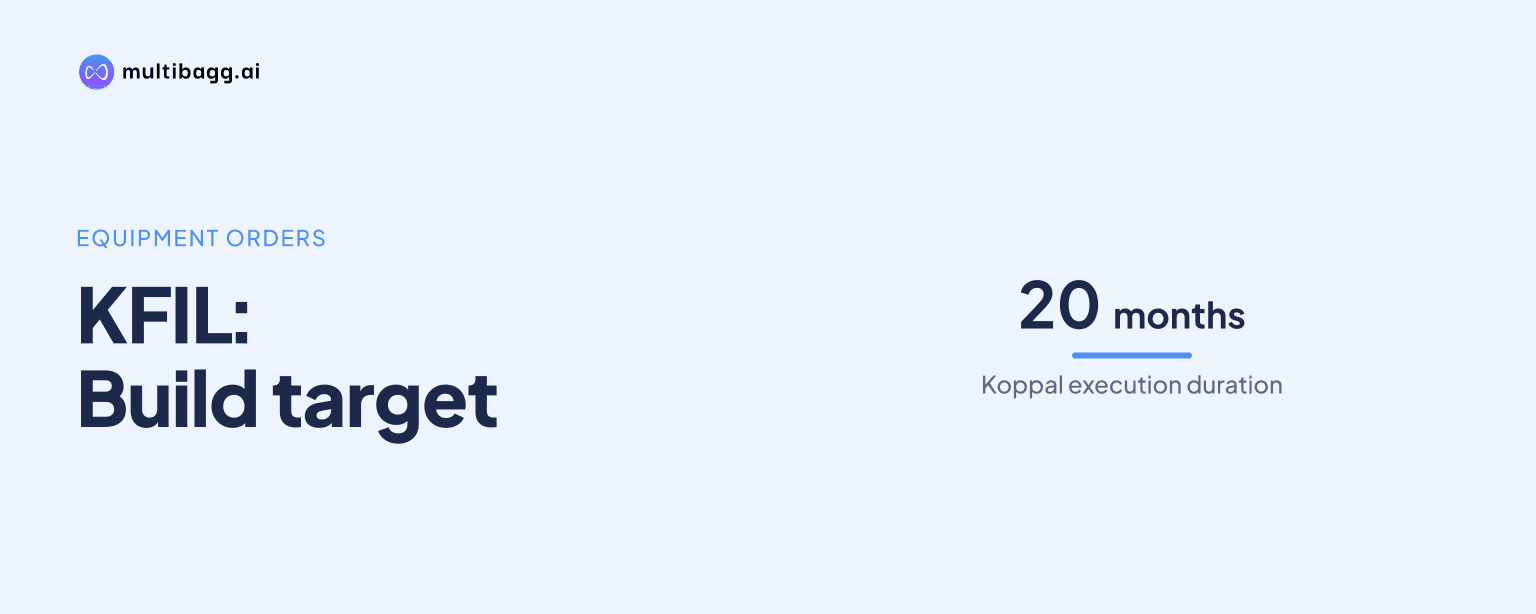
Kirloskar Ferrous Industries Limited expects the delayed Koppal alloy-steel project to move to equipment ordering within two to three months of its 2 November 2026 call, followed by about 20 months of execution and implementation. KFIL said local issues and technology-finalisation challenges had held up the plan, but technology design partners are now tied up.
Know Kirloskar Ferrous Industries inside out
Results, valuation, peers and who's buying, in one view.
Why was the KFIL Koppal alloy-steel project delayed?
KFIL said the Koppal alloy-steel project was delayed by local issues and challenges in finalising technology. Managing Director R. V. Gumaste gave this explanation during the Q2 FY'27 earnings call on 2 November 2026 after an analyst clarified that the question concerned Koppal rather than the Jejuri steel expansion.
The analyst referred to Koppal as an alloy-steel plant that KFIL had intended to build over two years. Management did not disclose the nature of the local issues, nor did it provide a revised project cost, planned annual capacity, capital expenditure or a specific commissioning date on the call.
KFIL said it was “more or less done” with the matters that had caused the delay. This indicates that the remaining steps are commercial rather than technology-partner selection, but management still identified equipment ordering as the milestone required before the approximately 20-month execution period can begin.
The Koppal discussion was separate from KFIL’s other projects. Management said the Jejuri rolling-mill capacity expansion, the Baramati expander-mill project and small piercing mills at Ahmednagar had entered execution, with the tube projects intended to expand offerings in smaller tubes and large tubes used in oil and gas.
What stage has the KFIL Koppal project reached?
KFIL said it had ordered for technology design partners and tied up with them, taking the Koppal project to commercial negotiations and equipment ordering. As of 2 November 2026, management had not said that principal equipment purchase orders had been placed.
Management expects KFIL to take the project forward “full blast” over the next two to three months. That is a management expectation rather than a firm order date, and the stated sequence is technology design tie-up, commercial negotiation, equipment orders, then project execution and implementation.
The approximately 20-month estimate begins after equipment ordering, not from the 2 November 2026 call date. KFIL therefore did not provide a calendar completion month, and the two-to-three-month ordering expectation should not be treated as a fixed commissioning timetable.
Got a follow-up? Ask IRIS
How does KFIL’s Koppal plan fit its steel operations?
KFIL placed the Koppal project within a broader steel and tube expansion programme, while reporting higher steel production in the six months covered by the call. Management said steel output rose almost 14% to 1,33,000 metric tons from 1,17,000 metric tons in the comparable prior-year period.
External steel sales in Q2 FY'27 rose 48% to Rs 206 crore from Rs 139 crore a year earlier, according to management. Steel realisation increased 7.6% to Rs 77,500 per tonne from Rs 70,700 per tonne, but KFIL did not attribute these reported sales or realisation changes to the unbuilt Koppal alloy-steel project.
KFIL also linked Koppal to nearer-term pig-iron productivity measures. Management said it was looking at output of 6,60,000 to 6,70,000 metric tons, with oxygen enrichment and pulverised coal injection, or PCI, to be fully implemented in blast furnaces one and two at Koppal by the financial year-end.
After an upgrade at Hiriyur, management said KFIL’s three mini-blast furnaces could together produce 8.5 lakh to 9 lakh metric tons. It also said output would decline again once material began being converted into steel after about a year, showing that the company expects changes in its pig-iron and steel production mix as its projects progress.
What must KFIL complete before Koppal implementation starts?
KFIL must conclude commercial negotiations and place equipment orders before the estimated 20-month implementation period starts. The 2 November 2026 disclosure makes ordering the immediate gating event, even though management said technology design partners had already been tied up.
The Koppal schedule should be read separately from KFIL’s foundry ramp-up plans. At Solapur, management said production and sales had reached 5,200 metric tons per month and more than 15,000 metric tons per quarter, with an aim to lift utilisation at its two foundries above 6,000 metric tons per month, or 18,000 metric tons per quarter.
KFIL expected the Solapur two-part foundry to be fully operational by January. The facility is intended to make grey-iron and spheroidal graphite, or S.G., iron castings of up to two tonnes, compared with components of up to 300 kilograms from existing foundries, making its timing and product purpose different from the Koppal alloy-steel plan.
At Rajpura, management expected phase two to raise capacity to nearly 4,000 metric tons per month by 31 March and add another 24,000 metric tons through implementation. These separate milestones show that KFIL has multiple projects across castings, steel and tubes, while the Koppal project remained at the commercial-negotiation and equipment-ordering stage on the call date.
Conclusion
KFIL has moved the delayed Koppal alloy-steel project beyond technology-partner selection, but it had not yet reached equipment ordering on 2 November 2026. Management’s plan is to complete ordering within two to three months and then execute the project over about 20 months, without disclosing its cost, capacity or a fixed commissioning date.
The next point to watch is whether KFIL converts its commercial negotiations into equipment orders within the stated two-to-three-month window. Management also plans to complete oxygen enrichment and PCI at Koppal blast furnaces one and two by the financial year-end, alongside its 6,60,000 to 6,70,000 metric-ton pig-iron output outlook.