










Kirloskar Ferrous Industries Limited targets 900,000 tonnes
Key highlights
- KFIL expects 850,000-900,000 tonnes of pig-iron output after the Hiriyur upgrade.
- KFIL was considering 660,000-670,000 tonnes of output before the full upgrade path.
- KFIL exported 31,000 tonnes when export realisations exceeded domestic prices.
- KFIL said pig-iron availability will fall after steel conversion begins in a year or so.
powered by IRIS
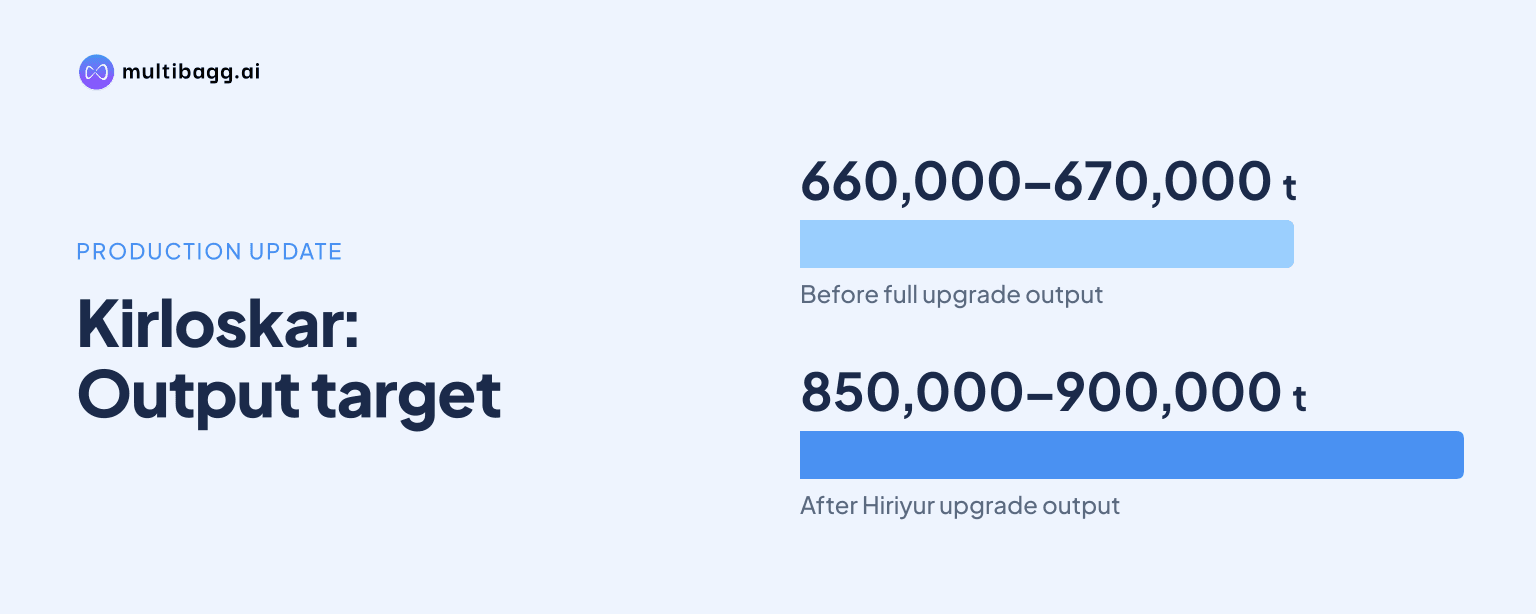
KFIL aims to raise combined mini-blast-furnace pig-iron output to 850,000-900,000 tonnes after oxygen enrichment, pulverised coal injection and a Hiriyur upgrade, but management said pig-iron availability would decline once part of the metal is converted into steel after a year or so.
Know Kirloskar Ferrous Industries inside out
Results, valuation, peers and who's buying, in one view.
How will KFIL raise pig-iron output to 850,000-900,000 tonnes?
KFIL plans to lift output first through oxygen enrichment and pulverised coal injection, or PCI, at blast furnaces one and two in Koppal. Management said full implementation of both measures was expected by year-end, after which the company anticipated a further increase from its then-current expected annual output of 660,000-670,000 tonnes.
The next step is an upgrade at Hiriyur. Management said that, once the Hiriyur plant is upgraded, all three mini-blast furnaces together could produce 850,000-900,000 tonnes. The range is a production objective disclosed on the call, rather than a stated sales target, and management did not provide a plant-by-plant output split or capital-expenditure figure for the upgrades.
The sequence matters because KFIL is not presenting maximum external pig-iron shipments as its permanent goal. Management said the production and productivity gains would support higher pig-iron volumes, but also stated that pig-iron availability would come down when steel conversion begins after a year or so.
Why did KFIL export 31,000 tonnes of pig iron?
KFIL exported 31,000 tonnes because management saw a short period in which export realisations exceeded domestic prices. It described the opportunity as a favourable pricing window, saying domestic prices faced a headwind while the export cargo allowed the company to secure better realisation and ease domestic market pressure while implementing price increases.
Management said the shipment was not a change in KFIL’s market strategy. It distinguished its approach from port-based pig-iron plants that continuously export, and said KFIL would continue to focus on domestic customers. The 31,000-tonne cargo was therefore a tactical response to relative pricing rather than a commitment to an export-led volume mix.
Pig iron is priced differently from castings in KFIL’s portfolio. Management said pig iron is sold in the spot market and prices are reviewed monthly according to demand, supply and cost calculations, whereas casting customers generally use a quarter-to-quarter mechanism. That difference means raw-material costs and market prices can affect the two businesses on separate timetables.
What will happen when KFIL diverts pig iron into steel?
KFIL expects to convert part of its pig-iron output into steel after a year or so, which management said would reduce pig-iron availability after the company reaches the 850,000-900,000-tonne production range. This is the central qualification to the higher-output roadmap: furnace upgrades are intended to support a broader steel strategy, not only larger merchant pig-iron sales.
Management did not disclose the tonnes that would be diverted into steel, the precise commissioning date, or the resulting external pig-iron sales volume. It did say KFIL had moved from pig iron and castings into steel and tubes, while identifying further opportunities beyond those four products. The call therefore does not permit calculation of a post-conversion pig-iron run rate.
KFIL also described progress on a Koppal alloy-steel project. Management said it had tied up technology design partners and reached commercial negotiations and equipment ordering, with an expectation of taking up the project in the next two to three months and then requiring around 20 months for execution and implementation. Management did not explicitly connect that project’s capacity to the 850,000-900,000-tonne pig-iron estimate.
Got a follow-up? Ask IRIS
What could affect KFIL’s pig-iron volumes and margins?
The key variables identified by management were coking-coal prices, pig-iron prices and other metallic cost structures. It said iron-ore costs had remained broadly steady, moving by only a few hundred rupees, despite changes in international prices. Management described coking coal as the main cost component affecting pig-iron economics.
Management contrasted the then-current year with the prior year, which it called one of the most challenging in KFIL’s pig-iron history. It said steel-grade pig-iron prices had fallen as low as Rs 21,000 per tonne in one month of the prior year, including one of the 31,000 tonnes exported, and that margins had improved somewhat in the current year despite cost increases and adverse major-raw-material exchange movements.
Management declined to speculate on whether the pig-iron market would provide further support. It said future demand would depend partly on steel-scrap prices and steel demand, and added that it was not yet seeing the degree of pickup it would associate with a sustained steel-demand cycle, even though prices had improved.
How does the output plan relate to KFIL’s casting and tube operations?
KFIL’s expansion agenda extends beyond pig iron. In castings, management said Koppal was contributing about 9,000 tonnes, Solapur about 5,000 tonnes and Oliver about 2,000-2,200 tonnes, while Rajpura delivered more than 6,000 tonnes in a quarter. It also said Solapur production and sales had exceeded 15,000 tonnes in a quarter as the facility ramps up.
For the Solapur two-part, or No-Bake, foundry, management said commissioning of the complete operation was expected by January. The line is intended to expand capability from components of up to 300 kilograms in existing foundries to castings of up to two tonnes, including grey iron and spheroidal-graphite, or SG, iron products. Management said it had already booked orders for a 480-kilogram non-automotive SG-iron component.
Machining is another stated value-addition priority. Management said annual machining value had reached about Rs 50 crore-Rs 60 crore, or around Rs 5 crore a month, and targeted more than Rs 100 crore within one or two years. It said investment was about Rs 200 crore and noted that some customers had bought only 50%-60% of the machining capability created for anticipated volumes, making utilisation an execution issue.
Conclusion
KFIL’s disclosed roadmap is to improve pig-iron output from 660,000-670,000 tonnes toward 850,000-900,000 tonnes through Koppal operating improvements and the Hiriyur upgrade. Its longer-term direction, however, is to use part of that metal for steel while expanding castings, machining and tubes.
The next milestones are management’s stated year-end implementation of oxygen enrichment and PCI at Koppal, the Hiriyur upgrade, and progress on the Koppal alloy-steel project after equipment negotiations. The timing and scale of steel conversion remain unresolved because KFIL did not disclose how many tonnes of pig iron would be redirected or when external pig-iron sales would decline.