










Kirloskar Ferrous targets over 35% renewable power by FY27
Key highlights
- Kirloskar Ferrous is targeting more than 35% renewable power by FY27-end through a combined 60 MW solar-and-wind programme.
- The 35 MW solar project was commissioned in QII 2026-27, while the 25 MW wind project is scheduled for QIII 2026-27.
- The company reported standalone gross debt of Rs 1,260 crore and a net-debt-to-EBITDA ratio of 1.40 times as of September 2026.
- Year-to-date FY27 capital expenditure was Rs 274 crore, allocated to efficiency and green-energy projects.
powered by IRIS
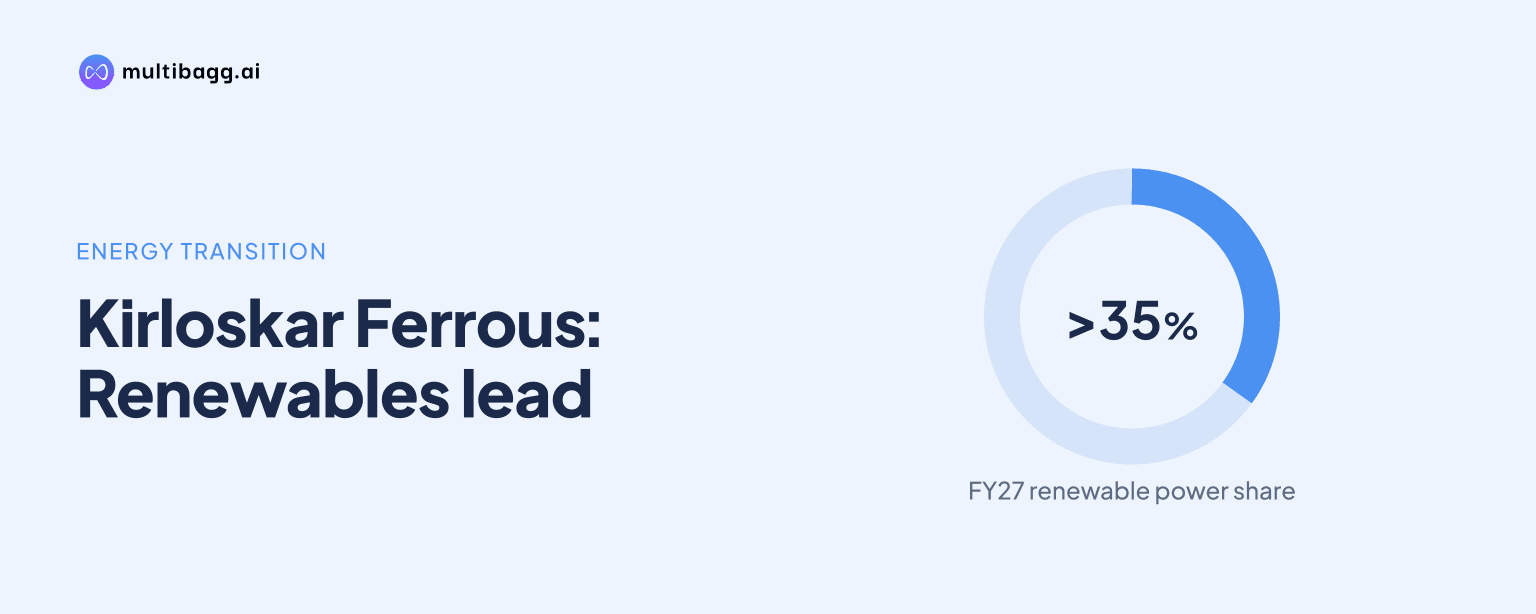
Kirloskar Ferrous Industries Limited is targeting more than 35% of its power from renewables by the end of FY27, supported by a 35 megawatt (MW) solar project commissioned in QII 2026-27 and a 25 MW wind project scheduled for QIII 2026-27. The combined 60 MW programme is intended to reduce power costs.
Know Kirloskar Ferrous Industries inside out
Results, valuation, peers and who's buying, in one view.
How is Kirloskar Ferrous building its renewable-power share?
Kirloskar Ferrous is building renewable capacity through 35 MW of solar power and 25 MW of wind power, a combined 60 MW programme for FY27. The company lists power-cost reduction as the objective of both projects and places the programme under its cost-leadership priority. Its strategic plan sets a target of around 35% green-power share, while its sustainability pillar specifies a target of 35% or more by the end of FY27.
The 35 MW solar project was commissioned in QII 2026-27, according to the FY27 project-status table. The 25 MW wind-mill project is scheduled for QIII 2026-27. This means that the solar component has been completed while the wind component remains a scheduled project, making the wind commissioning a key remaining step toward the FY27 renewable-power target.
Which FY27 projects are intended to reduce coke consumption?
Kirloskar Ferrous is pursuing coke-use reductions through coke-moisture management, a 149 tonnes-per-day (TPD) oxygen plant at Koppal, and pulverized-coal injection with oxygen enrichment at both blast furnaces. The company identifies these measures as part of its FY27 cost-leadership programme, alongside the renewable-power build-out. The presentation links the initiatives to an earnings before interest, tax, depreciation and amortisation (EBITDA) margin improvement from cost initiatives alone, without quantifying the potential improvement.
At the Hiriyur plant, a coke-bunker heating project will use flue gases to remove moisture from coke, with completion projected in QIV 2026-27. The stated aim is lower coke consumption. The 149 TPD oxygen plant at Koppal is also projected for QIV 2026-27 and is intended to reduce coke use while improving productivity. Separately, the strategic-priorities page says Koppal coke-moisture reduction has been completed, while the Hiriyur work is planned during FY27.
How does renewable power fit Kirloskar Ferrous's FY27 strategy?
Kirloskar Ferrous places the 35 MW solar and 25 MW wind projects in the first of its five FY27 strategic pillars, cost leadership. That pillar combines lower power-cost measures with blast-furnace initiatives, including pulverized-coal injection and oxygen enrichment. The company is therefore presenting renewable electricity and lower coke consumption as separate operating levers within the same cost programme rather than as alternatives to each other.
The sustainability and governance pillar extends the plan beyond generation capacity. Kirloskar Ferrous aims to establish a Scope 1 and Scope 2 emissions baseline and an intensity-reduction roadmap for its FY27 Business Responsibility and Sustainability Reporting (BRSR) disclosures. It also plans to pursue GreenCo or similar manufacturing certification for key plants and to strengthen environmental, social and governance disclosures in line with Securities and Exchange Board of India BRSR Core reporting requirements.
Got a follow-up? Ask IRIS
What capital and debt position supports Kirloskar Ferrous's FY27 projects?
Kirloskar Ferrous reported standalone gross debt of Rs 1,260 crore as of September 2026, alongside a net-debt-to-EBITDA ratio of 1.40 times. The presentation defines net debt as gross debt less cash and bank balances. Year-to-date FY27 capital expenditure was Rs 274 crore, which the company categorises as spending on efficiency and green energy.
Working-capital indicators show a mixed movement across reported quarters. Debtor days were 56 in Q2 FY27, up from 50 in Q4 FY26 and equal to Q2 FY26. Inventory days fell to 46 in Q2 FY27 from 48 in Q4 FY26 and 62 in Q2 FY25. The lower inventory-days figure coincides with ongoing FY27 capital expenditure on efficiency and green-energy projects, although the presentation does not assign working-capital movements to any specific project.
What other FY27 operating projects accompany the energy plan?
Kirloskar Ferrous is also expanding casting and machining capacity. Phase 1 of a new two-part foundry line at Solapur, designed for large castings, is projected for QIII 2026-27; Phase 2 is scheduled for QIV 2028-29. Machining-capacity enhancement remains ongoing. The company also plans to execute large-tubes orders and shift its tube mix toward oil country tubular goods (OCTG) and projects.
Its end-market mix shows why the programme spans several products. In pig iron, auto accounts for 55% and pumps for 25%; in castings, tractors account for 39%, while deemed-export commercial vehicles and domestic commercial vehicles each account for 17%. The castings customer base rose to 29 in FY27 Q2 from 26 in FY25, with auto utility and commercial vehicle customers increasing to 11 from 10, tractor customers to 10 from nine, and diesel-engine customers to five from four.
Conclusion
Kirloskar Ferrous is combining a 60 MW solar-and-wind programme with blast-furnace efficiency projects to pursue a renewable-power share above 35% by FY27-end and support cost-led EBITDA-margin improvement. The solar project was commissioned in QII FY27, while the planned wind project, coke-bunker heating at Hiriyur and the 149 TPD Koppal oxygen plant mark the remaining scheduled operating actions.
The next milestones are the 25 MW wind project in QIII 2026-27 and the Hiriyur coke-heating and Koppal oxygen projects in QIV 2026-27. Readers can also watch for the FY27 emissions baseline and intensity-reduction roadmap, as well as whether Kirloskar Ferrous reports progress toward its 35% or more renewable-power target and its planned GreenCo or similar certification effort.