










KFIL targets January start for 15,000-tonne casting line
Key highlights
- KFIL expects its Solapur large-casting foundry to operate fully by January.
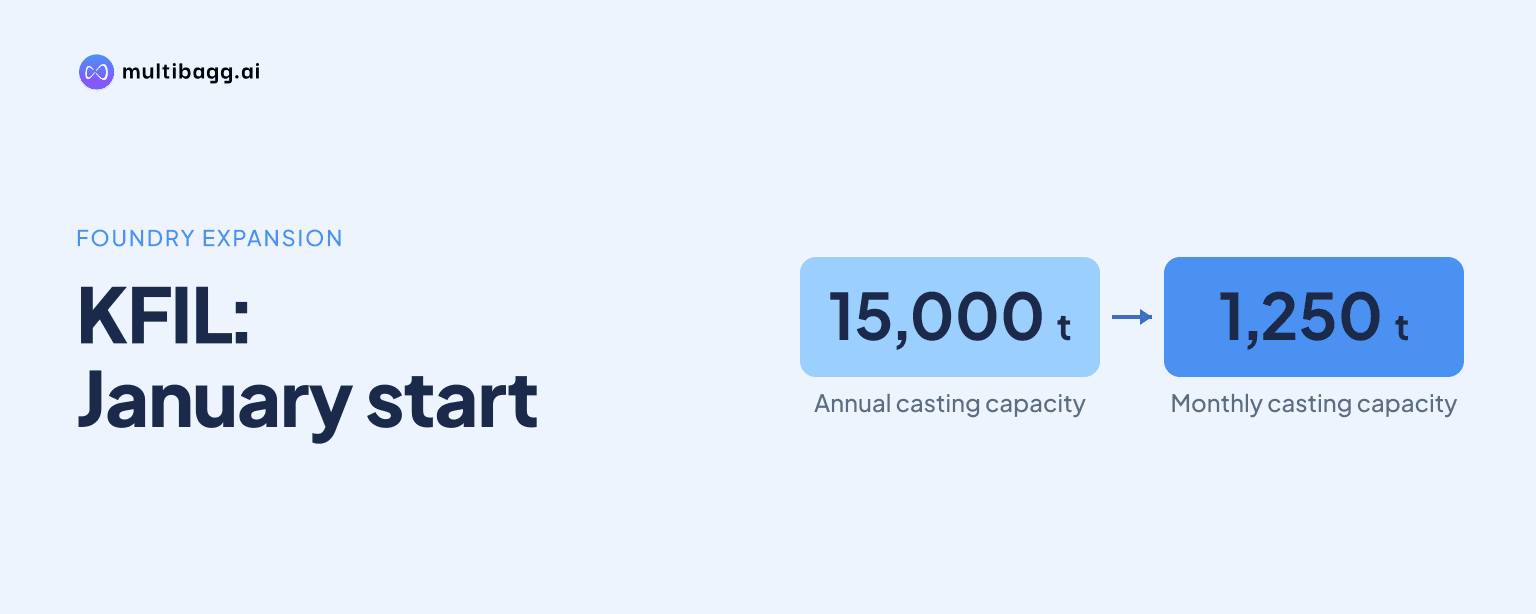
- The new Solapur line has annual capacity of 15,000 metric tonnes, or 1,250 metric tonnes a month.
- KFIL’s Q2 FY'27 net casting sales rose 20% year on year to 47,888 metric tonnes.
- KFIL has booked a 480-kilogram S.G. iron order for a non-automotive customer.
powered by IRIS
Kirloskar Ferrous Industries Limited expects its Solapur large-casting foundry to operate fully by January, adding 15,000 metric tonnes of annual capacity for castings weighing up to two tonnes. KFIL has booked an initial order for a 480-kilogram spheroidal-graphite iron component for a non-automotive customer, although management expects meaningful volume only next year.
Know Kirloskar Industries inside out
Results, valuation, peers and who's buying, in one view.
When will KFIL’s large-casting foundry start operating?
KFIL expects to be ready to operate the Solapur two-part, or No-Bake, foundry completely by January, following a further two to three months of commissioning work disclosed in its Q2 FY'27 earnings call. Management said it would not count on meaningful volume from the line in FY'27, as components need to move from development and temporary production arrangements into regular production.
The January target comes alongside a broader Solapur production ramp-up. KFIL said Solapur had moved beyond 15,000 metric tonnes of casting output and sales in a quarter, while its immediate objective for the two existing foundries was to exceed 6,000 metric tonnes a month, or 18,000 metric tonnes a quarter. The No-Bake line adds a different production capability rather than forming part of that existing-foundry utilisation target.
What castings will KFIL make at the Solapur line?
KFIL will be able to manufacture grey-iron and spheroidal-graphite, or S.G., iron castings weighing up to two tonnes, compared with cylinder blocks, cylinder heads and other S.G. iron components of up to 300 kilograms at its established foundries. Management said the new line could make engine blocks as well as other large castings, extending KFIL beyond its traditional component-size range.
The first booked programme is a 480-kilogram S.G. iron component for a non-automotive customer. KFIL did not disclose the customer, order value, annual volume or delivery schedule, but management said the foundry would not be restricted to cylinder blocks. The stated applications include a range of large grey-iron and S.G. iron castings, rather than a single automotive product category.
How much capacity does KFIL’s new foundry add?
KFIL has installed capacity of 15,000 metric tonnes a year at the large-casting foundry, equal to 1,250 metric tonnes a month. Management described this as a two-part-foundry format, which generally produces lower volumes than high-pressure moulding lines because it is designed for larger castings.
Management said a large-casting foundry typically produces about half the volume of a high-pressure moulding line and therefore requires materially higher value addition per tonne. It also said two-part foundry operators generally expect double the margin on large castings for that model to work. KFIL did not provide a company-specific margin target, sales realisation or profit forecast for the 15,000-metric-tonne line.
Got a follow-up? Ask IRIS
How is KFIL’s existing casting business developing?
KFIL’s net casting sales reached 47,888 metric tonnes in Q2 FY'27, up 20% from 39,980 metric tonnes in the same quarter a year earlier, while gross sales crossed 50,000 metric tonnes for the first time. Casting revenue increased nearly 30% to Rs 633 crore from Rs 487.8 crore, and average realisation rose 6.8% to Rs 1.30 lakh per tonne from Rs 1.21 lakh per tonne.
For the first six months of FY'27, KFIL’s casting production rose 20% to 93,000 metric tonnes from 78,000 metric tonnes. Management said demand was good from tractor, automotive, earth-moving equipment and stationary-engine customers, and that its three foundries were fully loaded in Q2 FY'27 and October. It nevertheless said tractor demand required careful monitoring, while automotive and earth-moving demand continued to be favourable.
Rajpura contributed more than 6,000 metric tonnes of sales during Q2 FY'27, according to management. KFIL plans to bring Rajpura phase two on stream by the March 31 financial year-end, taking capacity close to 4,000 metric tonnes a month and adding an indicated 24,000 metric tonnes. Management said the company’s long-term aim is 15% year-on-year casting-volume growth.
What must KFIL execute before large castings contribute meaningfully?
KFIL must finish commissioning and convert parts under development into serial production before the January-ready facility can make a material sales contribution. Management said casting commitments in development or approaching development exceed 3 lakh metric tonnes a year, against a capacity plan of 2.5 lakh metric tonnes through Solapur and Rajpura expansions. It did not specify how much of those programmes would be assigned to the 15,000-metric-tonne large-casting line.
Quality improvement at Solapur is also part of the execution plan. Management said thin-walled and critical castings had created challenges and projected that Solapur rejection levels would fall to 7% to 8% in the next quarter from 10% to 11%, based on initial heat-code trends. Rajpura production had stabilised at about 2,200 metric tonnes a month, with management targeting rejection below 5% there.
Machining is another route KFIL identified to increase value addition. The company said its annual machining value had reached about Rs 50 crore to Rs 60 crore, including about Rs 1.5 crore a month at Rajpura, and management aims to exceed Rs 100 crore within one or two years without major additional investment. It said past machine-shop investment of about Rs 200 crore had yet to produce the desired utilisation because of customer model changes and lower-than-planned purchases.
Conclusion
KFIL’s January operating target marks an expansion from castings of up to 300 kilograms to products of up to two tonnes. The 15,000-metric-tonne annual line, along with a booked 480-kilogram non-automotive order, provides evidence of an initial commercial programme. Its contribution, however, remains dependent on commissioning, customer qualification and conversion of development parts into serial production.
The next points to watch are KFIL’s confirmation that the foundry is fully operating by January, the volume it records in the following financial year, and the Solapur rejection rate against management’s 7% to 8% next-quarter expectation. Management also plans Rajpura phase two by March 31 and has set a one-to-two-year objective of more than Rs 100 crore in annual machining value.