










Kirloskar Ferrous Industries Limited Reports 16% Q2 Growth
Key highlights
- KFIL reported Q2 FY27 revenue of Rs 2,057 crore, up 16% from Rs 1,755 crore.
- Casting sales rose almost 30% to Rs 633 crore, while net casting sales volume increased 20% to 47,888 metric tonnes.
- Pig iron realization rose 12.4% to Rs 43,054 per tonne, and KFIL exported a 31,000-metric-tonne cargo.
- Tube sales volume declined about 2% to 48,547 metric tonnes despite a 1.6% increase in realization.
powered by IRIS
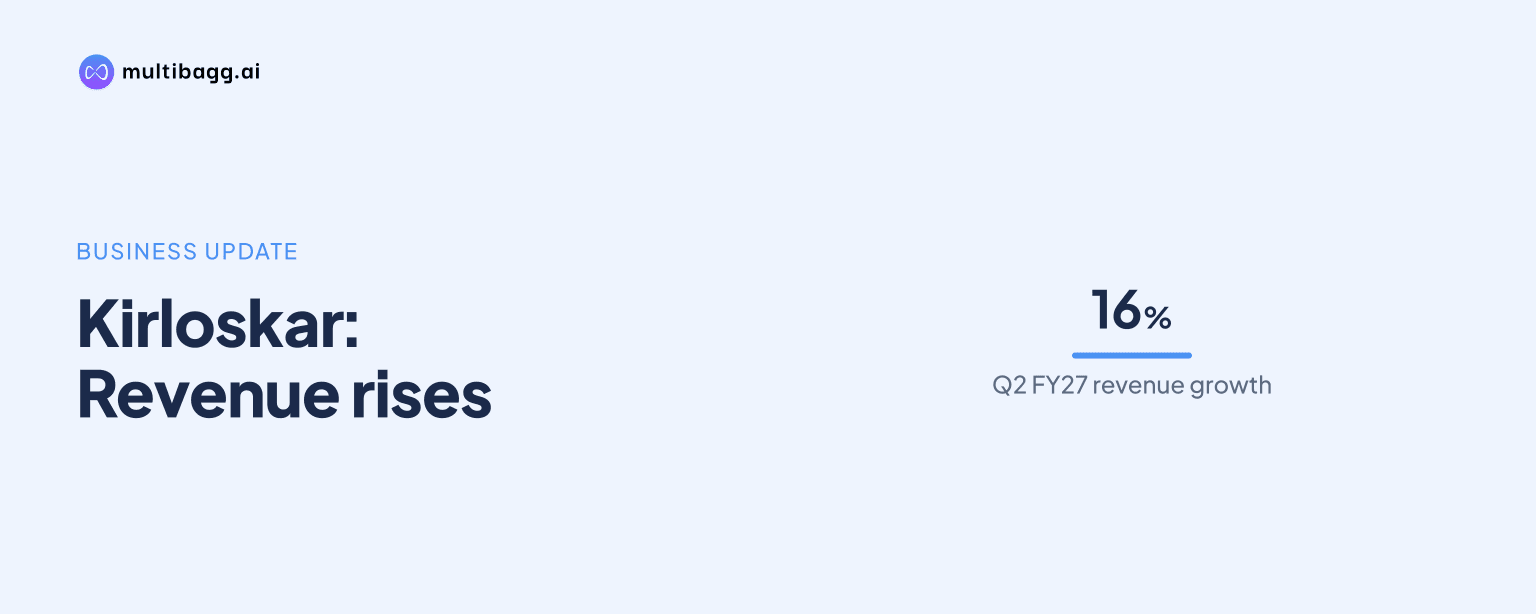
Kirloskar Ferrous Industries Limited reported Q2 FY27 revenue of Rs 2,057 crore, up 16% from Rs 1,755 crore a year earlier, as casting sales rose almost 30% to Rs 633 crore and pig iron realization increased 12.4% to Rs 43,054 per tonne. Growth was uneven, with tube volume still below the prior-year quarter.
Know Kirloskar Industries inside out
Results, valuation, peers and who's buying, in one view.
What drove KFIL's Q2 FY27 revenue growth?
KFIL's Q2 FY27 revenue rose 16% year on year to Rs 2,057 crore, while profit before tax, or PBT, increased to Rs 138 crore from Rs 120 crore in Q2 FY26. Management identified higher sales in castings, pig iron and steel as the principal contributors, while its tube business remained below its prior-year volume level.
Castings supplied the largest disclosed increase in sales value, rising to Rs 633 crore from Rs 487.8 crore in Q2 FY26, an increase of almost 30%. Pig iron sales rose 20% to Rs 581 crore from Rs 483.9 crore, while external steel sales increased 48% to Rs 206 crore from Rs 139 crore. These three product lines grew faster than the 16% company revenue increase.
The product mix was not uniformly positive. KFIL said steel and tube operations had faced significant challenges in Q1 FY27 and that the tube business had partly recovered in Q2. However, tube sales volume was 48,547 metric tonnes in Q2 FY27, compared with 49,588 metric tonnes a year earlier, leaving it as the disclosed business where volume remained lower.
How did KFIL's volumes and realizations change?
KFIL increased casting output and pig iron sales volume in Q2 FY27, while higher realizations contributed materially to sales growth. For the first six months, pig iron hot-metal production reached 331,896 metric tonnes, compared with 322,000 metric tonnes a year earlier, which management described as a 3% productivity improvement with all three furnaces operating apart from maintenance stoppages.
Casting production in the six months rose 20% to 93,000 metric tonnes from 78,000 metric tonnes. In Q2 alone, net casting sales increased 20% to 47,888 metric tonnes from 39,980 metric tonnes, while gross casting sales exceeded 50,000 metric tonnes for the first time. Management said its foundries across three locations were fully loaded in Q2 and October.
Pig iron external sales volume grew 3.5% to 134,000 metric tonnes from 128,000 metric tonnes. Sales value grew faster, by 20% to Rs 581 crore, because the average ex-works pig iron realization increased 12.4% to Rs 43,054 per tonne from Rs 38,000 per tonne. KFIL also exported one 31,000-metric-tonne cargo during the quarter.
Casting realization increased 6.8% to Rs 1.30 lakh per tonne from Rs 1.21 lakh per tonne. Steel realization rose 7.6% to Rs 77,500 per tonne from Rs 70,700 per tonne, while tube realization rose 1.6% to Rs 1.16 lakh per tonne from Rs 1.13 lakh per tonne. The tube price increase was smaller than the gains in pig iron, castings and steel.
Why did KFIL's realization improve despite cost pressures?
KFIL said it passed on some higher costs to customers after facing elevated coking-coal prices and an adverse rupee-dollar exchange rate over the previous three or four quarters. The 12.4% increase in pig iron realization to Rs 43,054 per tonne was the largest disclosed price movement among its four reported product categories.
For castings, management said customer contracts generally use a quarter-to-quarter pricing mechanism, under which cost movements in one quarter are reflected in the following quarter. It said some casting price increase was still to be realized after the 6.8% year-on-year increase to Rs 1.30 lakh per tonne in Q2 FY27.
Management said international pig iron prices improved during the quarter, prompting several manufacturers to export. KFIL exported a 31,000-metric-tonne cargo because export realization was better than domestic realization, though management said the company would continue to focus on the domestic market and consider exports when international pricing is higher.
Got a follow-up? Ask IRIS
Is casting demand supporting KFIL's expansion plans?
KFIL said casting demand was good in both Q1 and Q2 FY27 across tractors, automotive customers, earth-moving equipment and stationary engines. The 20% increase in Q2 net casting sales to 47,888 metric tonnes and full loading at foundries through October supported that assessment, although management said it was monitoring potential small corrections in tractor demand.
Management distinguished the tractor market from automotive and earth-moving equipment, where it said demand continued to be strong. This segment mix matters because KFIL's casting sales value rose almost 30% to Rs 633 crore in Q2 FY27, but management identified tractors as the area where near-term demand may change.
At Solapur, KFIL said its two-part, or No-Bake, foundry had reached production and sales of 5,200 metric tonnes per month, or more than 15,000 metric tonnes per quarter. Management aims to lift combined utilisation across its two Solapur foundries above 6,000 metric tonnes a month, equivalent to more than 18,000 metric tonnes per quarter.
The Solapur facility expands KFIL's capability from existing cylinder blocks, cylinder heads and spheroidal-graphite iron components weighing up to 300 kilograms to castings of up to two tonnes. Management said it had booked orders from one customer for a 480-kilogram non-automotive spheroidal-graphite iron component, illustrating the facility's intended move into larger castings.
What project milestones has KFIL disclosed?
KFIL expects to complete commissioning of the Solapur two-part foundry within another two to three months and said it should be fully operational by January. It also said Rajpura phase two is planned by the financial year-end of March 31, taking capacity close to 4,000 metric tonnes a month and potentially adding 24,000 metric tonnes after implementation.
For steel and tubes, management said it had entered the execution stage for a Jejuri rolling-mill capacity expansion, an expander mill at Baramati and small piercing mills at Ahmednagar. The projects are intended to expand smaller-tube capacity and large tubes for oil and gas, but management did not disclose capital expenditure or commissioning dates during the call.
KFIL said local issues and technology finalisation had delayed its Koppal alloy-steel project. Management said technology design partners had been selected and commercial negotiations and equipment ordering were under way. It expects to take up the project in full within two to three months, followed by about 20 months of execution and implementation.
Conclusion
KFIL's Q2 FY27 performance combined higher casting demand, improved pig iron realizations and substantially higher external steel sales to deliver 16% revenue growth and an Rs 18 crore increase in PBT. The contrast across products remained clear: casting net sales increased 20% and pig iron external volume rose 3.5%, while tube volume declined about 2% and tube realization increased only 1.6%.
The next disclosures to watch are full Solapur operation by January, Rajpura phase two by the March 31 financial year-end, and any tractor-demand correction flagged by management. Management's plan to advance the Koppal project within two to three months, followed by around 20 months of execution, is another stated milestone.