










Kirloskar Ferrous targets Koppal execution restart in 3 months
Key highlights
- Kirloskar Ferrous expects full-scale Koppal alloy-steel execution within 2-3 months of 2 November 2026.
- Kirloskar Ferrous management estimates around 20 months for Koppal execution and implementation after full-scale work begins.
- Kirloskar Ferrous reported Q2 FY'27 revenue of Rs 2,057 crore, up 16% from Rs 1,755 crore a year earlier.
- Kirloskar Ferrous produced 93,000 metric tons of castings in the first six months of FY'27, up 20% from 78,000 metric tons.
powered by IRIS
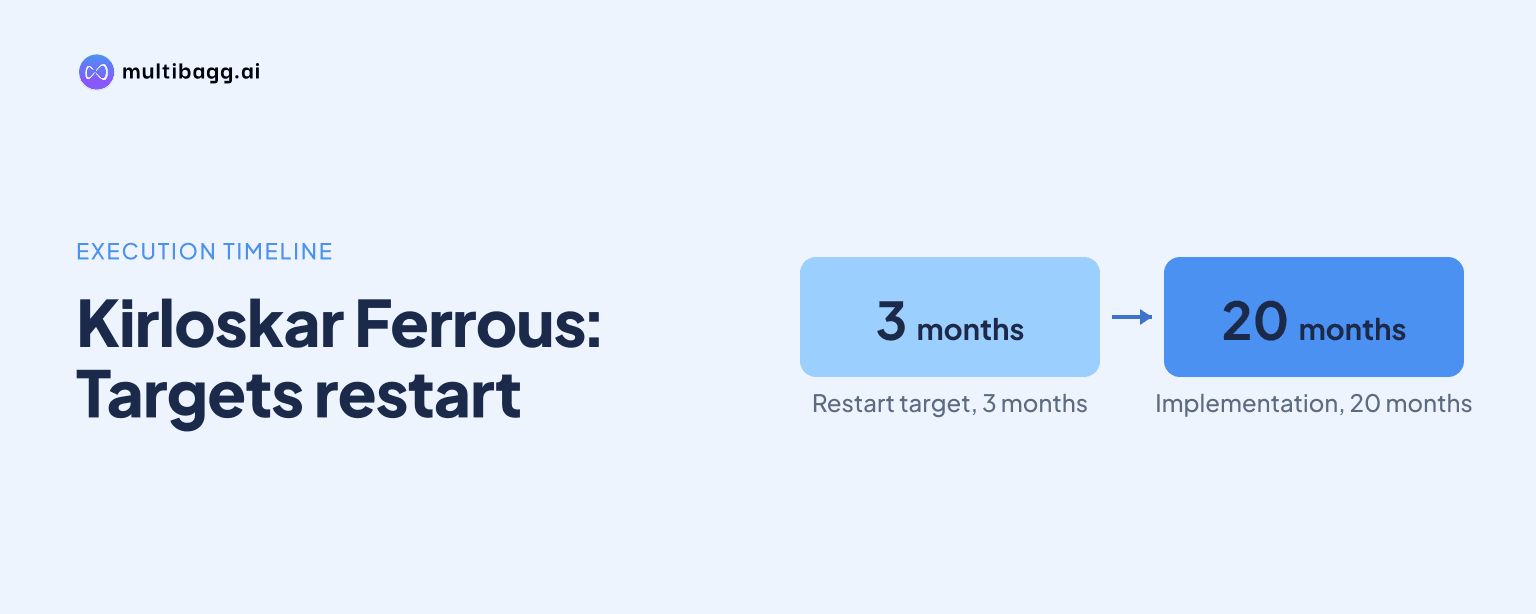
Kirloskar Ferrous Industries Limited expects to begin full-scale execution of its Koppal alloy-steel project within two to three months of its 2 November 2026 Q2 FY'27 call, with implementation estimated at around 20 months thereafter. Management said it had addressed local and technology-finalisation issues and moved to commercial negotiations and equipment ordering.
Know Kirloskar Industries inside out
Results, valuation, peers and who's buying, in one view.
When will Kirloskar Ferrous restart Koppal alloy-steel project execution?
Kirloskar Ferrous expects to take up the Koppal alloy-steel project at full pace within two to three months from 2 November 2026. Management said it had tied up technology design partners and ordered the technology design work, moving the project into commercial negotiations and equipment ordering.
Management estimated around 20 months for execution and implementation after full-scale work begins. This is a management timetable rather than a commissioning commitment: Kirloskar Ferrous did not disclose the project cost, alloy-steel capacity, financing arrangement or a calendar completion date in the Q2 FY'27 call.
The two-to-three-month expectation provides a nearer milestone than the earlier delay disclosure, but it does not resolve every delivery risk. Kirloskar Ferrous said only that it was “more or less done” with the identified issues, leaving the timing of equipment orders and site activity as the next disclosed markers.
Why was the Kirloskar Ferrous Koppal project delayed?
Kirloskar Ferrous said Koppal was delayed by local issues and the company’s need for clarity on several technology challenges. In the same Q2 FY'27 discussion, management also referred to market assessment and technology-finalisation delays while outlining its wider steel-project plans.
By 2 November 2026, management said it had reached the stage of negotiating commercially and ordering equipment. That represents a change from technology selection to procurement preparation, although Kirloskar Ferrous did not identify the technology suppliers or quantify any spending associated with the delay.
Kirloskar Ferrous also did not disclose whether approvals, raw-material availability or market conditions could affect the roughly 20-month implementation estimate. The call therefore establishes a planned execution sequence, but not a detailed construction schedule or a defined alloy-steel sales ramp-up.
Which other Kirloskar Ferrous steel and tube projects are progressing?
Kirloskar Ferrous said it was ready to advance a rolling-mill capacity expansion at Jejuri, an expander-mill project at Baramati and small piercing mills at Ahmednagar. Management said the projects are intended to broaden the product portfolio for smaller tubes and large tubes used in oil and gas.
Management said these steel and tube projects had entered the execution stage and that more updates would follow in coming quarters. Unlike Koppal, however, Kirloskar Ferrous gave no two-to-three-month full-execution target or 20-month implementation estimate for Jejuri, Baramati or Ahmednagar.
The product expansion plans follow mixed Q2 FY'27 trends in the existing businesses. Steel external sales rose 48% to Rs 206 crore from Rs 139 crore a year earlier, while tube value growth was 0.5% and tube sales volume declined about 2% to 48,547 metric tons from 49,588 metric tons.
Got a follow-up? Ask IRIS
How is Kirloskar Ferrous expanding its foundry operations?
Kirloskar Ferrous expects its two-part, or No-Bake, Solapur foundry to be fully operational by January. Management said phases one and two of the second Solapur foundry line were nearly complete and that current production and sales had reached 5,200 metric tons per month, or more than 15,000 metric tons per quarter.
The Solapur facility is intended to raise the company’s casting capability from components of up to 300 kilograms at its existing foundries to castings of up to two tonnes. Management cited a booked order for a 480-kilogram non-automotive spheroidal graphite, or S.G., iron component, alongside potential production of grey iron and S.G. iron castings.
Kirloskar Ferrous is aiming for combined utilisation across its two Solapur foundries of more than 6,000 metric tons a month, or 18,000 metric tons a quarter. The company said this ramp-up is focused on increasing output and sales rather than announcing another new Solapur capacity project.
What is the Kirloskar Ferrous Rajpura expansion timetable?
Kirloskar Ferrous expects to bring Rajpura foundry phase two into operation by the financial year-end on 31 March, with readiness for northern customers targeted in the first quarter of the following financial year. Management said existing Rajpura capacity was sold out and phase two should lift capacity to close to 4,000 metric tons a month.
Management said the phase-two project could add another 24,000 metric tons of capacity at Rajpura. This differs from Solapur’s January operating target because Rajpura is presented as additional capacity for northern customers, while Solapur is being commissioned for larger castings of up to two tonnes.
The foundry expansion follows higher casting volumes in FY'27 to date. Kirloskar Ferrous reported casting production of 93,000 metric tons in the first six months, compared with 78,000 metric tons a year earlier, while Q2 net casting sales rose to 47,888 metric tons from 39,980 metric tons.
What does Kirloskar Ferrous Q2 FY'27 performance show about demand?
Kirloskar Ferrous reported Q2 FY'27 revenue of Rs 2,057 crore, up 16% from Rs 1,755 crore in the corresponding prior-year quarter, while profit before tax rose to Rs 138 crore from Rs 120 crore. Management said all three foundries were fully loaded in Q2 and October, supported by tractor, automotive, earth-moving equipment and stationary-engine demand.
Pig iron production reached 331,896 metric tons in the first six months of FY'27, up from 322,000 metric tons a year earlier, representing a 3% productivity improvement. In Q2, Kirloskar Ferrous exported one 31,000-metric-ton cargo because export realisations exceeded domestic prices, but management said domestic sales would remain its main focus.
Management said pig iron output could reach 660,000 to 670,000 metric tons before further gains from oxygen enrichment and pulverised coal injection, or PCI, at Koppal blast furnaces one and two by the year-end. It said all three mini-blast furnaces could eventually produce 850,000 to 900,000 metric tons, before output is reduced once iron is converted into steel after about a year or more.
Conclusion
Kirloskar Ferrous has provided a defined next step for Koppal after technology and local delays: management expects full-scale project execution within two to three months and estimates around 20 months for implementation. Alongside that plan, the company is pursuing steel and tube projects across Jejuri, Baramati and Ahmednagar while expanding foundry capability at Solapur and Rajpura.
The next disclosed milestones are Koppal equipment orders and progress updates in coming quarters, Solapur’s target for full operation by January, and Rajpura phase two by 31 March. Management also plans to complete oxygen enrichment and PCI at Koppal blast furnaces one and two by the year-end, which it said could support higher pig iron output.