










Kirloskar Ferrous targets Rs 100 crore machining revenue
Key highlights
- KFIL reported annual machining value of about Rs 50 crore to Rs 60 crore, or roughly Rs 5 crore a month.
- Management said about Rs 200 crore of machining investment should generate Rs 90 crore to Rs 100 crore of revenue.
- Customers are buying only 50% to 60% of the volumes for which KFIL created machining capability.
- KFIL aims to cross Rs 100 crore of machining revenue within one to two years without major additional investment.
powered by IRIS
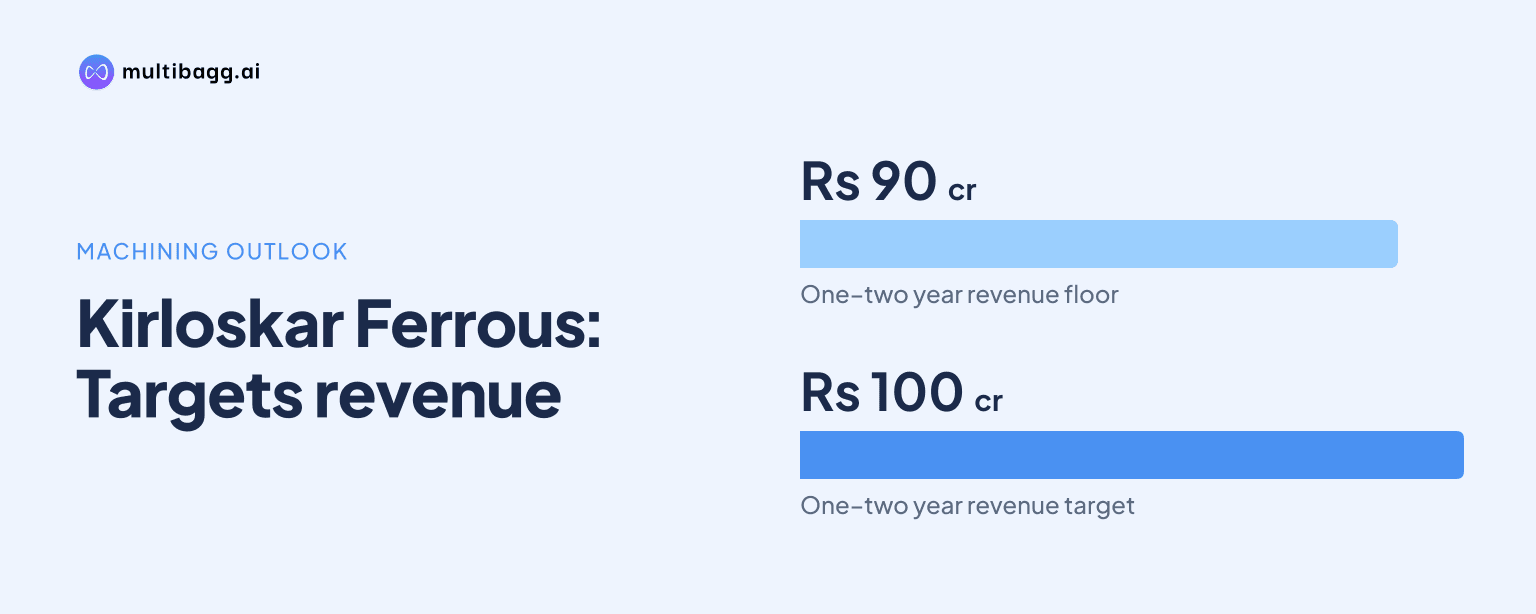
Kirloskar Ferrous said on its earnings call that about Rs 200 crore invested in machining is producing annual machining value of only Rs 50 crore to Rs 60 crore, and management aims to cross Rs 100 crore within one to two years. Customer model changes have resulted in purchases of only 50% to 60% of the machining volume originally planned.
Know Kirloskar Industries inside out
Results, valuation, peers and who's buying, in one view.
Why is KFIL’s machining investment underutilised?
KFIL’s machining investment is underutilised because revenue growth has lagged capital deployed across its three machine-shop locations. Management said machine shops have been established at all three sites and machining value is growing, but spending on machines, buildings and other infrastructure has increased faster than revenue. The current annual machining value is about Rs 50 crore to Rs 60 crore, equivalent to roughly Rs 5 crore a month.
Management put the machining investment at about Rs 200 crore, rather than the Rs 240 crore suggested by an analyst. It said this investment should generate around Rs 90 crore to Rs 100 crore of revenue to produce what it described as a good and decent return. The gap between the current Rs 50 crore to Rs 60 crore run rate and that range means KFIL needs greater output from installed capacity rather than a broad new capacity build.
Rajpura shows both the progress and the remaining opportunity. KFIL started a machine shop when it began Rajpura operations, and the facility has reached about Rs 1.5 crore of machining value a month. Management nevertheless said every location needs to deliver more meaningful machining revenue, even as customers show interest in expanding their machining work with KFIL.
What is holding back KFIL’s machining revenue?
KFIL said changes in automotive and tractor customer models are the main constraint on converting machining capability into billed volumes. Management said customers often buy only 50% to 60% of the volume for which KFIL had created machining capability. Dedicated equipment and infrastructure can therefore operate below plan when a component programme changes or its production volume falls short of the initial expectation.
KFIL is addressing this mismatch through commercial and operating measures. Management said senior machining personnel have joined its teams to help mitigate programme-volume changes, while customer participation in investment is one option being considered. It also cited greater use of special-purpose machines, which can be designed for specific customers and components rather than configured for broader use.
The company separated machining utilisation from casting-quality issues. At Solapur, management said thin-walled and more critical castings had caused operational challenges, but it expected rejection levels to fall to 7% to 8% in the next quarter from 10% to 11%. Rajpura had stabilised production at 2,200 metric tons a month, and management expected its rejection level to move below 5%.
Got a follow-up? Ask IRIS
How does KFIL plan to reach Rs 100 crore of machining revenue?
KFIL plans to cross Rs 100 crore of annual machining revenue within one to two years without major additional investment, primarily by raising utilisation of its existing facilities. Management said reaching that level would indicate very good capacity utilisation and make machining a more meaningful value addition to the casting business. The stated plan depends on filling capacity that currently produces Rs 50 crore to Rs 60 crore annually.
The plan extends beyond conventional machining of casting components. KFIL said it is examining higher-value machining opportunities through either acquisitions or internal development. It cited thread cutting for special or premium tube couplings as an example in the tube business, while saying the casting business would pursue machining more aggressively than simply supplying raw castings.
Management did not disclose an acquisition target, transaction timetable or value. It said KFIL would continue to establish more specific facilities for different customers and component-machining requirements, which it expects to carry better returns than broader capacity. Customer co-investment could also reduce the risk of KFIL building capacity for volumes that later fail to materialise.
Can casting growth support KFIL’s machining utilisation?
KFIL expects casting expansion to provide opportunities for more machining, although management did not quantify how much incremental casting volume would be machined internally. Casting sales were 48,000 metric tons in the reported second quarter, compared with gross sales of 50,000 metric tons before deductions for customer returns and rejections. Management said it was seeking to stabilise at 1 lakh metric tons of sales over the next two quarters.
Management said Rajpura delivered more than 6,000 metric tons of quarterly sales volume, while Solapur had moved beyond 15,000 metric tons in a quarter. It described Solapur as a site for more intricate and value-added components, with scope to reduce costs and improve value addition. Those components could offer machining opportunities, but the call did not specify their conversion into machine-shop revenue.
KFIL’s customer commitments for castings under development exceed its current annual sales ambition. Management said these commitments were above 3 lakh metric tons a year, versus a stated annual sales objective of 2 lakh metric tons. It outlined a path to 2.5 lakh metric tons through Solapur reaching 70,000 metric tons a year and completion of Rajpura phases 2 and 3 to reach another 70,000 metric tons.
The new foundry line is not expected to add meaningful volume in the current year. Management said some volume could emerge as components made in makeshift arrangements are formalised, but meaningful contribution is expected next year after component development advances into serial production. KFIL also identified castings, tubes and alloy steel as its growth drivers and projected 15% year-on-year volumetric growth in casting.
Conclusion
KFIL has acknowledged that about Rs 200 crore of machining investment is generating only Rs 50 crore to Rs 60 crore of annual value, below management’s Rs 90 crore to Rs 100 crore revenue benchmark. The disclosed constraint is not a lack of customer interest, but lower programme purchases after model changes, with customers taking 50% to 60% of the initially planned machining volume.
The next disclosures should show whether KFIL raises utilisation without major investment and progresses towards its Rs 100 crore machining target within one to two years. Management’s planned customer participation in investment, deployment of special-purpose machines, expected meaningful new-foundry volume next year, and Solapur’s targeted rejection reduction to 7% to 8% are the stated execution markers.