










KKCL keeps Rs 1,500 crore goal with 800 EBO target
Key highlights
- KKCL reduced its Vision 2028 EBO target by 100 outlets, to 800 from 900.
- KKCL retained its Vision 2028 revenue goal of Rs 1,500 crore.
- KKCL is targeting 1,000-1,200+ square-foot stores versus earlier stores of 600-800 square feet.
- Management said winter discounting could change third-quarter EBITDA mix by 1% to 2%.
powered by IRIS
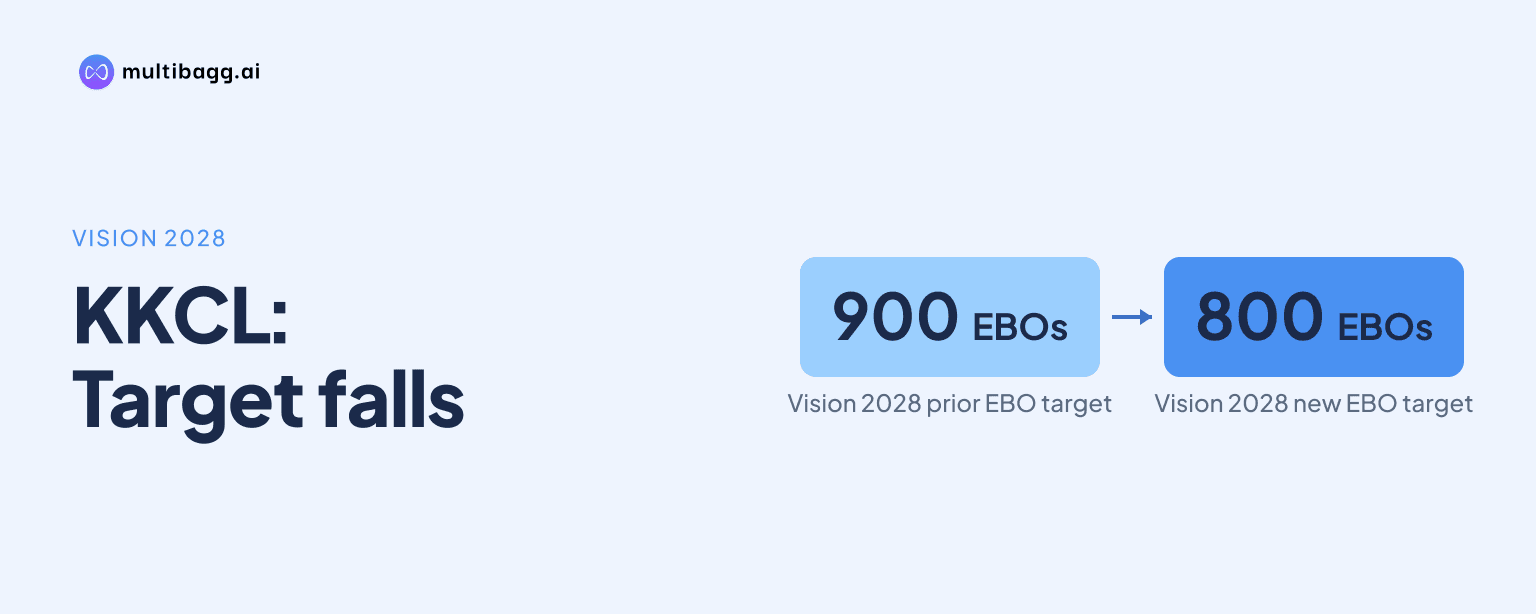
Kewal Kiran Clothing Limited has retained its Rs 1,500 crore Vision 2028 revenue goal while reducing its exclusive brand outlet target to 800 from 900, relying on 1,000-1,200+ square-foot stores, category additions and higher store throughput. KKCL management said the revised network is not expected to generate incremental EBITDA margins.
Know Kewal Kiran Clothing inside out
Results, valuation, peers and who's buying, in one view.
Why did KKCL reduce its EBO target to 800?
KKCL reduced its Vision 2028 exclusive brand outlet, or EBO, target from 900 to 800 because it is rationalising the K-Lounge format and changing the shape of its single-brand retail network. Management said it had kept K-Lounge numbers constant because it lacked a strategy for the format, but now plans to rationalise and square it off over the Vision 2028 period.
The revision changes the composition of the planned store estate rather than the revenue objective. KKCL kept the Rs 1,500 crore target unchanged while lowering the outlet target by 100, indicating that the plan depends on higher sales per planned store. On a target-based comparison, the revenue required per store rises by 12.5% when the same Rs 1,500 crore goal is spread across 800 rather than 900 outlets.
Management did not provide a current K-Lounge count or a specific closure timetable during the call. It said the lower store number reflects the K-Lounge rationalisation and a preference for larger single-brand outlets, rather than a reduction in the Rs 1,500 crore growth commitment.
How will KKCL maintain its Rs 1,500 crore revenue goal?
KKCL plans to maintain the Rs 1,500 crore goal through bigger stores, category expansion and locations on main lines and main streets. Hemant Jain said the company previously opened stores of 600-800 square feet but is now focusing on 1,000-1,200+ square-foot outlets, with the intention of maintaining sales with fewer stores.
The larger format is intended to carry a broader range than core menswear items such as jeans, shirts, T-shirts and trousers. Pankaj Jain cited accessories, formalwear including blazers and winterwear as categories that can add throughput, while Hemant Jain said kidswear has already been added in stores. Management did not disclose category-wise revenue targets or product-level sales assumptions.
KKCL said its location choice is part of the higher-throughput model. Hemant Jain said the company reduced the number of planned outlets because it wants to remain on main lines and main streets rather than open stores in side locations. The strategy places more importance on floor space, assortment and location than on expanding the number of retail doors.
General-trade distribution also informs site selection. Pankaj Jain said KKCL’s broad general-trade presence helps it understand a city before considering a new EBO or a counter in a large-format store. He said general trade is more entrepreneur-driven, and that KKCL places greater emphasis on the entrepreneur than on the area in that channel.
Will the 800-EBO plan raise KKCL’s EBITDA margin?
KKCL does not expect the revised 800-EBO plan to generate incremental EBITDA margins, despite the aim of raising throughput per store. EBITDA means earnings before interest, tax, depreciation and amortisation. Pankaj Jain said better throughput would not necessarily result in higher incremental margins.
Management said the added floor space carries additional rental expense, although Pankaj Jain described rental as the incremental investment associated with a larger store. It also said most KKCL outlets are franchisee-owned and franchisee-operated, meaning part of the additional revenue generated at those locations goes to franchisees.
Pankaj Jain added that any incremental benefit could be used to generate sales, including through marketing. That indicates the 800-EBO reset is designed to preserve growth and the Rs 1,500 crore target, rather than to commit KKCL to a higher operating-margin percentage.
Got a follow-up? Ask IRIS
What risks could affect KKCL’s retail strategy?
KKCL said winter can affect quarterly profitability because the season provides a window of roughly 60 days and can require discounting. Pankaj Jain said winter conditions could change the EBITDA mix by 1% to 2% in the third quarter, without giving a full-year margin forecast.
Fabric-cost inflation is another unresolved variable for the third and fourth quarters. Management said first-half gross margins remained intact despite higher fabric prices, but it said inflationary pressure could persist. KKCL said it would try to respond either by reducing discounts or by raising the maximum retail price, or MRP, while acknowledging uncertainty over whether customers would absorb an increase.
Production disruption can also affect the availability of merchandise for the retail network. Hemant Jain said demand was not the problem during flooding, but production was disrupted when people could not reach factories and a factory was under water. He said about 7 to 10 days were lost and the company could not produce against orders during that period.
What is KKCL’s category expansion plan?
KKCL is using larger stores to support category expansion, but management said it is too early to give a complete update on its brand pivots. Pankaj Jain said KKCL had not cracked the initiatives as well as expected and asked for at least two more quarters before providing an update.
That timing is relevant because the Rs 1,500 crore target now depends more on what each 1,000-1,200+ square-foot outlet can sell. Kidswear is already present in stores, while blazers, winterwear, accessories and other fashion-related categories may be added according to market demand. Hemant Jain said management could not disclose an exact category-by-category product plan.
KKCL also rejected an analyst’s suggestion that ethnicwear had driven its latest second-quarter sales of around Rs 370 crore. Pankaj Jain said that assumption was incorrect and identified Levi’s, Lee, Wrangler, Mufti, Pepe and Spykar as the core competitive set for the Killer brand.
Conclusion
KKCL’s Vision 2028 reset keeps the Rs 1,500 crore revenue ambition but lowers the EBO target by 100 outlets, placing greater weight on larger stores, main-street locations and wider assortments. The approach includes K-Lounge rationalisation and aims for higher store throughput, but management does not expect that change alone to lift EBITDA margins because of rental, marketing and franchisee economics.
The next item to watch is management’s update after at least two more quarters on brand pivots and category expansion. KKCL also identified third- and fourth-quarter fabric inflation, its ability to manage discounts or MRP increases, and the effect of winter discounting on third-quarter EBITDA mix as unresolved factors in delivering the Vision 2028 plan.