










KKCL Says Vapi-Daman Floods Cut Q2 Sales by 3%-4% Estimate
Key highlights
- KKCL estimated that Vapi-Daman flooding reduced Q2 sales by 3%-4%.
- Flooding halted KKCL production for about 7 to 10 days, and management said employees could not reach the factory.
- Kraus grew 25% through expansion and same-store growth without the same supply-chain disruption, according to management.
- KKCL reduced its store target to 800 from 900 and plans to rationalise K-Lounge over 2 to 2.5 years.
powered by IRIS
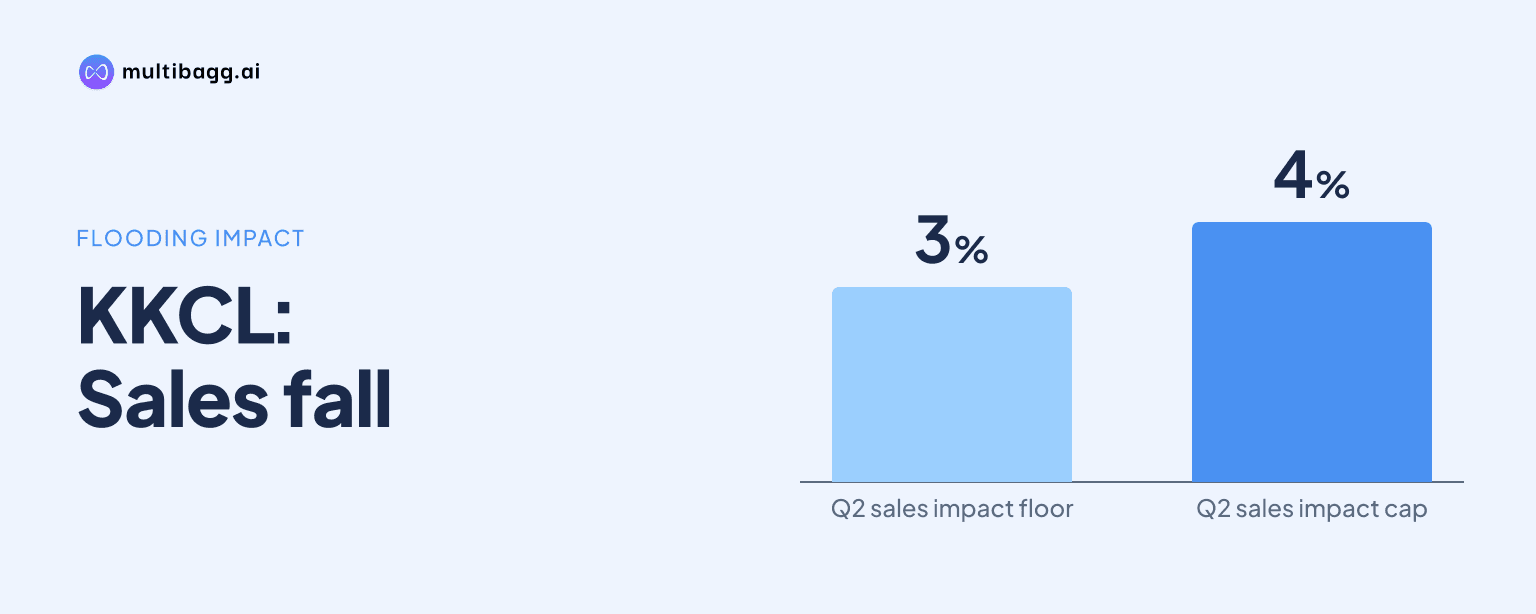
Kewal Kiran Clothing Limited said Vapi-Daman flooding cut Q2 sales by an estimated 3%-4% after its factory was inundated and production stopped for about 7 to 10 days, despite customer demand and outstanding orders. Management said employees could not reach the facility and merchandise could not be produced in time for the seasonal selling period.
Know Kewal Kiran Clothing inside out
Results, valuation, peers and who's buying, in one view.
Why did KKCL's Q2 sales fall?
KKCL said flooding, rather than weak demand, caused the Q2 sales disruption. Hemant Jain said the factory was “completely in the water”, while Pankaj Jain said people could not reach the factories. Management said the business had orders to fulfil but could not produce against those orders while the site was inaccessible.
The interruption lasted roughly 7, 8 to 10 days, including about a week during the season, according to management. That timing was significant because the unavailable production capacity affected merchandise intended for a selling window, not simply factory output that could necessarily be made up later. Management also cited oil and gas prices as factors that had an impact during the period.
How much did the Vapi-Daman flooding affect KKCL sales?
KKCL estimated that the Vapi-Daman disruption reduced Q2 sales by 3%-4%. The estimate was management's assessment of the sales effect from lost production time, rather than a separately disclosed financial line item or a reconciliation by brand.
Management linked the 3%-4% impact to its inability to manufacture against existing orders during the 7-to-10-day stoppage. Hemant Jain said demand was not the issue and that the company had been disturbed for a week in the season, making the loss of production time a direct constraint on deliveries.
The disclosure distinguishes the flood effect from a broad-based demand setback, but it does not quantify how much delayed output, if any, could be recovered in later quarters. It also does not provide a separate Q2 sales impact for individual brands, factories or distribution channels.
Was customer demand weak for KKCL in Q2?
KKCL said customer demand was not the problem in Q2; production and factory access were the constraints. Hemant Jain said there was demand, but the company could not produce against orders because the flood prevented normal operations at the affected facility.
Kraus offered a contrast within the portfolio, growing 25% through a combination of expansion and same-store growth, or SSG. Management said Kraus had not faced the same supply-chain or warehousing disruption, whereas Killer operates on a base about three times that of Kraus. The different warehousing capability and brand bases contributed to different outcomes.
Integriti delivered double-digit growth in the first half following its revamp, although Pankaj Jain said he had expected a larger increase. These brand-level comments support management's position that demand existed in parts of the portfolio, while the flood created a supply-side disruption at the affected operations.
How is KKCL handling fabric inflation and winter discounting?
KKCL said it has already begun facing inflationary pressure in fabric and took price increases in the current two quarters. Management said first-half gross margins remained intact despite the fabric-price increase, but added that pressure could continue in Q3 and Q4.
Management identified two potential ways to address further cost increases: reducing discounts or increasing the maximum retail price, or MRP. It did not commit to either action or say that all inflation would be passed on, stating that it was too early to determine whether consumers would absorb further increases.
Winter also creates a separate Q3 consideration, according to management. Pankaj Jain said winter typically provides a roughly 60-day sales window and can alter the earnings before interest, tax, depreciation and amortisation, or EBITDA, mix by 1%-2% in Q3 because of discounting. That comment concerned the seasonal mix rather than a specific EBITDA target.
Got a follow-up? Ask IRIS
What is KKCL changing in its retail expansion plan?
KKCL has reduced its store target to 800 from 900 and plans to rationalise K-Lounge over the next 2 to 2.5 years. Management said it had kept the K-Lounge count broadly constant because it did not have a strategy for the format, and the lower total-store target reflects that rationalisation.
The company is focusing on single-brand retail stores in main-line and main-street locations, with larger store formats. Earlier stores were generally 600-800 square feet, while the current focus is on 1,000-1,200-plus square feet. Management said the larger formats are intended to support equivalent sales from fewer locations.
KKCL said larger stores can accommodate categories beyond jeans, shirts, T-shirts and trousers, including kidswear, accessories, formalwear, blazers and winterwear. Management did not expect a major incremental EBITDA-margin effect from higher throughput because most stores are franchisee-owned and franchisee-operated, and some incremental revenue goes to franchisees.
When will KKCL update investors on Vision 2028 pivots?
KKCL said it needs at least two more quarters before giving a fuller update on category pivots under Vision 2028. Pankaj Jain said the company had not yet cracked those initiatives as well as management had expected after roughly a year to a year and a half since listing them in the plan.
The store strategy is part of management's approach to raising sales throughput with a lower store count. Larger 1,000-1,200-plus-square-foot outlets and broader product categories are intended to increase sales per location, but management did not provide category-wise targets or a timetable for each addition.
Management also said premium malls can provide additional doors through retailers such as Shoppers Stop or Lifestyle, rather than necessarily creating a barrier to expansion. Its stated priority, however, is to remain in main-line and main-street locations instead of opening stores in less prominent sites.
Conclusion
KKCL's explanation for the estimated 3%-4% Q2 sales impact is principally operational: flooding inundated the factory, prevented employees from reaching it and halted production for as long as 10 days. The 25% growth at Kraus and double-digit first-half growth at Integriti provide context for management's assertion that demand was available, although the company has not disclosed a brand-by-brand quantification of flood-related lost sales.
The next factors to watch are management's handling of fabric inflation in Q3 and Q4 through discounts or MRP, and the indicated 1%-2% potential change in Q3 EBITDA mix from winter discounting. KKCL has also asked for at least two more quarters before updating on Vision 2028 pivots, while it executes the 800-store plan and rationalises K-Lounge over 2 to 2.5 years.