










Krishana Phoschem Limited raises NPK/DAP capacity to 495,000 tonnes
Key highlights
- KPL’s NPK/DAP capacity increased 50% from 330,000 tonnes to 495,000 tonnes.
- KPL’s total fertilizer capacity is 615,000 tonnes, including 120,000 tonnes of SSP capacity.
- KPL lists 70,000 tonnes of green ammonia annually through SECI for 10 years.
- KPL’s sulphuric acid capacity increased from 264,000 tonnes to 363,000 tonnes.
powered by IRIS
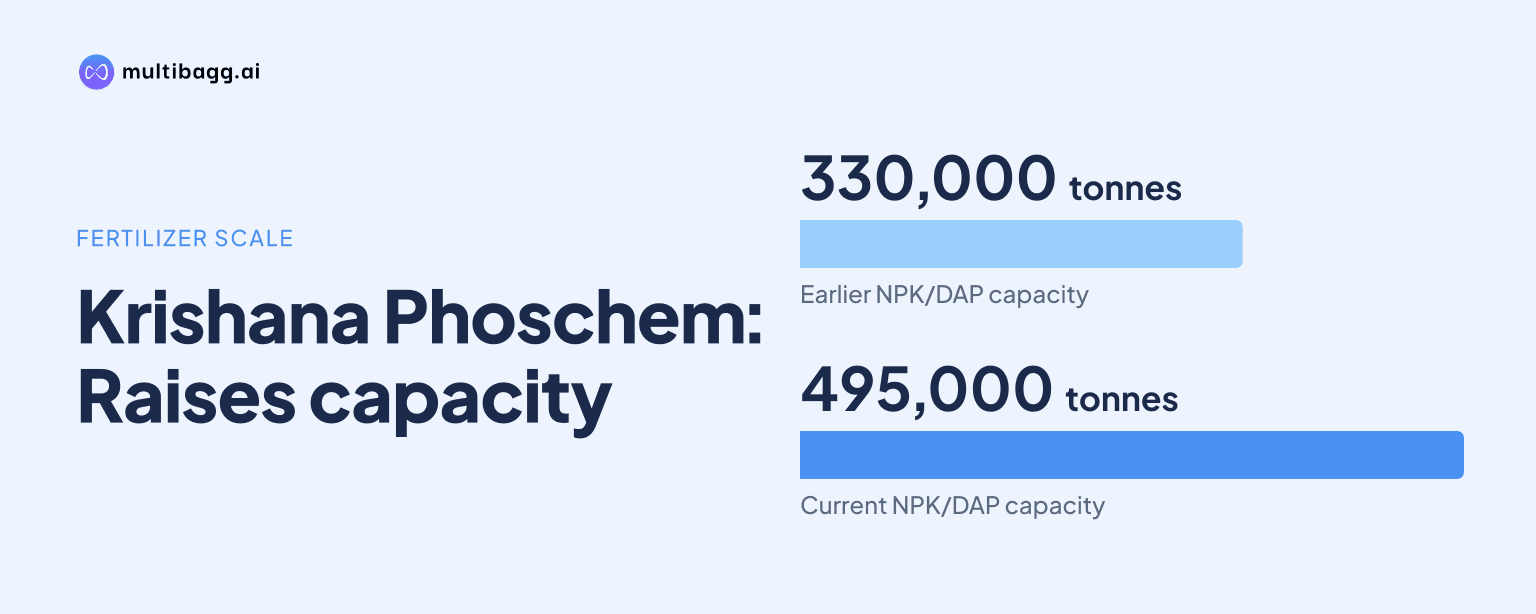
Krishana Phoschem Limited (KPL) has raised commissioned NPK/DAP capacity by 50% to 495,000 tonnes, adding 165,000 tonnes in its 2026 expansion plan. The presentation also lists 70,000 tonnes of green ammonia annually secured through the Solar Energy Corporation of India for 10 years, linking the additional fertilizer capacity with a disclosed input-supply arrangement.
Know Krishana Phoschem inside out
Results, valuation, peers and who's buying, in one view.
How much NPK/DAP capacity has KPL added?
KPL has added 165,000 tonnes of NPK/DAP capacity, taking commissioned capacity from 330,000 tonnes to 495,000 tonnes, a 50% increase. The presentation describes the larger NPK/DAP base as an expansion of KPL’s higher-value fertilizer portfolio and lists the addition among its 2026 milestones.
The 495,000-tonne figure follows the 2023 commissioning of 330,000 tonnes of NPK/DAP capacity from plants acquired from Spain. KPL’s 2026 timeline then records the further 165,000-tonne NPK/DAP expansion. The presentation does not provide a separate commissioning date within 2026 or a utilisation rate for the added line.
KPL’s total fertilizer capacity is shown as 615,000 tonnes, comprising 495,000 tonnes of NPK/DAP and 120,000 tonnes of SSP. This means the disclosed growth is concentrated in NPK/DAP rather than SSP, whose 120,000-tonne capacity was added in 2013 according to the company’s operating-history timeline.
Management said in its H1 FY27 commentary that SSP was operating at peak capacity utilisation while manufactured NPK retained significant headroom to scale. That stated capacity position explains why KPL is prioritising additional manufactured NPK volumes after the 165,000-tonne expansion rather than identifying further SSP capacity in the 2026 milestones.
What intermediate capacities support KPL’s fertilizer expansion?
KPL’s sulphuric acid capacity rises from 264,000 tonnes to 363,000 tonnes, while phosphoric acid capacity remains 99,000 tonnes and beneficiation of rock phosphate, or BRP, crushing capacity remains 200,000 tonnes. The presentation labels the change across these intermediate facilities as 38% growth.
The 99,000-tonne sulphuric acid addition is listed in KPL’s 2026 milestones. It follows a 165,000-tonne captive sulphuric acid plant commissioned in 2023 and a 99,000-tonne sulphuric acid plant shown as commissioned in 2017, producing the reported 363,000-tonne capacity.
KPL operates NPK and SSP manufacturing along with BRP crushing, sulphuric acid and phosphoric acid facilities at Meghnagar, Madhya Pradesh. The company says this integrated structure is intended to improve raw-material security, cost competitiveness and operational resilience, while its Bharat brand covers NPK/DAP complex fertilizers and Annadata covers SSP.
The intermediate additions are smaller than the 165,000-tonne NPK/DAP increase: sulphuric acid expands by 99,000 tonnes, while BRP crushing and phosphoric acid stay at 200,000 tonnes and 99,000 tonnes respectively. The presentation does not disclose how much of each intermediate capacity will be used for the enlarged NPK/DAP operation.
Got a follow-up? Ask IRIS
What does KPL’s green-ammonia arrangement provide?
KPL’s presentation says 70,000 tonnes of green ammonia will be secured annually for 10 years through the Solar Energy Corporation of India, or SECI. The company lists this arrangement in its 2026 timeline, while describing the agreement on another page as a Green Ammonia Purchase Agreement signed by Ostwal Group of Industries under the Government of India’s National Green Hydrogen Mission.
The presentation says the arrangement provides priority availability of green ammonia and claims a procurement cost advantage of more than 30%. It does not disclose the price benchmark, pricing formula, delivery schedule, start date or total contractual value, so the claimed advantage is a management presentation statement rather than a calculation that can be independently tested from the disclosed material.
KPL describes the transaction as India’s largest green-ammonia supply deal and says it would make Ostwal Group of Industries the country’s largest future consumer of green ammonia. These are company characterisations; the presentation provides the 70,000-tonne annual volume and 10-year term, but no market-wide supply comparison supporting the ranking.
Ammonia is one of the inputs management discussed in H1 FY27, alongside sulphur, phosphoric acid and rock phosphate. Management said ammonia prices softened slightly during H1 FY27, while sulphur and phosphoric acid prices were elevated and rock phosphate prices were broadly stable, placing the planned supply arrangement alongside a mixed input-cost environment.
How will KPL use the enlarged manufacturing base?
KPL says it will prioritise the ramp-up of newly commissioned capacities, expansion into high-potential geographies and deeper distribution penetration after H1 FY27. The company supports this plan with more than 3,000 wholesalers and dealers, over 40,000 retailers and operations across 14 states.
KPL markets NPK/DAP complexes through Bharat and SSP through Annadata, while the presentation identifies a 10% nationwide SSP market share. It also reports a 6% SSP share in Madhya Pradesh and a 16% SSP share in Chhattisgarh, providing the disclosed SSP market base alongside the effort to scale manufactured NPK volumes.
Management also said KPL would continue NPK trading activities to pursue market opportunities, strengthen channel relationships and increase market share while expanding manufactured NPK. The presentation separately says new plants were stabilised and reached optimal capacity utilisation during 2024-25, but it does not quantify the utilisation achieved by NPK/DAP facilities in H1 FY27.
The financial backdrop was H1 FY27 revenue of Rs 1,235 crore, up 23% year on year, earnings before interest, tax, depreciation and amortisation of Rs 216 crore, up 56%, and profit after tax of Rs 125 crore, up 96%. In Q2 FY27, revenue was Rs 703 crore, compared with Rs 608 crore in Q2 FY26, while profit after tax rose to Rs 78 crore from Rs 33 crore.
Conclusion
KPL’s disclosed 2026 manufacturing step adds 165,000 tonnes of NPK/DAP capacity and brings the total to 495,000 tonnes, while total fertilizer capacity reaches 615,000 tonnes and sulphuric acid capacity reaches 363,000 tonnes. The 70,000-tonne annual green-ammonia arrangement adds a planned 10-year supply mechanism alongside KPL’s existing BRP, phosphoric acid and sulphuric acid integration.
The next disclosed execution points are the ramp-up of newly commissioned capacity, expansion into high-potential geographies and deeper distribution penetration, all identified by management in H1 FY27. Supply timing, pricing terms and the calculation behind the claimed more-than-30% green-ammonia procurement advantage remain unspecified in the presentation, making those details important unresolved matters to watch.