










Krishana Phoschem H1 profit rises 96% as volumes fall
Key highlights
- Krishana Phoschem reported H1FY27 revenue of Rs 1,235 crore, up 23% year on year.
- Krishana Phoschem’s H1FY27 EBITDA rose 56% to Rs 216 crore and PAT rose 96% to Rs 125 crore.
- Krishana Phoschem’s H1FY27 SSP sales fell 15% to 64,098 tonnes and NPK sales fell 22% to 106,685 tonnes.
- Krishana Phoschem’s Q2FY27 EBITDA margin reached 18%, compared with 12% in Q2FY26.
powered by IRIS
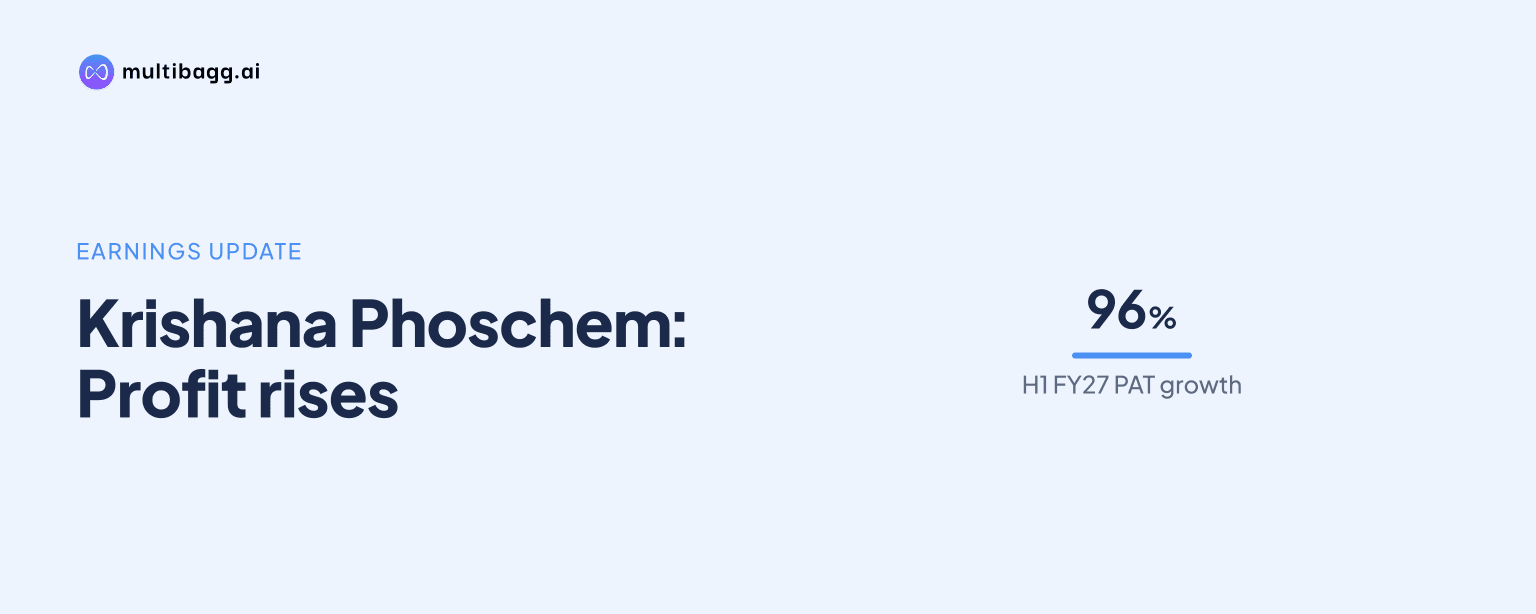
Krishana Phoschem Limited lifted H1FY27 profit after tax by 96% year on year to Rs 125 crore even as Single Super Phosphate sales fell 15% and NPK sales fell 22%, while revenue increased 23% to Rs 1,235 crore. Management attributed the record half-year figures to execution, operating efficiency and integrated manufacturing assets.
Know Krishana Phoschem inside out
Results, valuation, peers and who's buying, in one view.
How did Krishana Phoschem perform in H1FY27?
Krishana Phoschem reported record H1FY27 revenue, earnings before interest, tax, depreciation and amortisation (EBITDA), and profit after tax (PAT). Revenue rose to Rs 1,235 crore from Rs 1,003 crore in H1FY26, EBITDA increased to Rs 216 crore from Rs 139 crore, and PAT reached Rs 125 crore from Rs 64 crore. Earnings per share also rose 96% to Rs 4.04 from Rs 2.06.
Profit grew faster than revenue in H1FY27. Revenue rose 23% year on year, compared with EBITDA growth of 56% and PAT growth of 96%. Chairman M.K. Ostwal said the result was delivered amid geopolitical tensions in West Asia, supply-chain disruptions, volatile raw-material prices and uneven monsoon distribution, and reflected disciplined execution, operational efficiency and the integrated asset base.
Why did Krishana Phoschem’s earnings rise while sales volumes declined?
Krishana Phoschem’s presentation shows that earnings rose despite lower reported fertiliser sales tonnage, but it does not provide a numerical bridge for prices, product mix, trading or costs. Single Super Phosphate (SSP) sales declined to 64,098 tonnes in H1FY27 from 75,369 tonnes in H1FY26, a 15% fall. NPK sales declined 22% to 106,685 tonnes from 137,081 tonnes.
The difference between volumes and financial results was substantial: H1FY27 revenue increased by Rs 232 crore while SSP sales decreased by 11,271 tonnes and NPK sales decreased by 30,396 tonnes. Krishana Phoschem’s EBITDA increased by Rs 77 crore and PAT by Rs 61 crore across the same comparison. The disclosed figures therefore show that the two volume measures were not the sole determinant of first-half earnings.
Management cited operational efficiency and integrated manufacturing assets, while also highlighting mixed input-cost movements in H1FY27. According to the chairman, sulphur and phosphoric-acid prices remained elevated, ammonia prices softened slightly and rock-phosphate prices were broadly stable. Krishana Phoschem also said it continued NPK trading to capture market opportunities, strengthen channel relationships and enhance market share alongside manufacturing operations.
What did Krishana Phoschem report for Q2FY27?
Krishana Phoschem reported Q2FY27 revenue of Rs 703 crore, EBITDA excluding other income of Rs 127 crore and PAT of Rs 78 crore. Revenue was 16% above Rs 608 crore in Q2FY26 and 32% above Rs 532 crore in Q1FY27. EBITDA rose 74% year on year from Rs 73 crore and 43% sequentially from Rs 89 crore.
Q2FY27 PAT increased 135% from Rs 33 crore in Q2FY26 and 65% from Rs 47 crore in Q1FY27. EBITDA margin reached 18%, compared with 12% a year earlier and 17% in the preceding quarter. PAT margin was 11%, against 6% in Q2FY26 and 9% in Q1FY27.
The quarter supplied Rs 703 crore of the Rs 1,235 crore reported for H1FY27, while its Rs 78 crore PAT accounted for Rs 125 crore of first-half PAT. This comparison follows Q1FY27 revenue of Rs 532 crore and PAT of Rs 47 crore. The presentation does not disclose quarterly sales volumes, selling prices or segment profitability to explain the sequential change.
Got a follow-up? Ask IRIS
How fully did Krishana Phoschem use its fertiliser capacity in Q2FY27?
Krishana Phoschem’s SSP output was 30,763 tonnes in Q2FY27, equal to 103% utilisation of its 120,000-metric-tonnes-per-annum (MTPA) installed capacity. This was below 111% utilisation on output of 33,163 tonnes in Q2FY26, but above Q1FY27 utilisation of 121% on output of 36,232 tonnes.
NPK and diammonium phosphate (DAP) output was 61,396 tonnes in Q2FY27, equal to 50% utilisation of 495,000 MTPA installed capacity. That output was close to 62,620 tonnes in Q2FY26, but utilisation declined from 76% because the installed base had expanded. Q1FY27 NPK/DAP output was 53,515 tonnes, at 43% utilisation.
The integrated assets ran at lower utilisation year on year in Q2FY27. Beneficiation of rock phosphate (BRP) crushing operated at 77%, compared with 78% in Q2FY26; sulphuric-acid utilisation was 50%, down from 71%; and phosphoric-acid utilisation was 59%, compared with 67%. The respective installed capacities were 200,000 MTPA, 363,000 MTPA and 99,000 MTPA.
What expansion plans and operating factors did Krishana Phoschem disclose?
Krishana Phoschem added 165,000 MTPA of NPK/DAP capacity and 99,000 MTPA of sulphuric-acid capacity from 31 March 2026, taking NPK/DAP capacity to 495,000 MTPA and sulphuric-acid capacity to 363,000 MTPA. Management said SSP was at peak capacity utilisation while manufactured NPK had significant scope to scale, making the Q2FY27 50% NPK/DAP utilisation a disclosed operational focus.
Management said its next growth phase would prioritise ramping up newly commissioned capacity, expanding into high-potential geographies and increasing distribution penetration. Krishana Phoschem has more than 3,000 wholesalers and 40,000 retailers across 14 states, according to the presentation. Its stated NPK trading activity is intended to complement manufacturing and support channel relationships.
In 2026, Krishana Phoschem said it secured 70,000 tonnes of green ammonia annually for 10 years through a purchase agreement with the Solar Energy Corporation of India. The presentation characterises this as part of the Government of India’s National Green Hydrogen Mission. No financial terms, start date for deliveries or effect on input costs were disclosed.
What policy and market conditions did Krishana Phoschem identify?
Krishana Phoschem identified domestic demand, imports and nutrient use as relevant industry conditions. Its presentation states that imports account for 42% of NPK plus DAP sales, compared with 58% supplied domestically. It also cites India’s 2024-25 nitrogen, phosphorus and potassium consumption ratio of about 9.3:3.5:1, against a recommended ratio of about 4:2:1.
The chairman also pointed to the Government of India’s approval of Rs 62,370 crore under the Nutrient Based Subsidy scheme for the Rabi 2026-27 season. He said further moderation in raw-material prices could support complex-fertiliser consumption in coming quarters. That comment followed H1FY27 conditions in which sulphur and phosphoric-acid prices were elevated, while ammonia prices softened slightly.
Conclusion
Krishana Phoschem’s H1FY27 figures show revenue rising 23%, EBITDA rising 56% and PAT rising 96% even as its disclosed SSP and NPK sales volumes declined. The contrast points to the importance of the company’s integrated assets, cost and operational execution, and trading activity, although the presentation does not quantify the contribution of each factor.
The next disclosures to watch are the ramp-up of 165,000 MTPA of added NPK/DAP capacity and 99,000 MTPA of added sulphuric-acid capacity from 31 March 2026, as well as NPK/DAP utilisation after Q2FY27’s 50%. Management’s stated plans for geographic and distribution expansion, input-price movement, and the 70,000-tonne annual green-ammonia arrangement for 10 years are additional operating factors to monitor.