










Krishana Phoschem Q2 FY27 Call Transcript Filed With ₹78 Crore PAT
Key highlights
- Krishana Phoschem Limited filed its Q2 and H1 FY27 earnings-call transcript on November 23, 2026, after the November 18 call.
- Q2 FY27 revenue from operations rose 16% year-on-year to ₹703 crore.
- Q2 FY27 EBITDA increased 74% year-on-year to ₹127 crore and the EBITDA margin reached 18%.
- Q2 FY27 PAT rose 135% year-on-year to ₹78 crore, while H1 FY27 PAT was ₹125 crore.
powered by IRIS
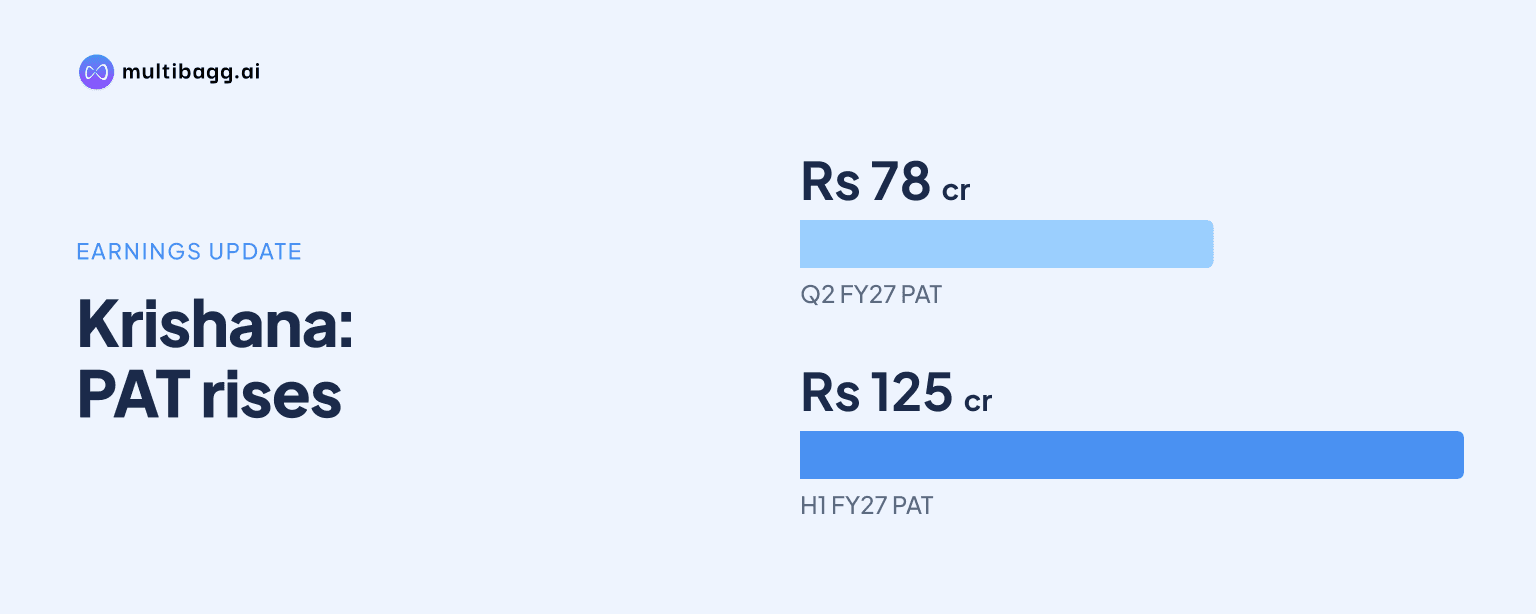
Krishana Phoschem Limited filed the transcript of its Q2 and H1 FY27 earnings call on November 23, 2026, documenting Q2 FY27 profit after tax of ₹78 crore. The call, held on November 18, reported revenue from operations of ₹703 crore, EBITDA of ₹127 crore and an EBITDA margin of 18% for the quarter.
Know Krishana Phoschem inside out
Results, valuation, peers and who's buying, in one view.
What did Krishana Phoschem file with the exchange?
Krishana Phoschem filed the official transcript of its Q2 and H1 FY27 earnings conference call, providing investors with the management discussion around the company’s reported financial performance. The filing was made on November 23, five days after the earnings call held on November 18, 2026.
The transcript relates to the company’s second-quarter and first-half performance for FY27. Its release places the figures and management commentary in the public domain through an exchange filing. The filing itself is a disclosure of the call record and should be read alongside the company’s financial results and other statutory announcements.
The disclosed Q2 figures show higher revenue and a sharper rise in operating and net profitability compared with the corresponding quarter of the previous year. Krishana Phoschem also reported that its H1 FY27 performance was its highest half-yearly financial performance, according to the call summary.
What were Krishana Phoschem’s Q2 FY27 financial results?
Krishana Phoschem reported Q2 FY27 revenue from operations of ₹703 crore, up 16% year-on-year, while PAT increased 135% year-on-year to ₹78 crore. EBITDA rose 74% year-on-year to ₹127 crore, lifting the operating margin to 18%.
The growth in EBITDA was faster than the increase in revenue, which explains the improvement in the company’s reported profitability for the quarter. Earnings per share stood at ₹2.52 in Q2 FY27. For the first half of FY27, the disclosed PAT figure was ₹125 crore.
The filing and related call summary present the quarter as a period of improved margins as well as revenue growth. However, the provided disclosure does not give a full line-by-line reconciliation of the factors behind the change in profit.
Why did EBITDA margin improve in Q2 FY27?
Krishana Phoschem’s EBITDA margin improved to 18% in Q2 FY27 from 12% in the corresponding earlier period, with call summaries associating the increase with one-time Nutrient Based Subsidy, or NBS, policy benefits and capacity expansion. The company reported the resulting EBITDA at ₹127 crore.
The NBS framework is relevant to fertiliser-sector economics because subsidy policy can influence product realisations and working capital conditions. In this case, the disclosed comparison indicates that margin improvement was materially stronger than revenue growth during the quarter.
The available context does not quantify the individual contribution of policy benefits, capacity utilisation or production growth to EBITDA. Investors therefore have a reported margin outcome and broad management context, but not a detailed split of the gain between operational and policy-related factors.
Got a follow-up? Ask IRIS
What guidance and demand commentary did management provide?
Krishana Phoschem retained its FY27 revenue guidance of ₹3,150 crore to ₹3,200 crore. Retaining the target after the Q2 and H1 FY27 discussion gives investors a stated reference point for assessing the company’s remaining performance during the financial year.
Management commentary in the transcript also addressed fertiliser demand and inventory conditions. The company indicated that inventories may vary in the short term, while maintaining that long-term demand for fertiliser in India remains supported. The call summary referred to Rabi-season demand visibility, higher minimum support prices and subsidy support.
For customers and industry participants, these comments matter because fertiliser sales are influenced by seasonal farm demand, subsidy administration and channel inventory. The filing does not provide a revised volume target, a product-wise sales outlook or a new capital-expenditure commitment.
How does the filing matter to investors and the fertiliser sector?
Krishana Phoschem’s filing matters to investors because it formally records management’s discussion of a quarter in which PAT rose faster than revenue. Revenue increased 16% to ₹703 crore, while PAT rose 135% to ₹78 crore and EBITDA margin reached 18%.
The difference between revenue growth and profit growth makes margin sustainability a central point for evaluating the results. The disclosed context identifies one-time NBS policy benefits as a factor in the margin improvement, meaning investors may distinguish between underlying operational performance and policy-linked gains when reviewing future quarters.
The retained FY27 revenue guidance is also relevant for tracking execution. No share-price movement, analyst estimate or further financial target was included in the provided filing material, so the disclosure does not establish a market valuation impact or a revised earnings outlook beyond the stated revenue range.
Conclusion
The November 23 filing gives the market an official transcript of Krishana Phoschem’s Q2 and H1 FY27 earnings call. Its key disclosed figures were Q2 revenue of ₹703 crore, EBITDA of ₹127 crore, an 18% EBITDA margin and PAT of ₹78 crore, with profitability growing faster than sales.
The next disclosed milestone is progress toward the retained FY27 revenue guidance of ₹3,150 crore to ₹3,200 crore. Investors can also monitor whether the 18% EBITDA margin is sustained, particularly given management’s reference to policy-related benefits and changing short-term inventory conditions.