










Krishana Phoschem says H1 18% margin boost was one-off
Key highlights
- H1 FY27 EBITDA rose 56% year on year to Rs 216 crore, while EBITDA margin increased to 18% from 14%.
- Krishana Phoschem said the 18% H1 FY27 margin included a one-time NBS valuation benefit and guided normal margins of 12%-13%.
- The Rabi 2026-27 NBS allocation was about Rs 62,370 crore, compared with Rs 37,952 crore in the previous Rabi season.
- H1 FY27 fertilizer production was 181,906 metric tonnes and sales were 170,783 metric tonnes.
powered by IRIS
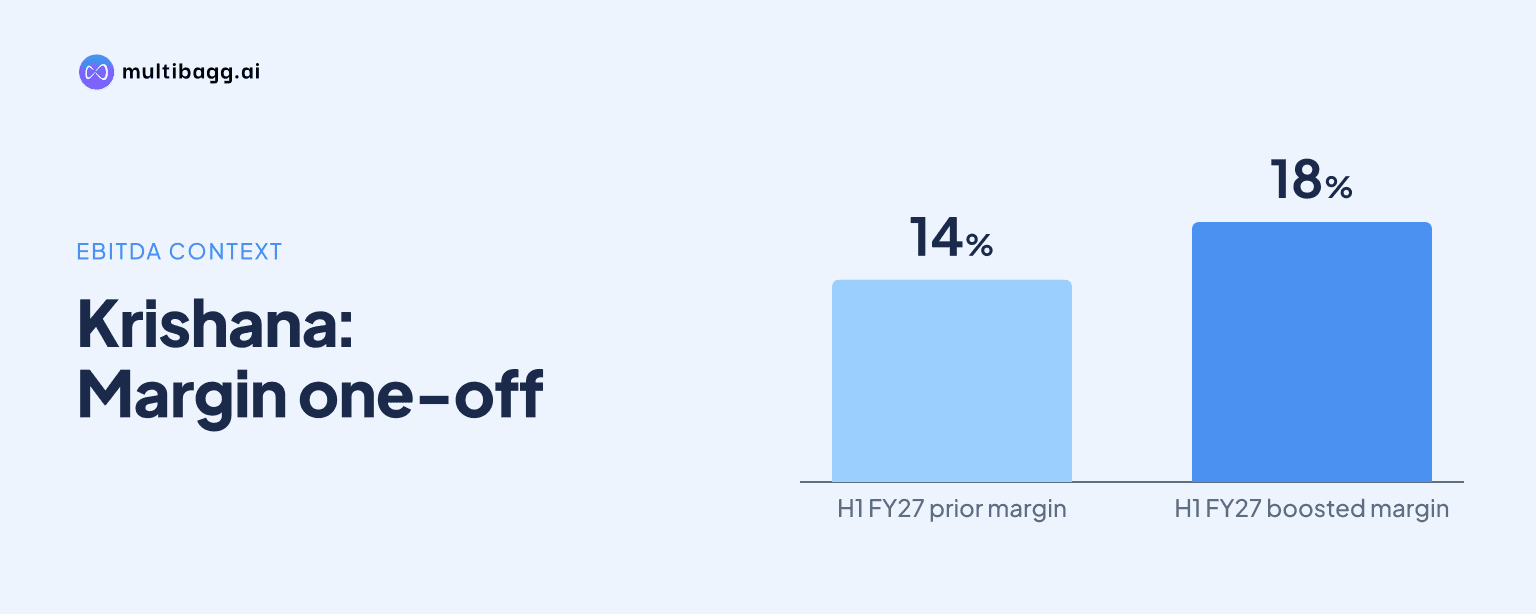
Krishana Phoschem Limited said its H1 FY27 earnings before interest, tax, depreciation and amortisation (EBITDA) margin of 18% was lifted principally by a one-time Nutrient-Based Subsidy valuation benefit, while management expects normal EBITDA margins of 12%-13%. H1 EBITDA rose 56% year on year to Rs 216 crore, against 23% growth in revenue from operations to Rs 1,235 crore.
Know Krishana Phoschem inside out
Results, valuation, peers and who's buying, in one view.
Why did Krishana Phoschem report an 18% EBITDA margin in H1 FY27?
Krishana Phoschem reported an 18% EBITDA margin mainly because Nutrient-Based Subsidy, or NBS, rates announced by the Government of India raised the valuation benefit applicable during H1 FY27. Group Financial Advisor Pukhraj Kanther described the benefit on the November 18, 2026 earnings call as a one-time variation, rather than evidence that the company’s recurring profitability range had permanently changed.
The gap between sales growth and operating-profit growth illustrates the effect. H1 FY27 revenue from operations increased 23% year on year to Rs 1,235 crore, while EBITDA increased 56% to Rs 216 crore and the margin rose from 14% in H1 FY26 to 18%. Profit after tax increased 96% to Rs 125 crore, and earnings per share for the half year were Rs 4.04.
Krishana Phoschem did not quantify the respective contribution of higher subsidy rates, production growth and cost control to the EBITDA increase. Asked for a split, Kanther said this would require detailed analysis and that the company could attempt to provide a response in writing, leaving the precise mix of drivers undisclosed in the call.
What EBITDA margin does Krishana Phoschem expect after the subsidy effect?
Krishana Phoschem expects its average EBITDA margin to return to 12%-13% after the unusual subsidy-related uplift in H1 FY27. Kanther gave this range twice, including when discussing sulphuric-acid operations, and said the company had broadly maintained margins around 12%-13% when assessed over longer periods such as three-year intervals.
That range is 5 to 6 percentage points below the 18% reported in both Q2 and H1 FY27. In Q2 FY27, EBITDA increased 74% year on year to Rs 127 crore, while revenue from operations rose 16% to Rs 703 crore. The Q2 margin improved from 12% in Q2 FY26 to 18%, and profit after tax rose 135% to Rs 78 crore.
Management also identified continuing cost variables that could affect profitability. It said phosphoric acid and sulphur remained elevated globally, ammonia prices softened slightly and rock phosphate was broadly stable. Tensions in West Asia and transit uncertainty around the Strait of Hormuz also increased freight and insurance costs, although management said higher subsidy rates helped offset higher sulphur, ammonia and other input costs.
How did subsidy policy change Krishana Phoschem’s fertilizer economics?
Krishana Phoschem said the higher NBS rates improved unit economics across the fertilizer value chain and were the main reason for the exceptionally high profits reported in H1 FY27. The Union Cabinet approved about Rs 62,370 crore under the NBS scheme for Rabi 2026-27, compared with Rs 37,952 crore in the previous Rabi season, a difference of Rs 24,418 crore.
The company also cited special support for domestic sulphur and sulphuric-acid manufacturers equivalent to 20% of actual procurement costs, subject to floor prices. Continued single super phosphate, or SSP, freight subsidy support for the Rabi season was another policy measure management identified. Krishana Phoschem said higher sulphur prices had increased phosphoric-acid costs, which the new subsidy regime addressed.
The first half nevertheless included selling pressure in complex fertilizers. Management said end-consumer prices for nitrogen, phosphorus and potassium, or NPK, fertilizers rose slightly because the subsidy offset had initially been inadequate. With the maximum retail price of diammonium phosphate, or DAP, fixed and urea availability good, farmers favoured DAP, while higher NPK prices made it harder for Krishana Phoschem to push NPK products into the market.
Got a follow-up? Ask IRIS
Can Krishana Phoschem meet its FY27 volume and turnover plans?
Krishana Phoschem expects Rabi demand and wholesaler purchases to support its targeted volumes despite existing inventories and farmers’ preference for DAP. H1 FY27 fertilizer production was 181,906 metric tonnes and sales were 170,783 metric tonnes. Management said the newly commissioned capacity had largely stabilised and that the second-half turnover should be better.
An analyst referred to earlier FY27 turnover guidance of 30%-35% growth, or about Rs 3,150 crore to Rs 3,200 crore. Management did not revise that range and said its sales team, marketing capabilities and network of wholesalers and traders should support the objective, despite DAP availability, higher NPK prices and market challenges.
Krishana Phoschem said it would maintain SSP utilisation above 100% for the full year, but put a reasonable NPK/DAP utilisation range at 70%-80%, depending on demand, sulphuric-acid prices and other conditions. It reported SSP utilisation of 103% in Q2 FY27 and 121% in H1 FY27, partly because it introduced SSP Boron and SSP Urea alongside SSP. No SSP capacity expansion is planned.
How much of Krishana Phoschem’s revenue came from trading?
Krishana Phoschem said Q2 FY27 revenue of Rs 703 crore included sales of imported finished NPK fertilizers through trading operations, rather than only manufactured products. The company manufactures its 20:20:0:13 NPK grade, while it imported other grades during H1 FY27 to develop markets before expanded manufacturing capacity is used more fully.
Management said importing multiple NPK grades is intended to establish demand and create a ready market for expanded capacity. Its stated plan is to scale manufactured NPK production while using trading opportunities to meet demand and broaden product availability. The call did not disclose the rupee value or percentage of H1 or Q2 revenue represented by imported-product trading.
Short-term borrowings increased during H1 FY27 because imports rose and turnover approached Rs 1,200 crore, according to management. Kanther said substantial imports in the latter part of the half year increased current-asset requirements and cited current assets of Rs 1,700 crore. Management said borrowings were supported by corresponding assets, but did not disclose borrowings, inventory or receivables balances in the transcript.
Conclusion
Krishana Phoschem’s H1 FY27 performance separates reported profitability from management’s stated recurring margin expectation. EBITDA of Rs 216 crore and an 18% margin reflected the higher NBS-related valuation benefit, while management identified 12%-13% as its normal average EBITDA margin range over longer periods.
The next focus is the Rabi season and the company’s plan to improve production from newly commissioned capacity. Investors can watch whether the Rs 62,370 crore Rabi 2026-27 NBS allocation, targeted 70%-80% NPK/DAP utilisation and SSP utilisation above 100% support the previously discussed FY27 turnover objective of about Rs 3,150 crore to Rs 3,200 crore.