










Krishana Phoschem says H1 18% margin is exceptional
Key highlights
- Krishana Phoschem reported H1 FY27 EBITDA of Rs 216 crore, up 56%, with margin at 18% versus 14%.
- Krishana Phoschem said the H1 FY27 margin uplift was mainly due to NBS valuation and expects 12%-13% average EBITDA margin.
- Krishana Phoschem reported H1 FY27 profit after tax of Rs 125 crore, up 96%, on revenue of Rs 1,235 crore.
- Krishana Phoschem produced 1,81,906 metric tonnes and sold 1,70,783 metric tonnes of fertiliser in H1 FY27.
powered by IRIS
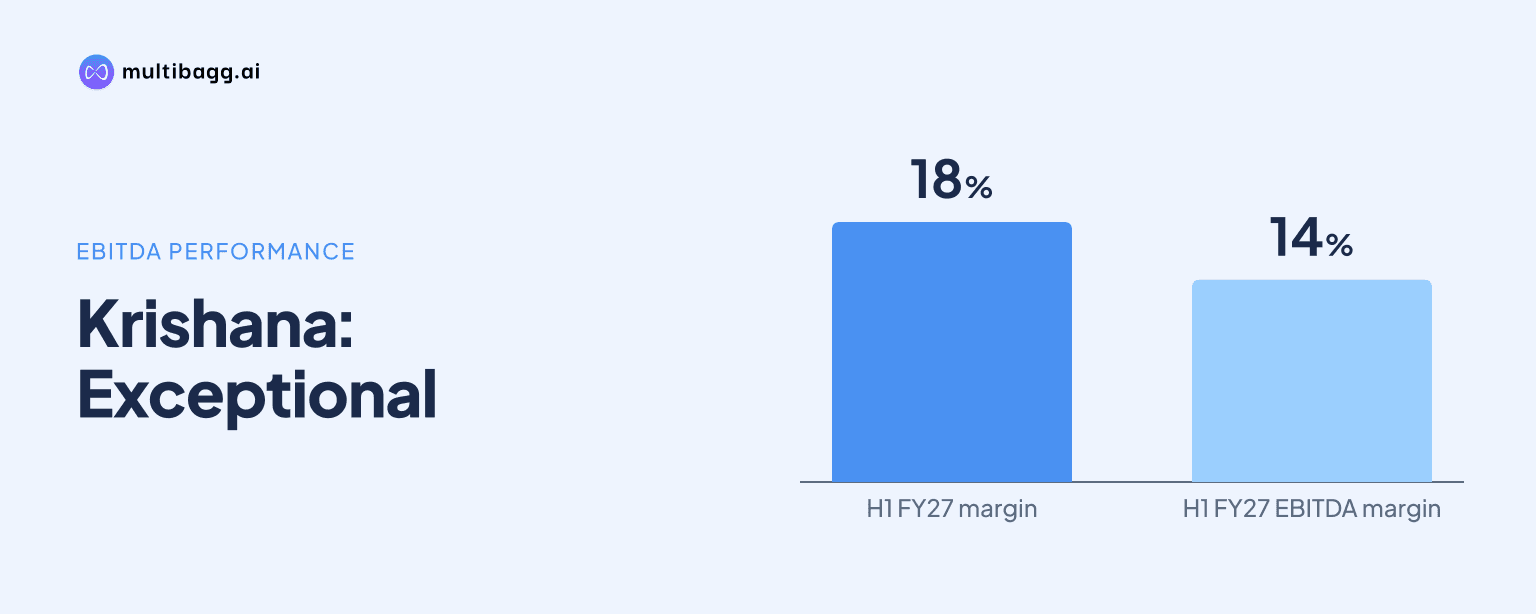
Krishana Phoschem Limited said its H1 FY27 EBITDA margin of 18% was an exceptional, subsidy-driven outcome rather than a new baseline, after EBITDA rose 56% year on year to Rs 216 crore. Management attributed the uplift principally to Nutrient-Based Subsidy valuations and said its normal average EBITDA margin is 12%-13%.
Know Krishana Phoschem inside out
Results, valuation, peers and who's buying, in one view.
Why did Krishana Phoschem's H1 FY27 EBITDA margin reach 18%?
Krishana Phoschem said the 18% EBITDA margin in H1 FY27 primarily reflected Nutrient-Based Subsidy, or NBS, rates announced by the Government of India and applicable during the period. Management said the increased valuation benefit lifted EBITDA and described it as a one-time variation, rather than a recurring operating-margin level.
The profit increase outpaced revenue growth in H1 FY27. Revenue from operations increased 23% year on year to Rs 1,235 crore, while EBITDA rose 56% to Rs 216 crore and profit after tax rose 96% to an all-time high of Rs 125 crore. The difference between the 23% sales increase and the 56% EBITDA increase is consistent with management's explanation that subsidy valuation was a material earnings driver.
Krishana Phoschem did not quantify the separate contributions from higher subsidy rates, production growth and expense control to H1 FY27 EBITDA. Management said a detailed analysis would be needed to make that split and indicated it could respond separately in writing, leaving the exact contribution from each factor unresolved.
Is Krishana Phoschem guiding EBITDA margin back to 12%-13%?
Yes, Krishana Phoschem said its normal EBITDA margin should be 12%-13% and that it expects to maintain average margin in that range. Management also said that, over periods such as three-year intervals, EBITDA margins have broadly been around 12%-13%, rather than the H1 FY27 level of 18%.
Q2 FY27 showed the same pattern as the half year. Revenue from operations rose 16% year on year to Rs 703 crore, but EBITDA rose 74% to Rs 127 crore, lifting the quarterly margin to 18% from 12% in Q2 FY26. Profit after tax increased 135% to Rs 78 crore and earnings per share stood at Rs 2.52.
Management linked the higher NBS rates to offsetting increases in sulphur, ammonia and other input costs. It said the revised subsidy regime included compensation for higher sulphur prices, while cautioning that raw-material trends and geopolitical developments remain factors in the operating environment.
How did volumes and trading affect Krishana Phoschem's H1 FY27 results?
Krishana Phoschem produced 1,81,906 metric tonnes of fertiliser and sold 1,70,783 metric tonnes in H1 FY27. Production therefore exceeded reported sales by 11,123 metric tonnes during the half year, as management also referred to inventories in the market and expected to achieve its targeted Rabi volumes.
The Rs 703 crore revenue reported for Q2 FY27 included trading sales of imported finished nitrogen-phosphorus-potassium, or NPK, fertilisers. Krishana Phoschem said it manufactures its 20:20:0:13 NPK grade, while importing other grades as a market-development measure before using its expanded capacity to serve those product categories.
Management said slightly higher end-consumer NPK and diammonium phosphate, or DAP, prices in the first half had created pressure in moving NPK products into the market. It attributed the increase to an inadequate subsidy offset at that point, but said it expected conditions to normalise in the second half and proposed to reduce costs to farmers.
Got a follow-up? Ask IRIS
What capacity utilisation does Krishana Phoschem expect in FY27?
Krishana Phoschem said it intends to maintain single super phosphate, or SSP, capacity utilisation at 100% for FY27, while aiming for 70%-80% utilisation in NPK and DAP. Management said NPK/DAP utilisation will depend on market demand, sulphuric-acid prices and other conditions, and confirmed that its NPK/DAP capacity expansion has already been implemented.
SSP utilisation was 103% in Q2 FY27 and 121% in H1 FY27, above the installed level. Management attributed this to introducing three products beyond standard SSP, including SSP Boron and SSP Urea, which it said have received a good market response. It said no SSP capacity expansion has been planned so far.
For sulphuric acid, Krishana Phoschem said it adjusts between in-house production and purchases of competitively priced by-product acid available from other Indian manufacturers. It reduces internal output when externally available acid is more competitive and raises production when that supply is unavailable, a mechanism management said is intended to manage costs amid high sulphur prices.
What could shape Krishana Phoschem's second-half FY27 outcome?
Krishana Phoschem expects Rabi demand to continue broadly along current lines, with wholesaler purchases supporting volume targets even when farmer offtake is relatively low in the last quarter. Management cited higher minimum support prices for crops including mustard and lentils, continued government support and the enhanced Rabi 2026-27 NBS outlay as factors that could support NPK consumption.
Management said its new capacity had largely stabilised and that its marketing network, sales team, wholesalers and traders could support the full-year turnover target of about Rs 3,150 crore to Rs 3,200 crore. That target reflected the 30%-35% turnover-growth guidance cited from Q1, although management also identified DAP availability, farmer preference for DAP and higher NPK prices as challenges.
Working-capital needs increased alongside imports and rising turnover. Management said current assets had reached an all-time high of Rs 1,700 crore and said short-term borrowings increased after substantial imports in the latter half of H1 FY27. It said the borrowings were backed by corresponding assets, while an investor's concern over inventory and receivables was not addressed with separate numerical balances in the discussion.
Conclusion
Krishana Phoschem's H1 FY27 results combined 23% revenue growth with EBITDA growth of 56% and profit-after-tax growth of 96%, but management directly tied the margin outperformance to the applicable NBS valuation. Its stated 12%-13% average EBITDA-margin range is therefore management's benchmark for assessing the 18% H1 FY27 result.
The next disclosures to watch are Rabi demand, the planned 70%-80% NPK/DAP utilisation range and management's aim to sustain 100% SSP utilisation after reporting 121% in H1 FY27. Progress toward the Rs 3,150 crore to Rs 3,200 crore turnover target will also depend on DAP availability, NPK pricing, raw-material costs and imported NPK trading sales.