










Krishana Phoschem targets 70%-80% NPK/DAP utilisation
Key highlights
- Krishana Phoschem targets 70%-80% utilisation for its expanded NPK/DAP capacity.
- Krishana Phoschem reported SSP utilisation of 121% in H1 and 103% in Q2.
- Krishana Phoschem has not planned an SSP capacity expansion so far.
- Krishana Phoschem reported Rs 703 crore of Q2 revenue, including imported NPK trading sales.
powered by IRIS
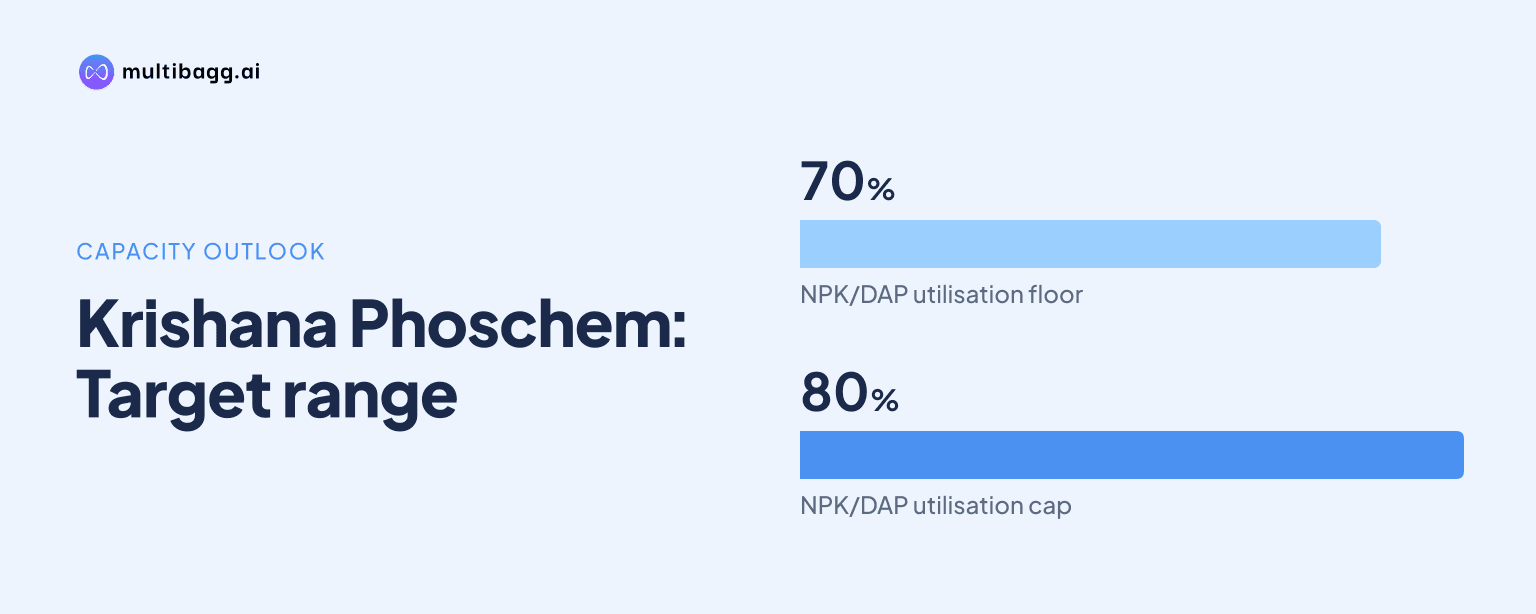
During the earnings call, Krishana Phoschem Limited said it will seek 70%-80% utilisation at its expanded NPK/DAP capacity while maintaining SSP utilisation above 100%, after SSP reached 121% in H1. It has not planned an SSP expansion so far, while management is evaluating other projects for future manufacturing growth.
Know Krishana Phoschem inside out
Results, valuation, peers and who's buying, in one view.
What utilisation does Krishana Phoschem target for NPK and DAP?
Krishana Phoschem targets 70%-80% utilisation for its NPK/DAP capacity, subject to market conditions, demand, sulphuric-acid prices and other factors. Management said the NPK/DAP expansion has already been implemented, making the immediate objective a production ramp-up from the newly expanded manufacturing base rather than another disclosed capacity addition.
The target differs from the SSP operating plan because the segments are at different stages of capacity use. Krishana Phoschem said it is operating SSP at more than 100% utilisation and expects to maintain that level for the full year, whereas NPK/DAP utilisation will remain dependent on commercial and input-cost conditions. Management did not disclose installed capacity volumes during the call, so the 70%-80% range is a utilisation objective, not a production-volume forecast.
The NPK/DAP ramp-up is also linked to Krishana Phoschem's product-market approach. The company manufactures its 20:20:0:13 NPK grade, while importing other grades where demand exists. Management said imports made during the first half help it develop demand and create a ready market for products that can be supplied from expanded capacity.
Why is Krishana Phoschem not expanding SSP capacity now?
Krishana Phoschem has no SSP expansion planned so far because the segment is already operating above 100% utilisation. Management confirmed its expectation of maintaining that level through the full year, placing the near-term focus on operating the existing SSP base rather than commissioning a new project.
Management attributed the above-nameplate utilisation partly to three product additions introduced in the previous year. Alongside standard SSP, Krishana Phoschem added SSP Boron and SSP Urea, which management said have received a good market response. SSP utilisation was 103% in Q2 and 121% in H1, meaning the reported first-half rate was higher than the Q2 rate.
The company did not portray H1 utilisation of 121% as a reason for a new SSP project. Instead, it identified the additional products as the mechanism supporting utilisation above 100%. Its disclosed manufacturing strategy gives priority to raising output from the completed NPK/DAP expansion while seeking to retain current SSP operating levels.
How do demand and trading affect Krishana Phoschem's NPK/DAP ramp-up?
Krishana Phoschem said NPK/DAP sales in the first half faced pressure from fixed DAP maximum retail pricing, adequate urea availability and higher NPK prices. Management said end-consumer NPK prices rose slightly because the Government of India subsidy offset was not adequate in the first half, though it expected the situation to normalise in the second half.
Management nevertheless said Rabi demand should continue on similar lines and that targeted volumes remain achievable despite market inventory. It described the last quarter as a lean period for farmers' offtake, but said wholesalers and retailers continue purchasing. Wholesaler demand, rather than only direct farmer offtake, is expected to support the company's volume targets.
Krishana Phoschem reported Q2 revenue of Rs 703 crore, but management clarified that the figure included imported finished NPK products sold through trading operations. The company imported multiple NPK grades during the first half while manufacturing 20:20:0:13. Therefore, Q2 revenue does not represent manufactured-fertiliser sales alone.
Management said overseas suppliers still serve around 35%-40% of India's complex-fertiliser market. It cited that import dependence as the basis for potential domestic NPK capacity growth. However, the 70%-80% utilisation objective is conditional rather than fixed, with demand, NPK pricing and sulphuric-acid costs all identified as variables.
Got a follow-up? Ask IRIS
What will drive Krishana Phoschem's next manufacturing expansion?
Krishana Phoschem said manufacturing will remain its primary growth driver, while management evaluates certain projects for the next phase. No project segment, investment amount or implementation timetable was disclosed. Management said a final proposal would be presented at the appropriate time after the evaluation is completed.
The company acknowledged that additional opportunities would require consideration as NPK/DAP facilities approach higher utilisation after FY27. Management said it has undertaken various expansion projects over the past 20 years and reviews further opportunities after completing a project. It also said it is evaluating diversification within its existing product portfolio and new areas.
Imports and trading are intended to complement manufacturing rather than become the principal growth engine. Krishana Phoschem said imported products are brought in when demand arises and act as a catalyst for reaching wider markets. The Rs 703 crore Q2 revenue therefore contained a trading component, but management said future growth would primarily depend on manufacturing.
Sulphuric-acid operations provide one cost-management mechanism for this plan. Management said it compares in-house production with sulphuric acid available as a by-product from other Indian manufacturers. It reduces own production when by-product acid is more competitive and increases production when that supply is unavailable.
How do subsidy rates and margins fit into the capacity plan?
Krishana Phoschem said higher Nutrient-Based Subsidy (NBS) rates were the main reason H1 EBITDA, or earnings before interest, tax, depreciation and amortisation, rose 56% to Rs 216 crore while revenue increased 23%. Management described the subsidy-related valuation benefit as a one-time variation and said its normal EBITDA margin is in the 12%-13% range.
Higher NBS rates helped offset increases in sulphur, ammonia and other input costs, management said. It did not quantify separately the earnings contribution from subsidy rates, higher production and expense control. The company said the subsidy rates announced by the government apply until March 2027.
For the second half, management expects EBITDA margin of around 13%, compared with the exceptional first-half result. This means the utilisation strategy is not presented as independent of fertilizer policy and raw-material economics: NPK/DAP output will be increased within the 70%-80% band only as market and cost conditions permit, while SSP is expected to remain above 100% utilisation.
Conclusion
Krishana Phoschem's disclosed capacity plan centres on extracting higher output from its completed NPK/DAP expansion while retaining above-100% SSP utilisation from its existing base. The 70%-80% NPK/DAP target is conditional on demand, pricing and sulphuric-acid costs, whereas SSP's full-year operating objective is above 100%, supported by SSP Boron and SSP Urea.
The next item to watch is the final proposal for projects management says it is evaluating, as no segment, capital cost or schedule has been disclosed. Investors can also track whether SSP sustains above-100% utilisation, whether NPK/DAP moves toward the 70%-80% range, and whether the NBS regime through March 2027 supports management's approximately 13% second-half EBITDA-margin expectation.