










Krishana Phoschem Uses Imports to Build NPK Markets Ahead of Ramp-Up
Key highlights
- Krishana Phoschem reported Rs 703 crore of Q2 FY27 revenue, including sales of imported NPK fertilisers.
- H1 FY27 revenue rose 23% year on year to Rs 1,235 crore, with fertiliser sales of 1,70,783 metric tonnes.
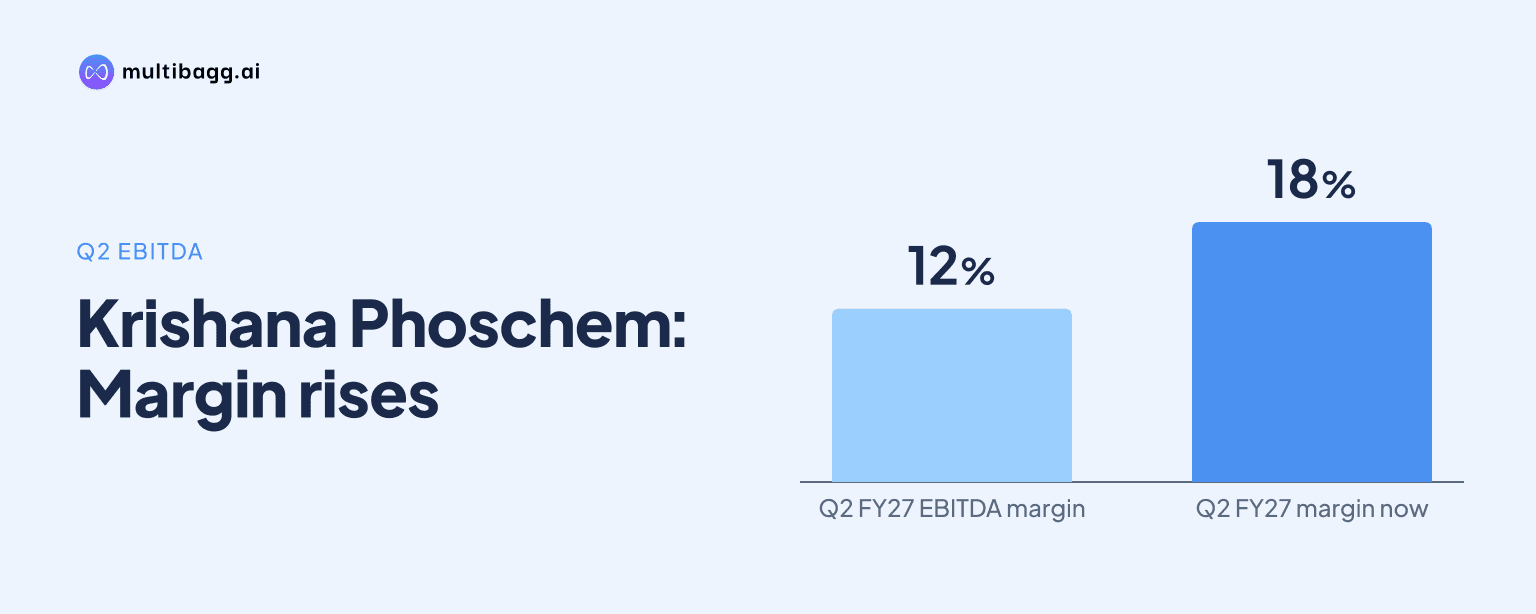
- Q2 FY27 EBITDA increased 74% year on year to Rs 127 crore, and EBITDA margin rose to 18% from 12%.
- Krishana Phoschem targets 70%-80% NPK/DAP utilisation and reported SSP utilisation above 100%.
powered by IRIS
Krishana Phoschem Limited said Q2 FY27 revenue of Rs 703 crore included sales of imported nitrogen, phosphorus and potassium, or NPK, fertiliser grades, a market-development step intended to establish demand before expanded domestic capacity is used more fully. Revenue rose 16% year on year, while management said the NPK/DAP facilities were largely stabilised.
Know Krishana Phoschem inside out
Results, valuation, peers and who's buying, in one view.
What did Krishana Phoschem's Rs 703 crore quarterly revenue include?
Krishana Phoschem's Rs 703 crore revenue in the second quarter, or Q2, of FY27 included both manufactured fertiliser sales and trading revenue from imported finished NPK products. Management confirmed on November 18, 2026 that the figure was not manufacturing revenue alone. It did not disclose the value or volume split between domestic production and imported NPK trading.
The mix means the 16% year-on-year increase in Q2 revenue cannot be attributed solely to higher in-house output. In the first half, or H1, of FY27, revenue from operations rose 23% year on year to Rs 1,235 crore, while fertiliser production totalled 1,81,906 metric tonnes and sales were 1,70,783 metric tonnes. Management said finished NPK products across several grades were imported during H1 FY27.
Why is Krishana Phoschem importing finished NPK fertilisers?
Krishana Phoschem is importing finished NPK fertilisers to supply grades for which it sees demand and to build a ready market for expanded domestic capacity. Management identified 20:20:0:13 as a popular grade it manufactures, while saying it imports other grades as part of market-development initiatives. The call did not quantify imported volumes or disclose which other grades were traded.
The strategy combines current availability with planned production growth. Management listed higher utilisation of newly commissioned capacity, wider product availability and deeper distribution as priorities for coming quarters. It also said overseas suppliers serve about 35%-40% of India's complex-fertiliser market, supporting its view that domestic NPK capacity has room to expand even as imported grades are used to establish customer demand.
Can Krishana Phoschem meet Rabi demand and raise capacity use?
Krishana Phoschem expects to achieve its targeted Rabi-season volumes despite existing inventories and pressure on NPK demand in H1 FY27. Management did not disclose a Rabi volume target, but said wholesalers and retailers continue to buy during the final quarter, even though farmers' offtake is relatively low in that lean period. It also said the company proposes to reduce costs to farmers in the second half.
Demand was affected by uneven monsoon conditions, DAP availability and higher NPK prices during the first half. The Union Cabinet approved about Rs 62,370 crore under the Nutrient Based Subsidy, or NBS, scheme for Rabi 2026-27, compared with Rs 37,952 crore in the previous Rabi season. Management said the higher outlay should improve affordability of balanced NPK grades. It plans to maintain 70%-80% utilisation in NPK/DAP, or diammonium phosphate, depending on demand and sulphuric-acid costs, while single super phosphate, or SSP, utilisation was above 100% with no SSP expansion planned.
Got a follow-up? Ask IRIS
What do earnings and working capital show about the strategy?
Krishana Phoschem reported faster growth in profit than revenue in Q2 and H1 FY27, with management attributing much of the increase to NBS-rate valuation benefits. Earnings before interest, tax, depreciation and amortisation, or EBITDA, margin reached 18% in both periods, compared with 12% in Q2 FY26 and 14% in H1 FY26. Management described the benefit as a one-time variation and said normal EBITDA margin would be about 12%-13%.
Short-term borrowings rose because imports and turnover increased current-asset requirements, management said. It cited turnover of nearly Rs 1,200 crore during the half year, substantial imports in the latter part of H1 FY27 and current assets of Rs 1,700 crore, but did not disclose the borrowing amount. Management retained its earlier FY27 turnover expectation of Rs 3,150 crore to Rs 3,200 crore, while identifying DAP availability, farmer preference for DAP and higher NPK prices as challenges.
Conclusion
Krishana Phoschem's imported NPK trading is a stated route to develop demand across grades while its expanded domestic facilities increase utilisation. The Rs 703 crore Q2 FY27 revenue therefore reflects manufactured fertiliser sales as well as trading sales of imported products, and the H1 FY27 margin improvement was also influenced by NBS-rate valuation benefits.
The next measures to watch are Rabi sales progress, NPK/DAP utilisation against management's 70%-80% range and delivery against the Rs 3,150 crore to Rs 3,200 crore FY27 turnover expectation. Management also expects EBITDA margin to average 12%-13% after the NBS-related variation, while input costs and DAP availability remain unresolved operating factors.