










La Tim H1 profit rose as operating cash used Rs 12.7 crore
Key highlights
- La Tim’s H1 FY27 profit after tax rose to Rs 7.1 crore from Rs 3.5 crore a year earlier.
- Revenue increased 62.7% to Rs 287.7 crore in H1 FY27, while EBITDA rose to Rs 14.3 crore from Rs 7.7 crore.
- Operating activities used Rs 12.7 crore of cash in H1 FY27, as inventories and receivables rose by a combined Rs 47.0 crore from FY26.
- Financing activities generated Rs 20.4 crore in H1 FY27, while the debt-equity ratio increased to 0.9 times from 0.6 times.
powered by IRIS
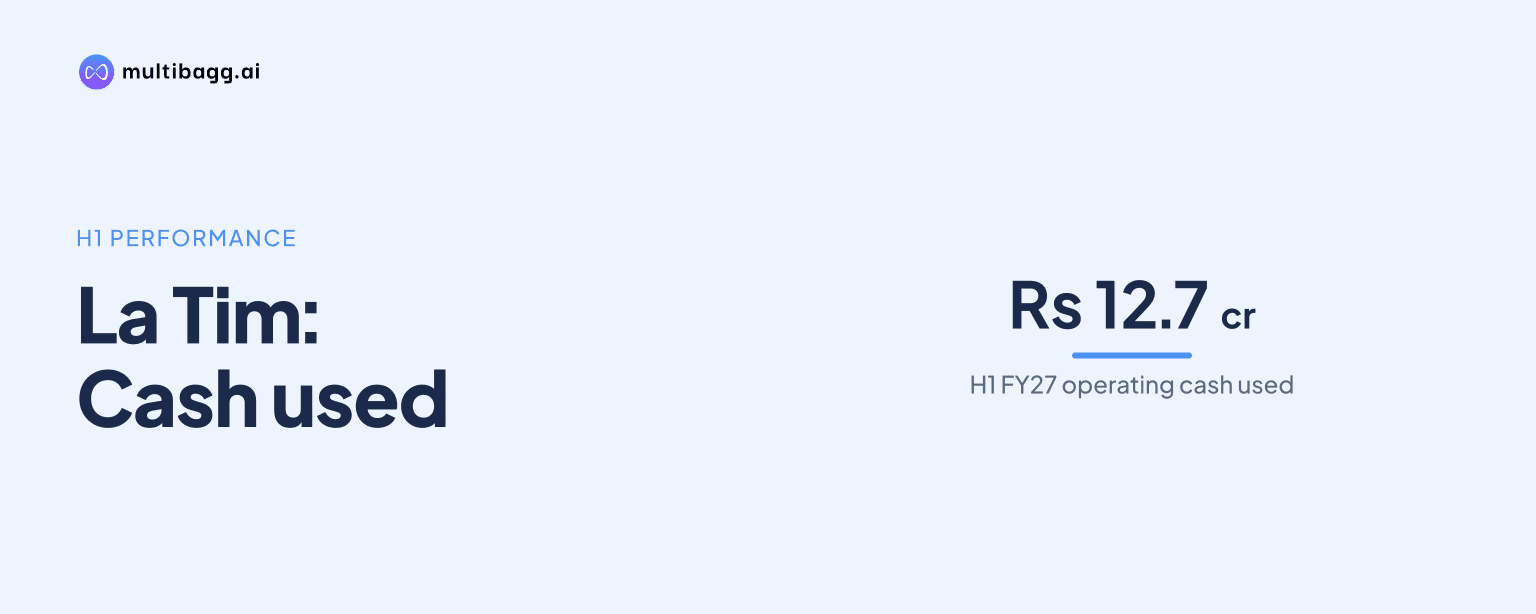
La Tim reported profit after tax of Rs 7.1 crore in H1 FY27, up from Rs 3.5 crore a year earlier, while net cash used in operating activities was Rs 12.7 crore. The contrast coincided with inventories rising to Rs 102.1 crore and trade receivables to Rs 65.4 crore at H1 FY27.
Know La Tim Metal & Industries inside out
Results, valuation, peers and who's buying, in one view.
Why did La Tim report an operating cash outflow in H1 FY27?
La Tim used Rs 12.7 crore in operating activities during H1 FY27, compared with cash generated from operations of Rs 0.9 crore in FY26 and an operating outflow of Rs 3.9 crore in FY25. The presentation does not provide a cash-flow bridge that allocates the H1 outflow between profit, working-capital movements, tax and other operating items. It does, however, show increases in working-capital balance-sheet accounts over FY26.
Inventories increased by Rs 10.1 crore to Rs 102.1 crore at H1 FY27 from Rs 92.0 crore at FY26. Trade receivables increased by Rs 36.9 crore to Rs 65.4 crore from Rs 28.5 crore. Together, those two balances rose by Rs 47.0 crore, while revenue from operations in H1 FY27 was Rs 287.7 crore, 62.7% above Rs 176.8 crore in H1 FY26. The balance-sheet changes and the operating cash outflow occurred in the same half-year, but the presentation does not quantify a direct causal allocation.
How did profit grow while operating cash fell?
La Tim’s profit grew because earnings measures improved in H1 FY27, even as the period’s operating cash flow was negative. Revenue rose to Rs 287.7 crore from Rs 176.8 crore, gross profit increased to Rs 30.4 crore from Rs 18.2 crore, and earnings before interest, tax, depreciation and amortisation, or EBITDA, rose to Rs 14.3 crore from Rs 7.7 crore. EBITDA margin increased to 5.0% from 4.4%.
Profit after tax, or PAT, more than doubled to Rs 7.1 crore from Rs 3.5 crore, and PAT margin rose to 2.5% from 2.0%. Profit before tax and exceptional items increased to Rs 10.1 crore from Rs 4.2 crore, while tax expense rose to Rs 3.0 crore from Rs 0.8 crore. These income-statement figures measure profitability for H1 FY27; the Rs 12.7 crore operating cash outflow records cash movement and therefore does not move in lockstep with reported PAT.
The second quarter also contributed to the H1 increase. Q2 FY27 revenue was Rs 150.4 crore against Rs 89.2 crore in Q2 FY26, while Q2 PAT was Rs 3.9 crore against Rs 1.4 crore. Q2 EBITDA was Rs 7.5 crore, compared with Rs 3.3 crore a year earlier. Finance cost for H1 FY27 fell 31.6% to Rs 3.1 crore from Rs 4.6 crore, although Q2 finance cost increased to Rs 1.6 crore from Rs 1.4 crore.
Got a follow-up? Ask IRIS
How was La Tim’s cash requirement financed in H1 FY27?
La Tim recorded Rs 20.4 crore of net cash from financing activities in H1 FY27. That inflow exceeded the combined Rs 12.7 crore used in operating activities and Rs 4.5 crore used in investing activities, leaving a reported Rs 3.1 crore net increase in cash and cash equivalents during the period.
The financing inflow compared with Rs 1.8 crore in FY26 and Rs 5.7 crore in FY25. On the balance sheet, short-term borrowings increased by Rs 19.5 crore to Rs 62.3 crore at H1 FY27 from Rs 42.8 crore at FY26. Long-term borrowings increased by Rs 4.7 crore to Rs 12.6 crore from Rs 7.9 crore. The source presents aggregate financing cash flow and borrowings, but does not identify which borrowing movements made up the Rs 20.4 crore financing inflow.
Trade payables also increased by Rs 23.0 crore to Rs 61.9 crore from Rs 38.9 crore, while other current liabilities increased by Rs 2.8 crore to Rs 4.6 crore. Shareholders’ funds rose by Rs 7.1 crore to Rs 85.8 crore from Rs 78.7 crore, matching the reported H1 FY27 PAT of Rs 7.1 crore. The debt-equity ratio was 0.9 times at H1 FY27, compared with 0.6 times in FY26 and FY25.
What do the H1 FY27 balance sheet and cash figures show?
La Tim’s total assets rose by Rs 57.9 crore to Rs 236.0 crore at H1 FY27 from Rs 178.1 crore at FY26. Current asset movements included cash and cash equivalents of Rs 5.9 crore, short-term loans and advances of Rs 7.6 crore and other current assets of Rs 30.9 crore, compared with Rs 2.6 crore, Rs 4.1 crore and Rs 26.8 crore respectively at FY26.
The cash-flow statement reports cash and cash equivalents at the end of H1 FY27 of Rs 5.1 crore, up from Rs 1.9 crore at the beginning of the period. This differs from the Rs 5.9 crore cash-and-cash-equivalents balance in the H1 FY27 balance-sheet table. The presentation supplies both figures but does not explain the Rs 0.8 crore difference, so they should be treated as separately reported amounts rather than reconciled figures.
La Tim reported a current ratio of 1.6 times at H1 FY27, down from 1.8 times in FY26 and 1.9 times in FY25. At the same time, inventory turnover improved to 4.4 times from 3.8 times in FY26 and 3.6 times in FY25. Net capital turnover reached 5.9 times, compared with 5.5 times in FY26, while return on capital employed was 23.5%, up from 21.5%.
Conclusion
La Tim’s H1 FY27 accounts show two simultaneous developments: profitability rose sharply, with PAT reaching Rs 7.1 crore and EBITDA reaching Rs 14.3 crore, while operating activities used Rs 12.7 crore of cash. Inventory and receivable balances rose by Rs 47.0 crore from FY26 levels, and financing activities supplied Rs 20.4 crore as borrowings and trade payables also increased.
What to watch is whether future disclosures explain the difference between the Rs 5.1 crore cash-flow closing balance and the Rs 5.9 crore balance-sheet amount, and how working-capital balances develop. Management has also disclosed plans around OEM-driven applications, customised solutions, value-added coating, stone-coated steel roofing, asphalt shingles and phased land parceling through its Industrial Park venture.