










Laxmi India Finance lowers borrowing cost to 10.59% in H1 FY27
Key highlights
- Laxmi India Finance's average borrowing cost fell 51 basis points year on year to 10.59% at September 30, 2026.
- Banks accounted for approximately 65% of Laxmi India Finance's borrowing mix at September 2026.
- Laxmi India Finance raised approximately Rs 611 crore in H1 FY27, including Rs 100 crore through an NCD transaction.
- Laxmi India Finance's NIM increased 40 basis points year on year to 11.28% in H1 FY27.
powered by IRIS
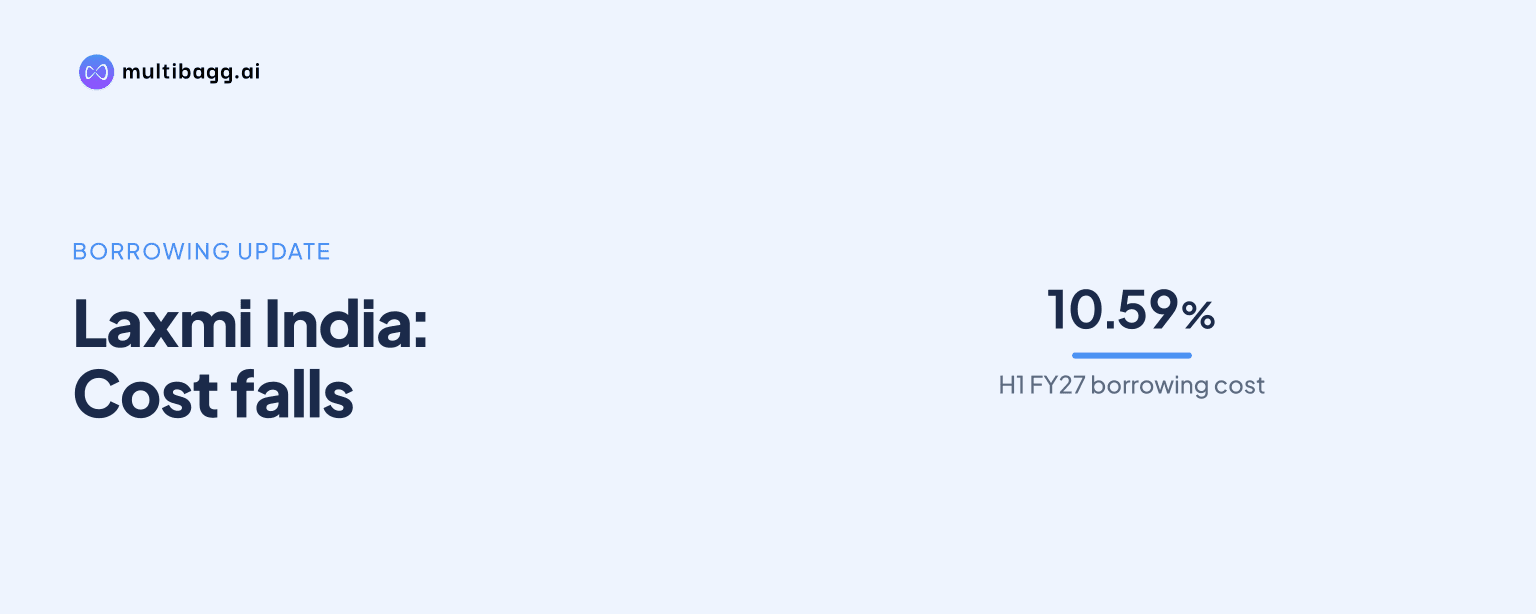
Laxmi India Finance lowered its average borrowing cost by 51 basis points to 10.59% at September 30, 2026, from 11.10% a year earlier, while banks represented approximately 65% of its borrowing mix. The reduction followed new lender relationships, pricing on incremental facilities and negotiations on existing facilities.
Know Laxmi India Finance inside out
Results, valuation, peers and who's buying, in one view.
How did Laxmi India Finance reduce its borrowing cost?
Laxmi India Finance reduced its average borrowing cost by 51 basis points, or bps, year on year and by 7 bps sequentially in the September 2026 quarter. The average cost fell from 11.10% in September 2025 to 10.59% in September 2026, and from 10.66% in June 2026. Management attributed the movement to stronger banking relationships, competitive pricing on new facilities and negotiation with existing lenders.
The funding-cost decline accompanied an improvement in net interest margin, or NIM, to 11.28% in the first half of financial year 2027 (H1 FY27), from 10.88% in H1 FY26. Net interest income increased to Rs 97 crore from Rs 72 crore over the same period, as the earning-asset base expanded and funding economics improved. An analyst noted that portfolio yield had declined by about 59 bps while borrowing cost fell 51 bps; management cited the reduced cost of borrowing in explaining the higher NIM.
Laxmi India Finance reported an incremental borrowing cost of approximately 10.42% over the preceding 12 months, below the 10.59% blended average cost in September 2026. Management said the gap offers scope to optimise the cost of older liabilities as they mature or become eligible for repricing. It did not provide a target for the future blended borrowing cost.
What changed in Laxmi India Finance's funding mix?
Laxmi India Finance had banks accounting for approximately 65% of its overall borrowing mix at September 2026. During H1 FY27, it added ICICI Bank and City Union Bank as lending partners while deepening relationships with public-sector and private-sector banks. Management said the additional relationships expanded funding access and could help optimise both pricing and maturity structures.
Laxmi India Finance also mobilised Rs 100 crore through a non-convertible debenture, or NCD, transaction during the quarter. Management said the capital-market instrument provides another funding source and reduces dependence on one lender category. Total borrowings raised through various arrangements were approximately Rs 611 crore in H1 FY27.
The increased funding supported assets under management, or AUM, of Rs 1,843 crore at September 2026, compared with Rs 1,386 crore at September 2025. The Rs 457 crore year-on-year increase came alongside H1 FY27 disbursements of approximately Rs 506 crore, versus Rs 311 crore in H1 FY26. Secured micro, small and medium enterprise lending accounted for approximately Rs 1,493 crore, or about 81%, of September 2026 AUM.
How exposed is Laxmi India Finance to interest-rate changes?
Laxmi India Finance said approximately 80% to 87% of borrowings were either fixed-rate or linked to the marginal cost of funds-based lending rate, or MCLR. Most MCLR-linked facilities reset in six to 12 months, which management said would prevent an immediate increase in cost on that portion of borrowings during a rate-hike cycle.
Laxmi India Finance said repo-rate-linked borrowings reset every three months, allowing time to adjust the borrowing profile. The company did not disclose the share of borrowings linked to the repo rate, so the transcript does not quantify its total sensitivity to benchmark-rate changes. Management's stated treasury priorities include continued funding-cost optimisation and liability-maturity management.
Laxmi India Finance reported a gross debt-to-equity ratio of 3.31 times at September 2026, up from 2.87 times in March 2026. Net worth stood at Rs 499 crore, while capital adequacy was 22.95%, including Tier 1 capital adequacy of 22.54%. Management said it was evaluating the balance between capital deployment and leverage as the balance sheet expands.
Got a follow-up? Ask IRIS
What liquidity resources does Laxmi India Finance have?
Laxmi India Finance held Rs 292 crore of liquidity at the end of September 2026 and had approximately Rs 117 crore of undrawn facilities. It also reported cumulative surpluses across its disclosed asset-liability management, or ALM, maturity buckets. Management said maintaining liquidity and maturity discipline was essential as the lending portfolio expands.
Laxmi India Finance's Q2 FY27 disbursements were approximately Rs 274 crore, compared with Rs 231 crore in Q1 FY27. Its branch network reached 209 branches across six states at September 2026, up from 164 branches a year earlier. Management said a branch typically reaches break-even within seven to nine months.
The branch expansion increased operating expenses to Rs 62 crore in H1 FY27 from Rs 49 crore in H1 FY26. In the question-and-answer session, management said branch AUM break-even levels were around Rs 2 crore for category one, Rs 1.75 crore for category two and Rs 1.5 crore for category three branches. The company said it is now focusing on productivity from branches opened during the prior 12 to 24 months.
How does the rating upgrade support Laxmi India Finance's funding plan?
Laxmi India Finance's external credit rating was upgraded from A-minus to A with a stable outlook. Management said the upgrade could broaden engagement with institutional lenders and create opportunities for improved funding terms as lender relationships mature. It presented the change as an important development in building its liability franchise.
Laxmi India Finance reported profit before tax of Rs 42.4 crore in H1 FY27, compared with Rs 25.5 crore in H1 FY26, while profit after tax rose to Rs 31.7 crore from Rs 19.1 crore. Return on assets increased to 3.18% from 2.56%, and return on equity rose to 13.16% from 11%. These results coincided with the lower borrowing cost and higher operating investment in branches, technology and infrastructure.
Laxmi India Finance reported gross non-performing assets of 1.75% and net non-performing assets of 0.49% at September 2026, with provision coverage of approximately 72%. H1 FY27 credit cost was Rs 7.82 crore, equal to 0.96% of average gross loans. Management said it would continue to monitor parts of the vehicle-finance portfolio while maintaining appropriate provisions for stressed exposures.
Conclusion
Laxmi India Finance's funding position in H1 FY27 combined a 51-bps reduction in average borrowing cost, a bank-led borrowing mix and a Rs 100 crore NCD issue. The cost reduction coincided with a 40-bps increase in NIM to 11.28%, while AUM increased by Rs 457 crore year on year to Rs 1,843 crore and H1 FY27 profit after tax rose by Rs 12.6 crore.
Investors can watch whether the 10.42% incremental borrowing cost is reflected in the repricing of existing liabilities, and whether the new bank relationships diversify the 65% bank-led mix. Management plans to deepen existing lender relationships, selectively add new lenders, assess capital-market and direct-assignment opportunities, and target AUM of more than Rs 2,000 crore by the end of FY27.