










Laxmi India Finance Ltd H1 PAT Rises 66% to ₹31.7 Crore
Key highlights
- Laxmi India Finance Ltd reported H1 FY27 PAT of ₹31.7 crore, up 66% year on year.
- Laxmi India Finance Ltd’s AUM reached ₹1,844 crore on September 30, 2026, up about 33% year on year.
- Secured MSME AUM was ₹1,493 crore, representing 81% of total AUM.
- Laxmi India Finance Ltd retained FY27 guidance for AUM above ₹2,000 crore and NII and PAT growth of 35% to 40%.
powered by IRIS
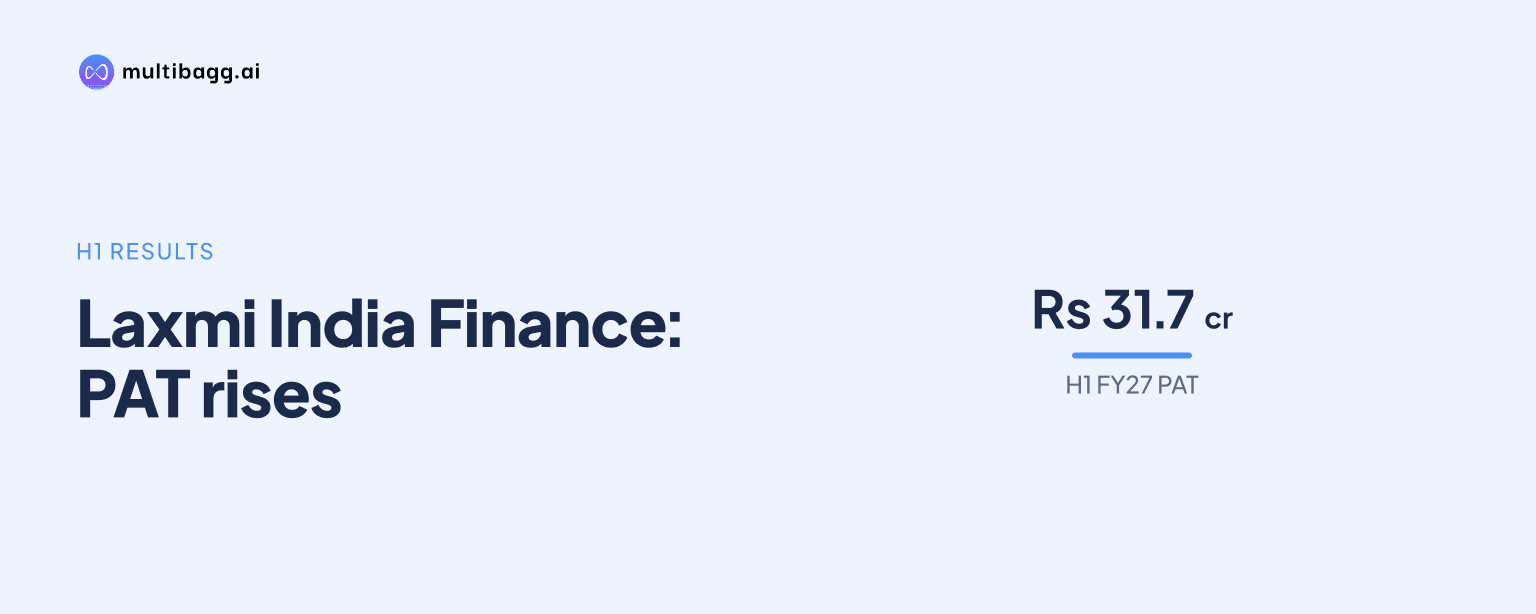
Laxmi India Finance Ltd reported H1 FY27 profit after tax of ₹31.7 crore, a 66% year-on-year increase, while assets under management reached ₹1,844 crore on September 30, 2026, up about 33% from a year earlier. The earnings call also retained the company’s FY27 growth guidance despite higher credit costs.
Know Laxmi India Finance inside out
Results, valuation, peers and who's buying, in one view.
What did Laxmi India Finance report for H1 FY27?
Laxmi India Finance reported H1 FY27 PAT of ₹31.7 crore, representing growth of 66% year on year. The earnings-call summary also cited an adjusted H1 PAT of ₹36.34 crore, up 91%, after excluding the impact of a direct assignment, or DA, default. Management presented both figures while discussing the effect of the default on reported profitability.
The company’s AUM stood at ₹1,844 crore as of September 30, 2026. Its secured MSME portfolio was ₹1,493 crore, accounting for 81% of AUM. This concentration underlines the continued importance of secured MSME lending to the company’s loan-book expansion and operating strategy.
How did margins and collections perform during the period?
Laxmi India Finance reported a net interest margin of 11.28%, compared with 10.88% in the comparable earlier period. Its cost of borrowings declined by 51 basis points to 10.59%, according to the call summary. The movement in these measures points to an improvement in the lending spread available to the company during the reported period.
Collection efficiency was 98.68%, compared with 93% in the prior year. Management also addressed questions around the DA default and evergreening, while maintaining its stated confidence in portfolio growth. The available call summary did not provide further quantified details on the default or any additional provisioning linked to it.
What was the position after the first quarter of FY27?
Laxmi India Finance entered the second quarter after reporting AUM of ₹1,721.7 crore at the end of Q1 FY27, up 28% year on year. Its own book was ₹1,626.9 crore, an increase of 31.7%, while quarterly disbursements were ₹232 crore against ₹166 crore in Q1 FY26.
In Q1 FY27, MSME AUM was about ₹1,395 crore. Net interest income rose 39% year on year to ₹47.1 crore, profit before tax increased about 72% to ₹21.9 crore, and PAT increased about 70% to ₹16.4 crore. Return on assets improved to 3.45% from 2.75%, providing context for the first-half earnings performance.
Got a follow-up? Ask IRIS
What is Laxmi India Finance’s FY27 guidance?
Laxmi India Finance retained its FY27 guidance for AUM above ₹2,000 crore, implying growth of about 25% from the stated base. Management also guided for NII and PAT growth of 35% to 40% for the year, while setting a return on assets target of 3.5% to 3.75%.
The company did not provide FY28 guidance during the call. Management’s position was that growth targets remain in place alongside a cautious stance on credit costs. For investors, the stated targets frame the key operating measures to track through the remaining quarters of FY27: loan-book growth, NII expansion, profitability and asset-quality performance.
Why do the reported figures matter for investors and the lending sector?
Laxmi India Finance’s results matter because its expansion is concentrated in secured MSME lending, which represented 81% of September AUM. The rise in collection efficiency to 98.68% is also relevant for a non-bank lender, as collections and credit costs directly affect profitability, liquidity management and the ability to sustain growth.
The company had earlier outlined a medium-term AUM compound annual growth target of 30% to 35%, supported by branch expansion and entry into additional states. In Q4 FY26, it had 176 branches across six states and identified Maharashtra and Uttar Pradesh as potential expansion markets. The current FY27 guidance is lower than that medium-term AUM range, while its NII and PAT guidance remains at 35% to 40%.
For the broader lending sector, the results show the importance of funding costs and collection quality alongside disbursement growth. Laxmi India Finance’s 51-basis-point reduction in borrowing cost and improvement in NIM were positive reported operating data, but the DA-default adjustment means investors may distinguish between reported and adjusted profit figures when assessing earnings quality.
Conclusion
Laxmi India Finance delivered 66% year-on-year growth in H1 FY27 PAT to ₹31.7 crore and expanded AUM by about 33% to ₹1,844 crore as of September 30, 2026. Higher NIM, lower borrowing costs and improved collection efficiency supported the reported operating position, while the DA default affected the comparison between reported and adjusted profit.
The next areas to watch are progress toward AUM above ₹2,000 crore, the 35% to 40% guidance for NII and PAT growth, and the company’s 3.5% to 3.75% ROA target for FY27. Management has not yet issued FY28 guidance, and the treatment and impact of the DA default remain relevant to future earnings assessments.