










Laxmi India Finance targets leverage as 45 branches mature
Key highlights
- Laxmi India Finance had 209 branches in six states in September 2026, up from 164 in September 2025.
- Management said branches typically break even within 7-9 months at Rs 1.5 crore to Rs 2 crore of AUM.
- H1 FY27 disbursements rose about 63% to Rs 506 crore, while September 2026 AUM reached Rs 1,843 crore.
- Operating expenses increased to Rs 62 crore in H1 FY27 from Rs 49 crore a year earlier as the branch network expanded.
powered by IRIS
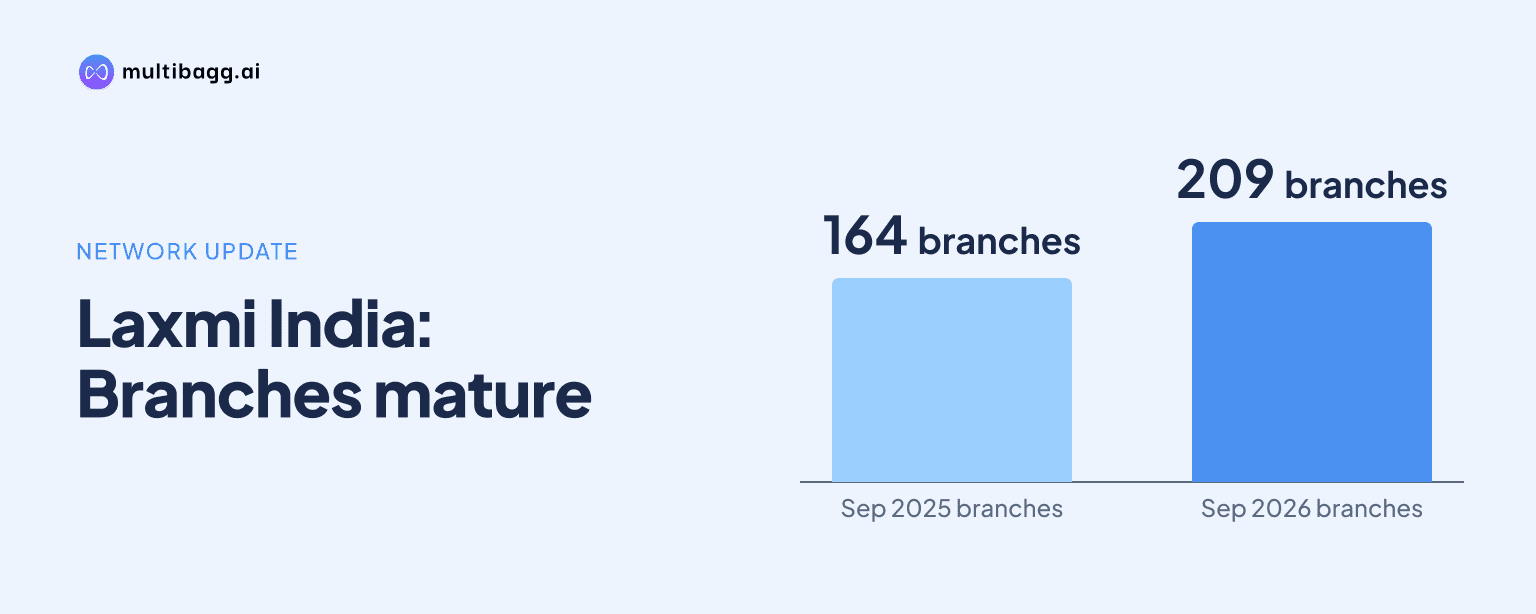
Laxmi India Finance said in H1 FY27 that the 45 branches added through September 2026 should support operating leverage as they mature, with a typical branch breaking even after 7-9 months at Rs 1.5 crore to Rs 2 crore of assets under management (AUM).
Know Laxmi India Finance inside out
Results, valuation, peers and who's buying, in one view.
How many branches did Laxmi India Finance add?
Laxmi India Finance expanded its branch network by 45 locations, to 209 branches in six states in September 2026 from 164 in September 2025. Management said the network served more than 45,500 customers and described the pace of openings in the last financial year as roughly one branch each week.
Rajasthan remained Laxmi India Finance's largest market, while management identified Uttar Pradesh and Maharashtra as newer markets with room to develop as local branches mature. The company said its relationship-led, secured-lending model targets micro, small and medium enterprises (MSMEs), traders and self-employed borrowers in semi-urban and underserved areas.
The network build-out coincided with a rise in lending activity. H1 FY27 disbursements were about Rs 506 crore, compared with Rs 311 crore in H1 FY26, while Q2 disbursements of about Rs 274 crore exceeded the Rs 231 crore reported in Q1. Management's priority is now to generate more business from the 209 existing branches, rather than expand branch count alone.
What AUM does a Laxmi India Finance branch need to break even?
Laxmi India Finance said new branches generally break even at AUM between Rs 1.5 crore and Rs 2 crore, depending on their category. Management defined break-even as the point at which branch income offsets regular branch expenses, including operating expenditure and capital expenditure.
Management said Rs 1.75 crore can be viewed as a broad midpoint across the three branch types. However, Laxmi India Finance did not disclose the number of category-one, category-two or category-three outlets, so the call does not provide a weighted-average break-even AUM for its 209-branch network.
The prepared remarks put the typical break-even period at 7-9 months, while management described the timeframe as around nine months in its analyst response. It also said branches opened in the past 12-24 months had matured and were positioned to contribute incremental AUM growth and operating leverage.
Why does branch maturity matter for Laxmi India Finance's profit?
Branch maturity matters because Laxmi India Finance's operating expenses rose to Rs 62 crore in H1 FY27 from Rs 49 crore in H1 FY26 as it expanded the branch network, employee base, technology and operating infrastructure. Management said these investments were needed to support a larger business, but that efficiency should improve as the resources are used across more lending activity.
Reported net interest income rose to Rs 97 crore in H1 FY27 from Rs 72 crore a year earlier. Profit before tax increased to Rs 42.4 crore from Rs 25.5 crore, and reported profit after tax increased to Rs 31.7 crore from Rs 19.1 crore. Management did not quantify the portion of either income or profit growth attributable specifically to mature branches.
The operating-leverage mechanism described by management is that a branch can originate additional loans after reaching the point where its recurring income covers its local cost base. Laxmi India Finance said it uses digital processes in sourcing, onboarding, underwriting, servicing and collections to improve turnaround time, standardise processes and manage a larger network, though it gave no branch-level cost-to-income ratio.
Got a follow-up? Ask IRIS
Is Laxmi India Finance producing enough AUM for its network?
Laxmi India Finance reported total AUM of Rs 1,843 crore in September 2026, compared with Rs 1,386 crore in September 2025. Secured MSME lending represented about Rs 1,493 crore, or around 81% of September 2026 AUM, making that segment central to branch utilisation and productivity.
The 63% rise in H1 FY27 disbursements was faster than the roughly 33% year-on-year increase in AUM. Management said annual prepayments were around 14% of the opening loan book and average loan tenure was about 48-52 months, explaining why gross disbursement growth does not translate directly into closing AUM growth.
Laxmi India Finance's stated plan is to deepen its secured MSME franchise while improving productivity at existing branches and expanding selectively where its underwriting and collection capabilities can be replicated. That approach links future network expansion to the performance of branches already operating in Rajasthan, Uttar Pradesh and Maharashtra.
Which metrics will show whether branch productivity is working?
Laxmi India Finance reported a net interest margin of 11.28% in H1 FY27, up from 10.88% in H1 FY26. Its average portfolio yield was 21.59%, while average borrowing cost declined to 10.59% from 11.10% a year earlier, which management identified as an important contributor to the margin improvement.
Collections and credit costs will also affect whether new branch AUM converts into earnings. Gross non-performing assets were 1.75% and net non-performing assets were 0.49% in September 2026, while management reported collection efficiency of 98.68%, compared with 93% in September 2025. Management said it did not see stress in its portfolio at that point.
Reported H1 FY27 profit after tax included an additional Rs 6 crore provision for the Up Money direct-assignment transaction, taking cumulative provisioning on that exposure to 90%. Management calculated adjusted profit after tax, excluding that transaction's impact, at Rs 36.34 crore, up 91% year on year; this was management's adjusted presentation rather than reported profit.
Conclusion
Laxmi India Finance's branch economics set out a measurable route to operating leverage: 45 net additions took the network to 209 branches by September 2026, and management said outlets generally reach break-even at Rs 1.5 crore to Rs 2 crore of AUM within 7-9 months. Higher disbursements of Rs 506 crore in H1 FY27 provide the flow of lending needed for those branches to build their books.
The next results should show whether mature locations can increase AUM and income without operating expenses rising proportionately from the H1 FY27 level of Rs 62 crore. Management's disclosed plan is to lift productivity in the existing network, deepen secured MSME lending and add branches selectively only where its underwriting and collection model can be replicated.