










Laxmi India makes 90% provision on Rs 19 crore default
Key highlights
- Laxmi India provided 90% of the Rs 19 crore Up Money default, equal to Rs 17.10 crore.
- The original Up Money transaction was Rs 26 crore, including Rs 7 crore received earlier and Rs 19 crore that defaulted.
- Laxmi India guided for FY27 credit costs of 1% to 1.25%.
- September 2026 collection efficiency was 98.68%, compared with 93% in September 2025.
powered by IRIS
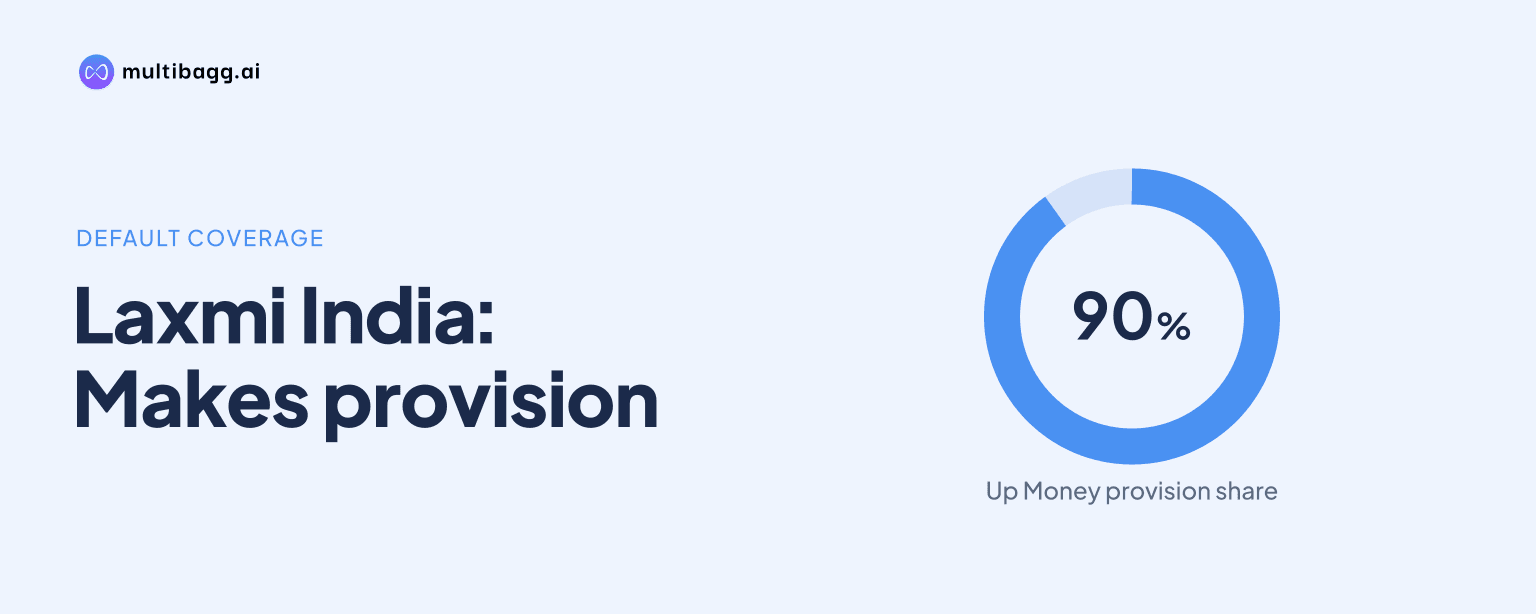
Laxmi India Finance said it provided 90%, or Rs 17.10 crore, against a Rs 19 crore default in an Up Money direct-assignment transaction, leaving Rs 1.90 crore unprovided. Management said the additional provisioning was the main reason for a 7% sequential fall in second-quarter profit after tax.
Know Laxmi India Finance inside out
Results, valuation, peers and who's buying, in one view.
What happened in Laxmi India’s Up Money transaction?
Laxmi India said Rs 19 crore defaulted in a direct-assignment, or DA, purchase involving Up Money. The original transaction was about Rs 26 crore, of which Rs 7 crore had been received earlier, while the remaining Rs 19 crore was stated to have defaulted.
Laxmi India made a 90% provision against the defaulted Rs 19 crore amount, equal to Rs 17.10 crore. The remaining 10% was Rs 1.90 crore. When asked how much cash had been recovered after the default and the expected recovery timeline, management repeated the Rs 26 crore transaction size and Rs 7 crore received earlier but did not disclose a subsequent recovery amount or a deadline.
Management said there were no further similar exposures in Laxmi India’s portfolio. It described the Up Money event as an unexpected DA-purchase default and characterised it as exceptional, while adding that other non-banking financial companies, or NBFCs, and banks had also lost money in Up Money. That broader industry comment was management’s view and was not quantified in the call.
How did the Up Money provision affect Laxmi India’s profit?
Laxmi India said additional Up Money provisioning was the main reason for the sequential decline in its second-quarter profit after tax, or PAT. An analyst described the quarterly PAT movement as a 7% decrease from the first quarter, and management attributed that change to the additional provision.
Management said it had provided 10% in the first quarter and an additional 20% in the second quarter when explaining the PAT movement. Elsewhere in the same exchange, it said total provision coverage had reached 90% of the Rs 19 crore default. The transcript does not reconcile the quarterly percentage comments with the 90% cumulative provision, making the disclosed Rs 17.10 crore total provision the clearest measure of coverage.
The profit movement came as an analyst cited 63% growth in disbursements and 33% growth in assets under management, or AUM. Laxmi India said annual prepayments were about 14% of its opening loan book and that its average loan tenure was about 48 to 52 months, indicating that repayments and early closures moderated the translation of disbursements into AUM growth.
Got a follow-up? Ask IRIS
What is Laxmi India’s credit-cost outlook after the default?
Laxmi India guided for credit costs of 1% to 1.25% in the coming quarters and for FY27. Management said a more precise estimate was difficult because credit costs depend on non-performing assets, collection behaviour and portfolio performance.
An analyst said first-half FY27 impairment expenses had increased by about 81% and the absolute Stage 3 loan balance had moved from Rs 12 crore to about Rs 30 crore. Management said the Up Money default was driving the higher impairment charge, while stating that gross non-performing assets, or GNPAs, were improving and that Stage 3 loans were moderate. The call did not provide a numerical GNPA ratio or reconcile the reported Stage 3 balance change.
Management reported collection efficiency of 98.68% in September 2026, compared with 93% in September 2025. It said borrowers’ multiple income sources supported collections and that it was not seeing portfolio stress, while distinguishing its secured lending model from unsecured microfinance lending.
Laxmi India said 81% of AUM was in micro, small and medium enterprise, or MSME, lending in semi-urban and rural towns. Management put the secured share of the overall book at about 87% to 89%, with around 2% to 3% unsecured. Its process includes digital onboarding, know-your-customer verification, a business-rule-engine credit score, central credit review and manual intervention by credit managers.
Does Laxmi India have further DA exposure or funding constraints?
Laxmi India said it had no additional exposure similar to the Up Money DA purchase. As of September, it reported liquidity of Rs 292 crore and Rs 117 crore of undrawn sanctioned lines, which management said positioned it for the next three to four months.
Management said Laxmi India had a lender base of 53, including around 29 banks. It also referred to sanctions and DA transactions approved in principle during October and November, but did not disclose their amounts, so the effect on future funding or asset growth cannot be calculated from the call.
On interest-rate exposure, management said 80% to 87% of borrowings were either fixed rate or linked to the marginal cost of funds-based lending rate, or MCLR, with six- to 12-month resets. It said Rs 200 crore to Rs 213 crore, or 13% of total borrowings, was linked to the repo rate and reset every three months. Laxmi India added that its entire loan portfolio carried fixed interest rates and that higher funding costs could be passed on only through subsequent disbursements.
Laxmi India’s capital adequacy ratio was 22.95%, while an analyst cited debt-to-equity of 3.31. Management said the ratio would have been 26.92% if Rs 292 crore of liquidity had been placed in fixed deposits rather than bonds with a 100% risk weight. It said it could sustain 25% to 30% year-on-year growth without new equity and would raise funds through a preferential issue or follow-on public offer when leverage reached about 4.5 to 4.75.
Conclusion
The Up Money event was a concentrated Rs 19 crore DA default that resulted in Rs 17.10 crore of provision coverage and increased impairment costs. Management linked the additional provisioning to a 7% sequential decline in second-quarter PAT, even as it reported September 2026 collection efficiency of 98.68% and described most of its book as secured.
The next disclosures to watch are any recovery from the Rs 19 crore default, since management gave no recovery timetable, and whether FY27 credit cost remains within its 1% to 1.25% guidance range. Management also said Laxmi India could maintain 25% to 30% annual growth without fresh equity and may raise capital after leverage reaches about 4.5 to 4.75.