










M&M says Nagpur plan could double capacity amid SUV waits
Key highlights
- M&M said the 7XO waiting period remains five to seven months.
- M&M produced more than 73,000 units in October against stated combined ICE and EV capacity of 69,000 units.
- M&M has acquired the first land phase and committed to buy close to 1,500 to 2,000 acres for the Nagpur project.
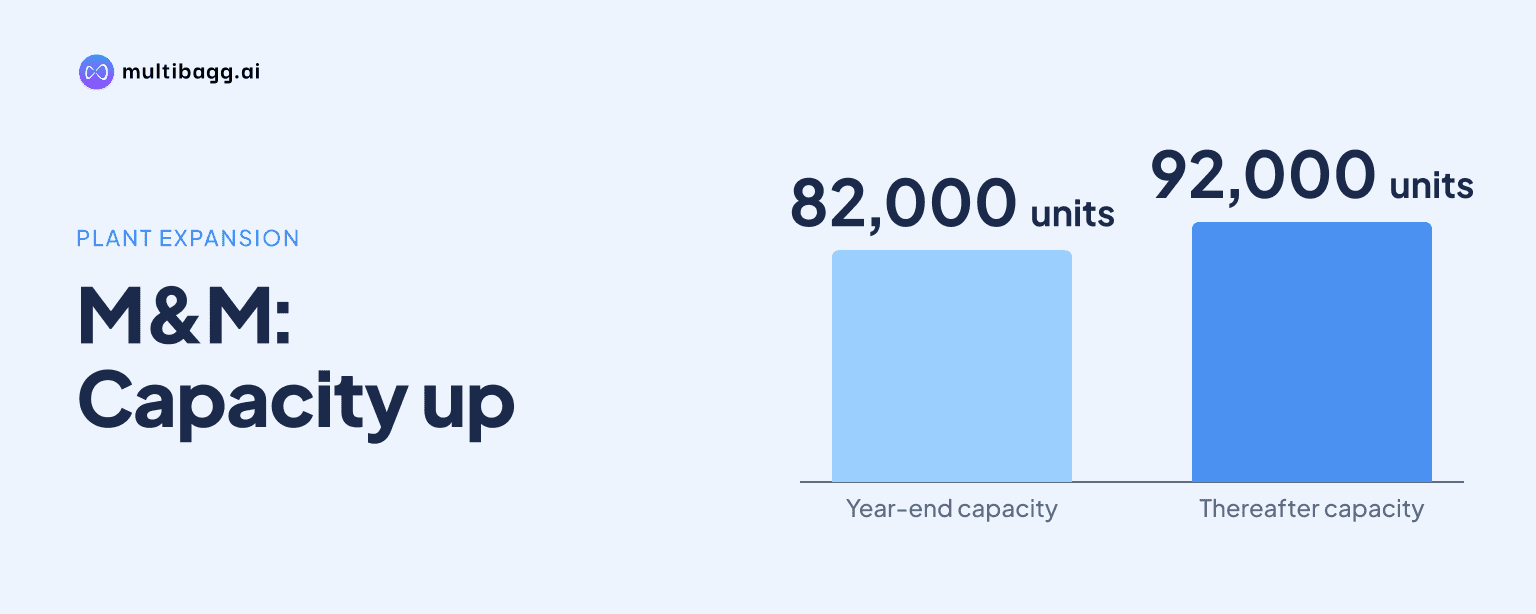
- M&M expects capacity of 82,000 units by the close of this year and 92,000 units thereafter.
powered by IRIS
Mahindra & Mahindra (M&M) says demand is exceeding supply across its SUV range, with the 7XO facing waits of five to seven months, while management says a Nagpur plant could effectively double current capacity. M&M has acquired the first land phase and committed to buy close to 1,500 to 2,000 acres.
Know Mahindra & Mahindra inside out
Results, valuation, peers and who's buying, in one view.
Why is M&M unable to meet SUV demand?
M&M says production capacity, rather than a lack of consumer demand, is limiting its SUV sales. In October, the company had internal-combustion engine, or ICE, capacity of 61,000 units and electric-vehicle, or EV, capacity of 8,000 units, for a combined 69,000 units, yet it recorded more than 73,000 units, partly using inventory and partly operating at the capacity installed.
M&M said physical dealer stocks were at very low levels and that every vehicle it produces is selling. Management described the Scorpio portfolio, particularly the Scorpio N, as fully capacity-constrained, while it put waiting periods for most other products at about one-and-a-half to two months. It said demand had remained robust in larger SUVs, Thar models and Bolero vehicles through the festive season.
How large is M&M's Nagpur expansion plan?
M&M says the Nagpur project is intended to give it capacity equivalent to roughly twice its current level, while retaining room for faster further expansion. Management said it had acquired the first phase of land needed to begin the project and had committed to buy close to 1,500 to 2,000 acres, although it did not disclose the plant's commissioning date, investment amount or rated output.
M&M also said it had bought land for a supplier park, intended to let component suppliers expand alongside the Nagpur facility. The arrangement addresses the need to expand both vehicle assembly and component supply. Management said the larger site should provide the company with room to respond after demand across products exceeded levels it had anticipated.
What capacity can M&M add before Nagpur opens?
M&M says it is pursuing nearer-term increases while it develops the Nagpur site. By February-March, management expects to add about 8,000 units of NU_IQ-related capacity at Chakan and another 4,000 units of EV capacity, taking total EV capacity from 8,000 to 12,000 units.
M&M expects capacity to rise 27% this year to 82,000 units and then to 92,000 units, while management said it would examine whether further near-term additions were possible. The company said semiconductor shortages around the COVID period had restricted its ability to add capacity for a couple of years, but it has since been able to expand output more readily.
The comparison shows how quickly M&M's production base has expanded before the proposed Nagpur doubling. Management said capacity moved from 17,000 units five years ago to 66,000 currently, or about four times the starting level, and should reach nearly five times that original base at 82,000 units by the close of this year. Even so, it said demand continued to exceed expectations.
Got a follow-up? Ask IRIS
Which M&M vehicles have the longest waiting periods?
M&M says the 7XO has the longest disclosed waiting period, at five to seven months, while the Scorpio N is also completely capacity-constrained. Management added that demand was high not only for these larger SUVs but also for the electric 9S, pickups, the Camper and high-load-tonnage two-tonne products, indicating that the constraint extends beyond one model or fuel type.
M&M said the 9S and 7XO had the longest order-to-delivery periods, while other products were generally at one-and-a-half to two months. Management did not provide order-book totals because it said cancellations make gross bookings less useful to report. Instead, it characterised the order book as robust and cited waiting periods as the clearer indicator of current supply pressure.
How do EVs and commercial vehicles affect M&M's capacity needs?
M&M says EV demand adds to, rather than replaces, its broader capacity requirement. EVs accounted for 12% of its total SUVs in the first half, when M&M said it ranked first by revenue market share, but the company said it could not fully serve the opportunity with EV capacity limited to 8,000 units before the planned February-March increase to 12,000 units.
M&M said its light commercial vehicle, or LCV, operations are similarly constrained, with pickups and Supro capacity of about 30,000 units and production operating at that level. In last-mile mobility, the company said it had added 25% capacity over the prior year and a half but had still run out of capacity, prompting short-term additions for the next financial year and consideration of a new platform with at least double the footprint.
Conclusion
M&M's central message is that reported volumes do not fully represent demand because SUVs, EVs, LCVs and last-mile products are encountering supply limits. The five-to-seven-month 7XO wait, output of more than 73,000 units in October against stated combined ICE and EV capacity of 69,000 units, and very low dealer inventory are the management evidence behind that view.
The next items to watch are execution of the February-March additions of 8,000 NU_IQ-related units and 4,000 EV units, progress at the Nagpur site after the first land phase, and whether M&M can move beyond its stated path to 82,000 units this year and 92,000 units thereafter. Management has not disclosed a Nagpur commissioning timetable or a specific output rating for the facility.