










Mahindra cuts FY27 tractor outlook to flat after drought
Key highlights
- Mahindra cut its FY27 tractor-industry outlook from 5% growth to flat growth.
- The monsoon estimate deteriorated from 90% to 87% of the long-period average.
- Mahindra said tractor-industry volumes were down 15% in the United States, 18% in Brazil and 36% in Turkey.
- Mahindra's Farm business profit contribution declined 9% year on year in Q2 FY27.
powered by IRIS
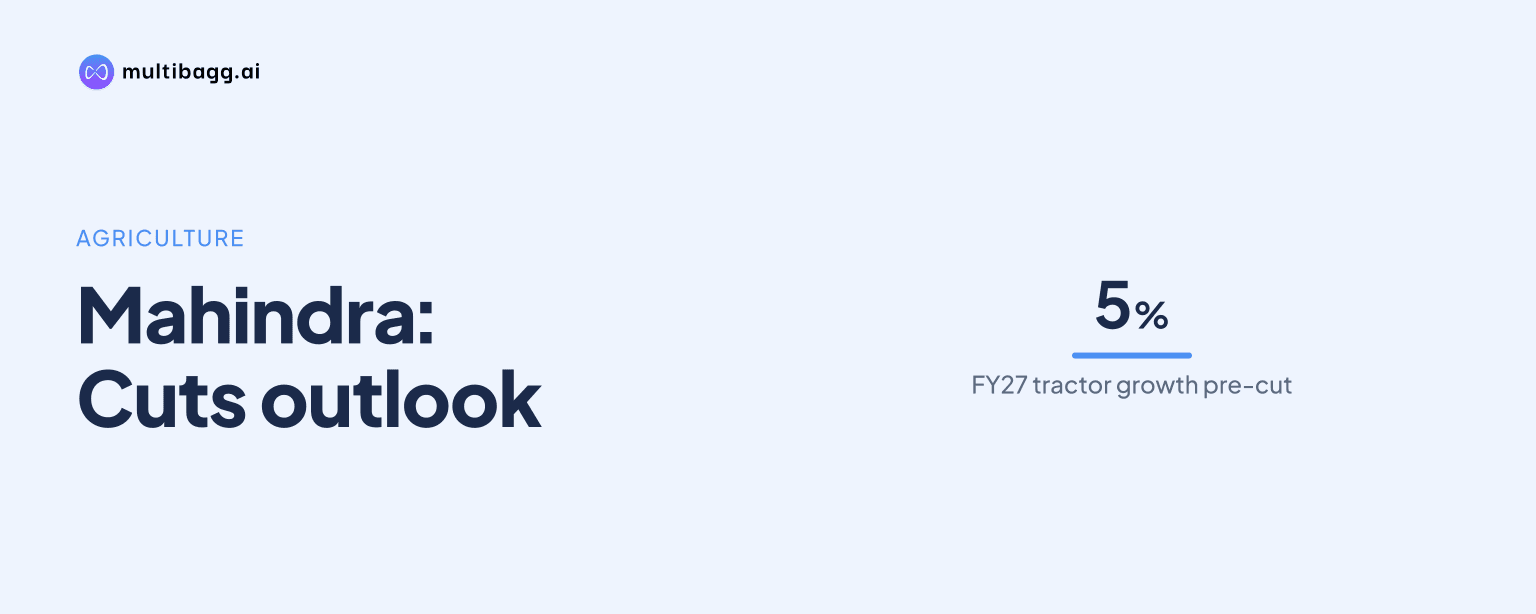
Mahindra & Mahindra Limited cut its full-year FY27 tractor-industry outlook from 5% growth to flat growth after the monsoon estimate weakened to 87% of the long-period average, with management citing drought in Maharashtra and Karnataka, low reservoir levels and uncertain crop yields.
Know Mahindra & Mahindra inside out
Results, valuation, peers and who's buying, in one view.
Why did Mahindra cut its FY27 tractor-industry outlook?
Mahindra cut the FY27 industry forecast because the monsoon deficit became worse than management expected in July, moving from an estimate of 90% of the long-period average to 87%. Management said Maharashtra and Karnataka were facing bad drought conditions, while Maharashtra was also dealing with the withdrawal of a subsidy that had supported the market in the previous year.
The revision applies to the full fiscal year, not only the second half, according to Rajesh Jejurikar, executive director and chief executive of Mahindra's Auto and Farm Sector. Management had previously expected 5% industry growth and now described its expectation as flattish, meaning broadly no growth for FY27.
Maharashtra matters because management identified it as a large tractor-industry market, and Karnataka was the second drought-affected state highlighted on November 5, 2026. Northern markets were performing relatively better, but management did not quantify whether their performance could offset conditions in those two states.
The worsening monsoon view was the main reason for the forecast cut. Mahindra said Kharif sowing acreage was “not so bad,” but expected yields were not expected to be as good, separating the area planted from the likely output of that planting.
What do reservoir levels and crop timing mean for Mahindra tractor demand?
Mahindra said reservoir levels were not at a good level, adding to the risk around crop yields despite Kharif sowing acreage holding up. The company also said Rabi sowing had been delayed, though management considered it too early to draw a conclusion because harvesting had itself been delayed and sowing could still pick up over the following weeks.
The timing of tractor purchases remained unresolved on November 5, 2026. Dhanteras was due the next day, Diwali was approaching, and management said delayed harvesting could extend the buying season beyond the festival period and into the third week of November.
That timing is why Mahindra did not treat the current forecast as a final assessment of seasonal demand. Jejurikar said it was “too early to call” because farm-market conditions can change quickly, while also making clear that flat growth was management's outlook at the analyst meeting.
The domestic outlook also sits beside an international slowdown. Mahindra reported tractor-industry declines of 15% in the United States, 18% in Brazil and 36% in Turkey, three strategic markets where its subsidiaries operate. Management described these markets as strategically important and said it had no intention of exiting them despite the industry stress.
Got a follow-up? Ask IRIS
How did Mahindra's Farm business perform in Q2 FY27?
Mahindra's Farm business profit contribution fell 9% year on year in Q2 FY27, according to Group Chief Executive and Managing Director Anish Shah, amid monsoon deficits and weaker international demand. Management also said the quarter was affected by a shift in the festive season, making the year-on-year comparison less straightforward than a normal seasonal comparison.
Farm machinery grew during the quarter, and Mahindra said it was gaining share in harvesters, a high-value segment where it had previously been under-penetrated. The company cited multiple actions in that segment but did not disclose a harvester sales volume, market-share figure or revenue contribution at the November meeting.
Management said consolidated Farm profit before interest and tax, or PBIT, improved sequentially even though the year-on-year decline remained. It attributed that improvement to better international performance as it completed or advanced closures and exits from businesses that had been weighing on results.
Three restructuring actions were identified: the exit from Sampo was complete, the Erkunt Foundry exit was complete, and the closure of Mitsubishi Mahindra Ag Machinery in Japan was in its final stages. Management expected the Japanese closure to be completed by Q4 FY27, and Group Chief Financial Officer Amarjyoti Barua said the faster execution of exits should help international subsidiaries in Q3 and Q4.
Mahindra contrasted the near-term industry reset with its longer-range Farm objective. The company said it had achieved two times growth from its ₹21,000 crore Farm-business starting point in FY20 and retained a decade objective of three times growth, supported by domestic leadership, international operations, farm machinery and a technology ecosystem.
Can Mahindra offset domestic tractor weakness with other businesses?
Mahindra can partly offset Farm pressure through its broader portfolio, but management did not say this would remove the effect of a flat tractor market. Consolidated revenue rose 25% year on year to ₹57,553 crore in Q2 FY27, while profit after tax also increased 25% to ₹4,588 crore, showing that Auto, financial services, technology and other businesses contributed alongside Farm.
The contrast across segments was pronounced: Auto profit was up 55%, Mahindra Finance profit was up 61%, and Tech Mahindra profit was up 33%, while Farm was down 9%. Shah said multiple businesses had driven the quarter, rather than Auto and Farm alone, and the company reported no monetisation during the quarter.
Mahindra also said its core tractor business could face pressure in Q3 FY27, while expecting possible improvement in Q4 FY27 and normalisation in FY28. That is management's outlook rather than a reported result, and it depends on agricultural conditions and the demand response through the delayed festival and post-harvest buying period.
Pricing and product actions are part of Mahindra's response to cost and demand conditions. The company said it raised Farm prices by 4%, compared with a 5% increase in Auto, while pursuing product refreshes and selected export acceleration. Management did not provide a revised Farm margin target alongside the flat industry-growth outlook.
Conclusion
Mahindra's forecast cut signals that a weaker-than-expected monsoon, drought in two important markets and reservoir concerns now outweigh the earlier expectation of 5% FY27 tractor-industry growth. Farm machinery progress and sequential support from international restructuring may support the business, but they do not change management's current view of a flat domestic industry.
The next indicators to watch are tractor demand through the third week of November, Rabi sowing after delayed harvesting, reservoir conditions and the planned completion of the Mitsubishi Mahindra Ag Machinery closure by Q4 FY27. Management's stated expectation of possible Q4 improvement and FY28 normalisation will depend on how those disclosed factors develop.