










Mahindra sold 100,000 electric SUVs, targets 250 chargers
Key highlights
- Mahindra has sold 100,000 electric SUVs since launch.
- Mahindra billed 23,345 domestic eSUVs in Q2 F27 and held 23.2% eSUV volume market share.
- Mahindra’s eSUV penetration was 12.7% in Q2 F27, versus 11.0% for the industry.
- Charge_IN has 59 live ultrafast stations, with 250 planned by end-2027.
powered by IRIS
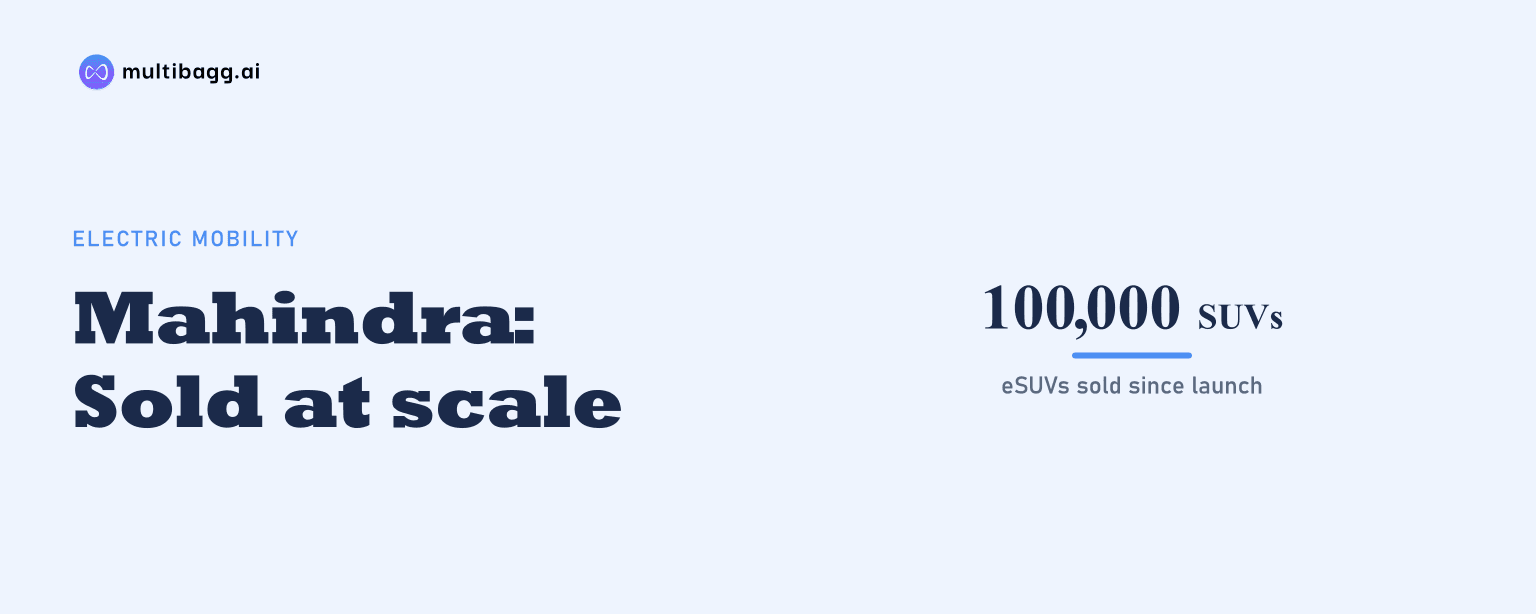
Mahindra & Mahindra has sold 100,000 electric SUVs since launch and plans to increase its Charge_IN ultrafast charging network from 59 live stations to 250 by the end of calendar year 2027. In Q2 F27, Mahindra billed 23,345 domestic eSUVs, held 23.2% eSUV volume market share and reported 12.7% eSUV penetration.
Know Mahindra & Mahindra inside out
Results, valuation, peers and who's buying, in one view.
How many electric SUVs has Mahindra sold?
Mahindra has sold 100,000 electric SUVs since launch, according to its Electric Origin SUV disclosure. The presentation does not disclose a launch date, a country split or a model-by-model breakdown for this cumulative sales milestone. It reported the figure alongside Q2 F27 EV operating data.
In Q2 F27, Mahindra billed 23,345 domestic eSUV units and captured 23.2% eSUV volume market share, or MS. The company says the billing and market-share figures include the XUV 400 and XUV 3XO EV. The source separately labels the 100,000-unit total as electric SUVs sold since launch, without specifying whether its geographic scope matches domestic billings.
The cumulative EV milestone coincided with total SUV volumes of 183,400 units in Q2 F27. This was above 174,700 units in Q1 F27 and close to 183,800 units in Q4 F26. Mahindra’s wider SUV data include internal-combustion-engine SUVs and eSUVs, meaning the presentation does not frame electric sales as a standalone substitute for the broader SUV portfolio.
How did Mahindra’s eSUV position change in Q2 F27?
Mahindra’s eSUV penetration rose to 12.7% in Q2 F27 from 8.7% in Q2 F26, while its eSUV volume MS declined to 23.2% from 24.0%. Penetration measures the electric share of the relevant SUV mix, whereas volume MS measures the company’s share of the eSUV market. These measures therefore recorded different year-on-year movements.
Mahindra’s penetration was 1.7 percentage points above the industry’s 11.0% in Q2 F27, compared with a 1.0-percentage-point gap in Q2 F26. On an industry basis excluding Vinfast and BYD, eSUV penetration was 10.0% in Q2 F27. The presentation notes that Vinfast and BYD shared data only for Q1 and Q2 across F26 and F27.
Mahindra ranked second in eSUV volume MS in Q2 F27. Its share was 31.4% in Q4 F26, then 26.3% in Q1 F27 and 23.2% in Q2 F27. Excluding Vinfast and BYD, Mahindra’s volume MS was 25.7% in Q2 F27, compared with 25.0% in Q2 F26.
Mahindra also reported eSUV revenue market share, or RMS, of 30.1% in Q2 F27, ranking second among original equipment manufacturers, or OEMs. The presentation, which cites JATO for this measure, lists OEM 1 at 32.7%, a difference of 2.6 percentage points. In H1 F27, Mahindra’s eSUV RMS was 32.3%, above OEM 1’s 30.6%.
Got a follow-up? Ask IRIS
Where is Mahindra building its Charge_IN network?
Mahindra has 59 operational ultrafast Charge_IN stations across India, covering about 12,000 kilometres of national-highway corridors. On the corridors covered, the company says a station is available roughly every 200 kilometres. The listed network locations include Delhi, Mumbai, Pune, Hyderabad, Bengaluru, Chennai and Amritsar.
The 59 stations had dispensed about 4 million kilowatt-hours, or kWh, of power. Mahindra says this enabled customers to drive about 2.5 crore kilometres. The presentation does not provide charging prices, station utilisation, the number of chargers per location, capital expenditure or a vehicle-efficiency assumption behind the estimated distance.
Mahindra plans 250 ultrafast Charge_IN stations by the end of calendar year 2027. That target implies 191 additional sites beyond the 59 now operating and more than four times the current network. The company does not disclose annual installation targets, planned spending, every future corridor or how many sites are already being built or contracted.
The charging plan is focused on inter-city travel rather than a reported urban-site count. The current footprint is defined by about 12,000 kilometres of highway corridors and roughly 200-kilometre station spacing, while the 250-site objective sets the planned scale. The source does not state whether all future stations will follow the same corridor-spacing approach.
Which products supported Mahindra’s Q2 F27 EV results?
Mahindra identified the XEV 9S as India’s highest-selling EV in Q2 F27, with 13,275 units sold. That model accounted for more than half of Mahindra’s 23,345 domestic eSUV billings in the quarter. The presentation does not provide unit sales for the company’s other electric-SUV models.
Mahindra said the BE 6 Sported launch re-ignited momentum, reporting a more than 50% increase in enquiries and a 93% increase in bookings. The comparison covers 1 July to 15 August before launch and 16 August to 30 September after launch. The company did not disclose absolute enquiry or booking totals, so the scale behind those percentage increases cannot be calculated from the presentation.
The EV product results followed a sequential rise in Mahindra’s eSUV penetration, from 9.6% in Q4 F26 to 12.0% in Q1 F27 and 12.7% in Q2 F27. Over the same Q2 F27 period, all-SUV revenue MS, which covers combustion and electric SUVs, was 24.3%. That was down 30 basis points quarter on quarter and 110 basis points year on year.
Conclusion
Mahindra’s 100,000-unit electric-SUV milestone sits alongside 23,345 domestic eSUV billings in Q2 F27, 23.2% eSUV volume MS and 30.1% eSUV RMS. Its 12.7% eSUV penetration exceeded the industry’s 11.0%, although its all-market eSUV volume MS was below the 24.0% reported in Q2 F26.
The next disclosed target is expansion from 59 Charge_IN stations to 250 by the end of calendar year 2027. Progress in station additions, highway coverage and power dispensed will show the pace of that rollout, while future domestic billing data can indicate whether the reported XEV 9S sales and BE 6 Sported booking growth are sustained.