










Mahindra reports 17.6% tractor margin, F27 outlook flattish
Key highlights
- Mahindra’s core tractor PBIT margin was 17.6% in Q2 F27, versus 20.6% in Q2 F26.
- Farm consolidated revenue declined 6% year on year to Rs 9,572 crore in Q2 F27.
- H1 F27 farm volumes rose 7% to 274,000 units, while market share declined 70 basis points to 43.4%.
- The October 2026 monsoon forecast was 87% of the long-period average and reservoir storage was 16% below normal.
powered by IRIS
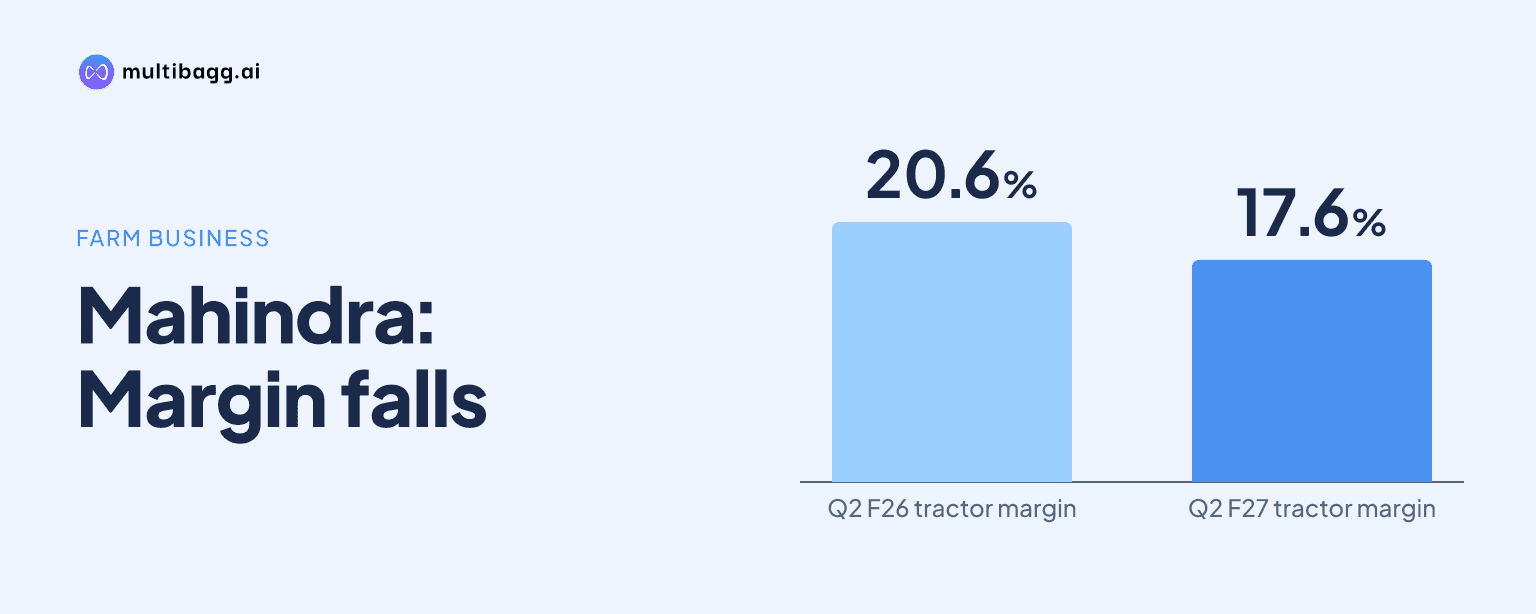
Mahindra reported a 17.6% core tractor profit before interest and tax margin in Q2 F27, while management reduced the F27 tractor-industry outlook to flattish after the October 2026 southwest-monsoon estimate fell to 87% of the long-period average and reservoir storage reached 16% below normal.
Know Mahindra & Mahindra inside out
Results, valuation, peers and who's buying, in one view.
What was Mahindra’s core tractor margin in Q2 F27?
Mahindra’s core tractor PBIT margin was 17.6% in Q2 F27, down from 20.6% in Q2 F26 and 19.2% in Q1 F27. Core tractor comprises the tractor business, including exports from India, and excludes Powerol and farm machinery. Management attributed the Q2 margin pressure to commodity-price hikes.
Core tractor revenue was broadly unchanged year on year at Rs 7,652 crore in Q2 F27, versus Rs 7,645 crore in Q2 F26, but was below Rs 9,964 crore in Q1 F27. PBIT declined to Rs 1,345 crore from Rs 1,574 crore a year earlier and Rs 1,917 crore sequentially. Industry growth moved to negative 3.1% in Q2 F27 from positive 30.7% in Q2 F26.
Why did Mahindra’s farm consolidated profit fall?
Mahindra’s farm consolidated revenue declined 6% year on year to Rs 9,572 crore in Q2 F27, while PBIT fell 14% to Rs 1,376 crore. Profit after tax declined 9% to Rs 1,053 crore from Rs 1,163 crore in Q2 F26. The consolidated PBIT margin was 14.4%, compared with 15.7% a year earlier and 14.2% in Q1 F27.
International subsidiaries recorded a PBIT loss of Rs 130 crore in Q2 F27, compared with a Rs 164 crore loss in Q2 F26, while revenue fell to Rs 1,259 crore from Rs 2,003 crore. Farm others, comprising Powerol, farm machinery and domestic subsidiaries, delivered Rs 161 crore of PBIT on Rs 1,899 crore of revenue, compared with Rs 197 crore on Rs 1,713 crore a year earlier. Reported consolidated revenue was net of Rs 1,234 crore of intercompany eliminations in Q2 F27.
How did Mahindra’s volumes and market share change?
Mahindra’s Q2 F27 farm volumes declined 6% year on year to 116,000 units, and market share declined 150 basis points to 41.5%. Both measures include Gromax. The quarterly result contrasted with H1 F27, when volumes increased 7% to 274,000 units and market share was 43.4%, down 70 basis points year on year.
Mahindra’s H1 F27 share of 43.4% was close to 43.6% in F26, but below the 43.3% reported for F25 only after allowing for the difference between a half year and a full year. The longer series shows share rising from 40.0% in F22 to 41.2% in F23, 41.8% in F24 and 43.3% in F25. Farm-machinery revenue, including MITRA, rose 5% to Rs 345 crore in Q2 F27 despite the 6% decline in consolidated farm revenue.
Got a follow-up? Ask IRIS
What is Mahindra doing with its overseas farm subsidiaries?
Mahindra has concluded exits from Sampo in Finland and Erkunt Foundry in Turkey, while the restructuring of MAM in Japan was on plan. Management said its divestment and restructuring actions are expected to reduce subsidiary losses in F27 compared with F26, but did not disclose a rupee target or a completion date for MAM.
Overseas industry conditions remained adverse in H1 F27. MAgNA’s below-110 horsepower market declined 15%, while its share fell to 6.0% from 6.8% in H1 F26; Mahindra listed the Oja Small Utility launch and refreshed 40-horsepower and 50-horsepower products. Brazil’s below-120 horsepower share held at 6.7% as its industry declined 18%, while Turkey’s Erkunt share rose to 6.3% from 5.8% despite a 36% industry decline.
Why did Mahindra reduce its F27 tractor-industry outlook?
Mahindra reduced its F27 industry outlook to flattish because the monsoon deficit widened and reservoir levels deteriorated between July and October 2026. The southwest-monsoon forecast for the June-to-September season moved from 92% of the long-period average in May to 90% in July and 87% in October. Reservoir storage moved from 19% above normal in May to 7% below normal in July and 16% below normal as of October 15.
Management cited increased yield risks from prolonged dry spells, poor soil moisture and lower reservoir availability, alongside negative terms of trade from input costs rising faster than retail prices. Maharashtra received 19% less rainfall than the long-period average over the preceding three months. Karnataka was reported to be in drought conditions, with rainfall 30% below the long-period average.
Conclusion
Mahindra’s farm results combine a 17.6% Q2 F27 core tractor margin with a 6% decline in consolidated revenue to Rs 9,572 crore and a 6% fall in quarterly volume to 116,000 units. Core tractor revenue remained near its Q2 F26 level, but lower industry growth, commodity costs and overseas subsidiary losses reduced farm profitability.
The next disclosed measures to watch are reservoir availability after storage stood 16% below normal on October 15, the F27 demand outcome under management’s flattish industry outlook, and progress on the MAM restructuring. Management also expects the completed Sampo and Erkunt Foundry exits, together with MAM’s restructuring, to reduce international subsidiary losses versus F26.