










Mahindra & Mahindra Q2 FY27 Revenue and PAT Rise 25%
Key highlights
- M&M reported Q2 FY27 consolidated revenue of ₹57,553 crore, up 25% from ₹46,106 crore a year earlier.
- Consolidated Q2 FY27 profit after tax rose 25% to ₹4,588 crore from ₹3,673 crore.
- M&M reported annualised consolidated return on equity of 21% for H1 FY27.
- The Auto business recorded 55% profit-after-tax growth, while Farm declined due to a festive-season shift.
powered by IRIS
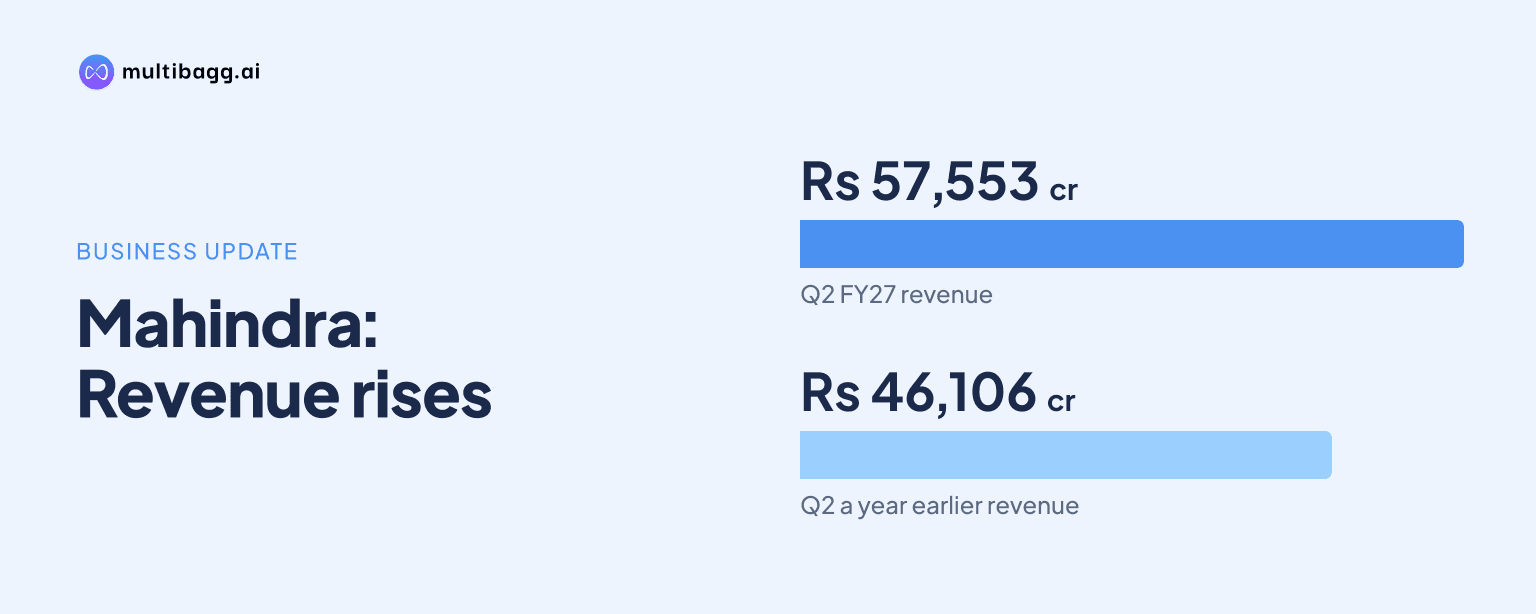
Mahindra & Mahindra Limited reported consolidated revenue of ₹57,553 crore and profit after tax of ₹4,588 crore for Q2 FY27, with both measures rising 25% year on year. The September-quarter performance came despite management citing commodity-price pressures, geopolitical issues and a monsoon deficit as operational challenges.
Know Mahindra & Mahindra inside out
Results, valuation, peers and who's buying, in one view.
What did Mahindra & Mahindra report for Q2 FY27?
Mahindra & Mahindra Limited, referred to as M&M, reported unaudited consolidated results for the quarter ended September 30, 2026, after its Board approved the financial statements on November 5, 2026. Consolidated revenue increased to ₹57,553 crore from ₹46,106 crore in Q2 FY26, a year-on-year rise of 25%.
Consolidated profit after tax rose by the same rate to ₹4,588 crore from ₹3,673 crore a year earlier. The company reported annualised consolidated return on equity of 21% for the first half of FY27. Management also said year-to-date profits had increased 29%, indicating that the group maintained profit growth through the first six months of the financial year.
The reported quarter was sequentially softer on the headline figures. Revenue was down 1.1% from ₹58,208 crore in Q1 FY27, while profit after tax declined 15.9% from ₹5,455 crore in the preceding quarter. These quarter-on-quarter comparisons reflect the numbers reported for the two periods and should be considered alongside the group’s year-on-year growth.
What drove M&M's quarterly performance?
M&M said its businesses delivered a strong operating performance during the quarter, with the Auto business recording a 55% rise in profit after tax. The company did not provide a consolidated business-wise breakdown in the supplied results highlights, but it identified Auto as a major contributor to the group’s profit growth.
The Farm business faced a decline because of a shift in the festive season, according to management. That timing effect was material enough for the company to flag it alongside the Auto business performance, underscoring differences in conditions across its operating segments during the quarter.
Management described the quarter as difficult despite the growth in revenue and profit. It cited higher commodity prices, geopolitical issues and monsoon deficits among the pressures faced by its businesses. The company presented resilience across its portfolio as the central feature of the quarter’s performance rather than attributing growth to a single external factor.
What did management say about the FY27 outlook?
M&M said it had reduced its full-year outlook from 5% to flattish. Management clarified during the analyst interaction that this revision applied to the entire financial year rather than only the second half. The supplied transcript excerpt does not identify the specific business measure to which the outlook refers.
This outlook revision provides important context for the Farm business commentary. The company linked the segment’s quarterly decline to the festive-season shift, while also acknowledging the impact of monsoon deficits. The reported results do not establish how much each factor affected revenue, volume or profitability, so the available information supports only the stated qualitative assessment.
The company held its Q2 FY27 analyst meeting in Mumbai on November 5, 2026, from 4:00 pm to 5:30 pm IST. Group Chief Executive Officer and Managing Director Dr. Anish Shah, Auto and Farm business Executive Director and Chief Executive Officer Rajesh Jejurikar, and Group Chief Financial Officer Amarjyoti Barua were listed as participants in the presentation.
Got a follow-up? Ask IRIS
How does the result affect investors and M&M's operations?
For investors, the key reported outcome is that consolidated revenue and profit after tax both expanded 25% from the year-earlier quarter, while annualised return on equity stood at 21%. The figures show continued growth in the group’s consolidated earnings base, although profit after tax was lower than the ₹5,455 crore reported in Q1 FY27.
The Auto business’s 55% profit-after-tax growth supports the group’s Q2 profitability, while the Farm business performance shows the effect that seasonal timing and agricultural conditions can have on the wider portfolio. M&M operates across these businesses, making segment-level trends relevant to the consolidated result even when group revenue and profit remain higher year on year.
The analyst meeting and publicly available recording also give market participants access to management’s comments on the reported numbers. M&M said only publicly available information was discussed during the investor interaction, in line with its stated compliance with SEBI Listing Obligations and Disclosure Requirements.
Why do the Q2 FY27 results matter for M&M?
The results matter because they combine 25% year-on-year gains in both revenue and profit after tax with a more cautious full-year outlook. M&M delivered higher consolidated earnings while operating amid the challenges it identified, including commodity costs, geopolitical conditions and monsoon deficits.
The figures also highlight the value of assessing M&M as a multi-business group. Auto recorded a strong increase in profit after tax, while Farm was affected by a festive-season shift. The contrast illustrates why consolidated results need to be read with management’s segment commentary and with attention to the conditions affecting each business.
Conclusion
M&M's Q2 FY27 results showed consolidated revenue of ₹57,553 crore and profit after tax of ₹4,588 crore, each 25% above the corresponding prior-year quarter. Annualised consolidated return on equity was 21%, with Auto profit growth helping offset a Farm business decline linked to festive-season timing.
Investors will watch how the company’s revised full-year outlook, reduced from 5% to flattish, develops through the remaining quarters. Further updates on Farm conditions, monsoon-related factors, commodity costs and the operating contribution from Auto will provide the next measurable indicators of performance.