










Neuland sees no meaningful CMS patent expiries before 2030
Key highlights
- Neuland said key commercial CMS molecules have no meaningful patent expiries before 2030 in significant customer markets.
- Neuland said about 5 or 6 commercial molecules contributed revenue in Q2.
- Neuland expects peptide PPQ-related revenue in 6 to 9 months from November 3, 2026.
- Management said peptide commercial revenue could begin in roughly 18 to 24 months.
powered by IRIS
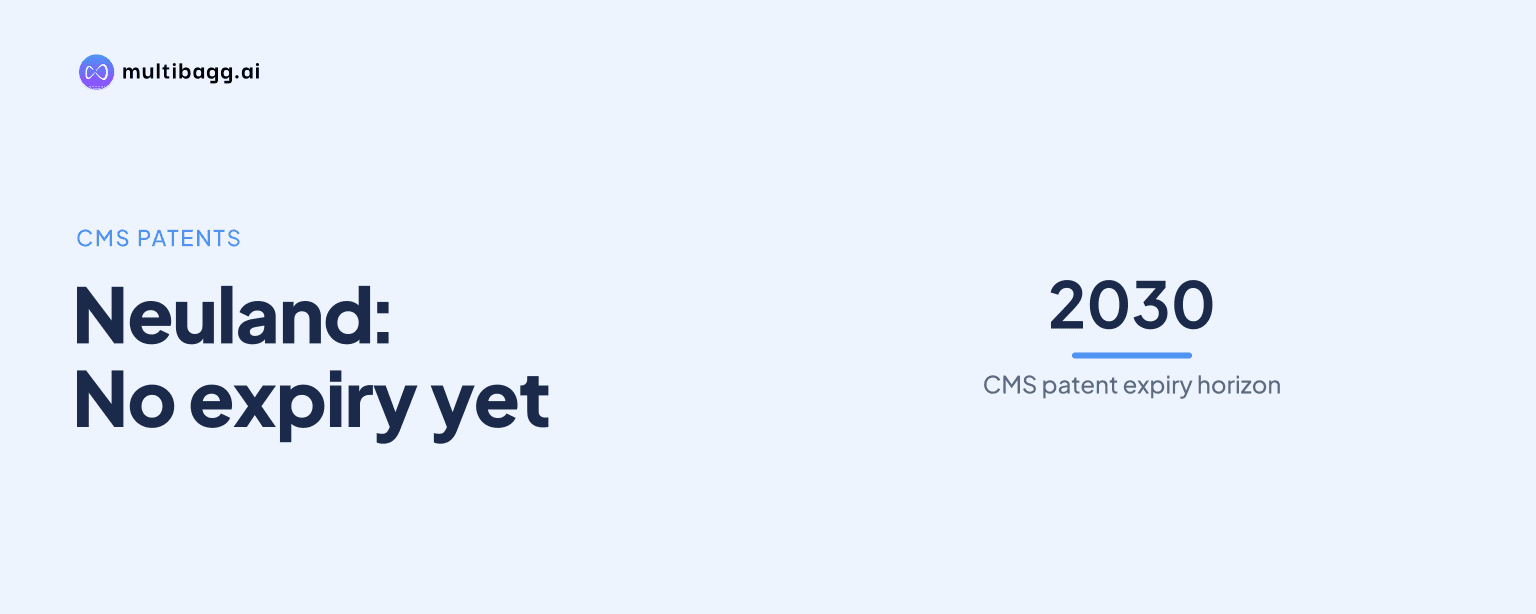
Neuland Laboratories Limited said on November 3, 2026 that its key commercial CMS molecules have no meaningful patent expiries before 2030 in markets that significantly contribute to customers, according to management. Neuland expects peptides, complex small molecules and other products to support growth when some commercial molecules later taper.
Know Neuland Laboratories inside out
Results, valuation, peers and who's buying, in one view.
When do Neuland’s key CMS molecule patents expire?
Neuland said it does not see patent expiries before 2030 for key commercial CMS molecules in meaningful markets that contribute significantly to its customers. Sajeev Medikonda made the statement in response to a question about the patent cliffs of three large commercial CMS products, without identifying the molecules, customers, countries or individual expiry dates.
The statement applies to meaningful customer markets rather than every market in which a customer may sell a product. Neuland did not provide a molecule-by-molecule patent schedule or quantify the share of CMS revenue associated with products protected through 2030. The disclosure is therefore management’s assessment of near-term patent exposure, not a detailed record of expiry dates.
Management described the period after 2030 as a taper rather than an immediate disruption. Saharsh Davuluri said Neuland’s objective is for any decline from these molecules after 2030 to have no impact on the company’s growth trajectory, although that is a management plan rather than a reported outcome.
Why can Neuland’s commercial CMS revenue move unevenly?
Neuland said uneven commercial CMS revenue reflects the timing and size of customer orders rather than the disappearance of a recent launch volume. Management said there had been no launches in the preceding two or three quarters as of November 3, 2026, and that the last launch was probably about one year earlier. It expects some further launches in the next one to two years.
The company said a limited number of commercial molecules contribute disproportionately to revenue, while customers do not necessarily order through all four quarters. Orders can arrive in one, two or three quarters, producing changes in shipment volumes between reporting periods. Neuland also said it does not disclose individual-molecule details, limiting visibility into the precise cause of quarterly movement.
In the Q2 CMS business, an analyst referred to Rs 214 crore of revenue and asked whether the top five molecules accounted for 80% to 90% of it. Neuland did not confirm that concentration range. Sajeev Medikonda instead said approximately five or six commercial molecules generated revenue in that quarter, while smaller intermediates may be ordered only once every two or three years, including for ophthalmic products.
The contrast between a concentrated commercial base and a broader set of smaller intermediates explains the shipment-timing issue described by management. A few commercial products can materially affect a quarter when their orders change, while certain smaller intermediate orders are intermittent by product type. Neuland said this pattern, rather than a new patent event, drove the unevenness observed over the last three or four quarters.
Got a follow-up? Ask IRIS
Can peptides offset a later CMS patent taper?
Neuland said peptides, complex small molecules and other products are intended to offset the effect of commercial molecules tapering after 2030. Davuluri said growth would not come from peptides alone, and management said it was fairly certain the aggregate business could continue growing despite some molecules falling off, or tapering from, the patent cliff.
The peptide contribution is not immediate. Neuland said it already bills peptide development revenue, although those revenues are not substantial. Management expects process performance qualification, or PPQ, related revenue in six to nine months from the November 3, 2026 call, with timing dependent on documentation, customer decision-making and manufacturing progress.
Management agreed with an analyst’s estimate that actual commercial revenue from the peptide facility could begin roughly one-and-a-half to two years after the call. The sequence described was PPQ work, a possible first-batch shipment, a manufacturing services agreement focused on PPQ, and then a commercial supply agreement if validation succeeds and the customer’s drug programme remains on track.
This timeline means the peptide programme is not presented as an immediate replacement for CMS shipments. Neuland said its first peptide module was configured for a couple of current projects, while equipment for Modules 2, 3 and 4 would be designed as the company gains visibility on later projects.
What could affect Neuland’s post-2030 plan?
Neuland’s ability to offset a post-2030 CMS taper depends on projects progressing from development through PPQ and into commercial supply. Management said the peptide facility was built for a portfolio of projects and that a couple were moving forward, but it also said idle time during the next one to one-and-a-half years would be borne by Neuland as idle cost.
The company said a peptide active pharmaceutical ingredient manufacturer needs downstream purification columns and lyophilizers or spray dryers to produce the final product. Upstream work on crude peptides or fragments uses solid-phase peptide synthesis and liquid-phase peptide synthesis reactors. Neuland said Module 1 uses equipment sized for its current portfolio, rather than larger equipment that could require batch sizes beyond customer requirements.
There are also execution dependencies outside peptide capacity. Management said specialty-segment performance had been affected because customers faced manufacturing difficulties with certain products. Based on what those customers told Neuland, management expected higher revenue from significant specialty products to start appearing by Q4, without specifying the products or a revenue value.
Management declined to provide a numerical growth range for FY2027 or FY2028. Davuluri said FY2027 would grow and FY2028 would also grow, while retaining prior commentary and acknowledging the business’s lumpy order pattern. The scale and timing of the planned offset therefore remain unquantified despite the stated post-2030 strategy.
Conclusion
Neuland’s central message is that key commercial CMS molecules should have no meaningful patent-expiry exposure before 2030 in significant customer markets. That does not remove quarterly variability: about five or six commercial molecules contributed revenue in Q2, and shipment timing can make CMS sales uneven even without a new launch or patent event.
The next disclosed indicators are PPQ-related peptide revenue in six to nine months from the November 3, 2026 call, possible commercial peptide revenue in about 18 to 24 months, and management’s expectation of specialty-product recovery by Q4. Neuland also expects some CMS launches in the next one to two years, while progression into supply agreements remains necessary for the peptide plan.