










Neuland says larger molecules may prolong CDMO lumpiness
Key highlights
- Neuland says a handful of commercial molecules can account for most CMS revenue and generate orders in only one, two or three quarters.
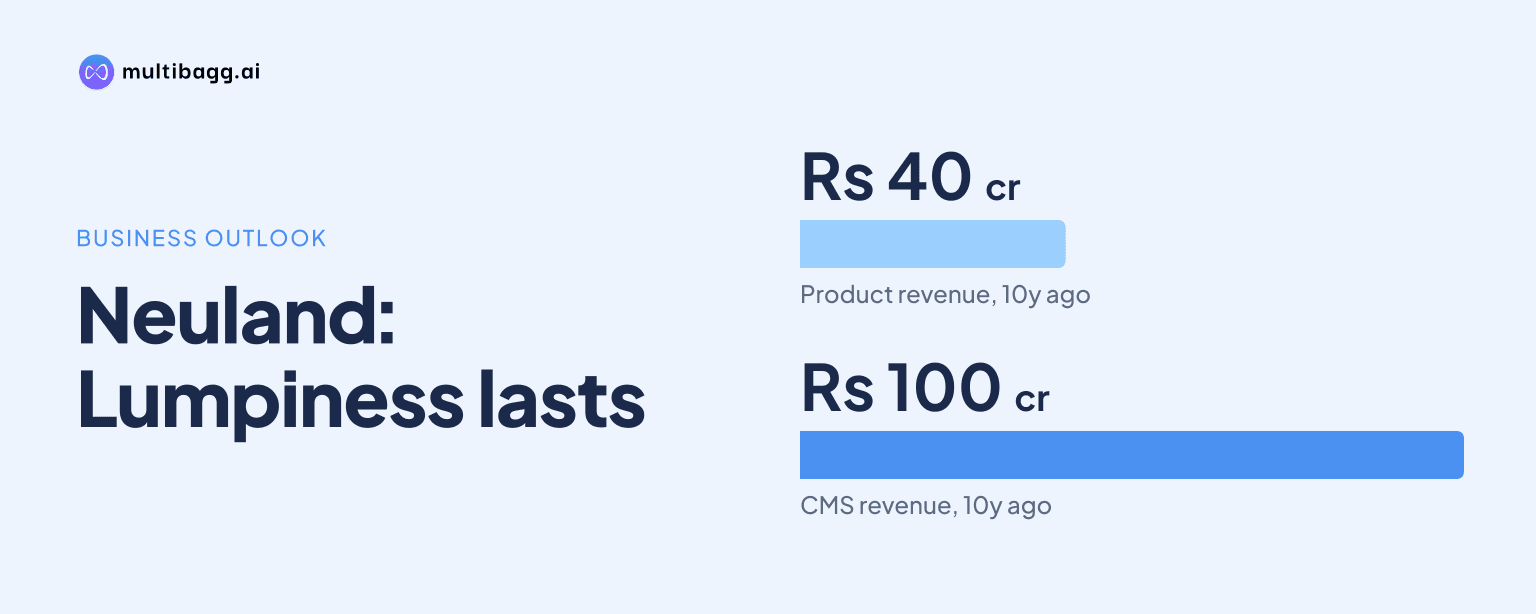
- About 10 years ago, Neuland's largest product generated Rs 40 crore annually against Rs 100 crore of CMS business.
- Management says the CMS business and its larger contributors have both grown roughly 10 times.
- Neuland expects peptide Module 2's configuration to be finalised within the next three to six months.
powered by IRIS
On November 3, 2026, Neuland Laboratories Limited said revenue could remain lumpy as larger commercial molecules scale, with its Contract Manufacturing Services (CMS) business and its largest contributors each roughly 10 times their size of about a decade ago. Management said a much broader group of similarly sized contributors, rather than growth alone, would be needed to smooth quarterly timing.
Know Neuland Laboratories inside out
Results, valuation, peers and who's buying, in one view.
Why is Neuland's CMS revenue lumpy?
Neuland said CMS revenue is lumpy because a handful of commercial molecules contribute disproportionately to the segment, while customers do not necessarily order production evenly through all four quarters. A molecule can generate orders in one, two or three quarters rather than continuously, making the timing of revenue difficult to predict.
The mechanism is therefore both customer concentration and batch-order timing. Neuland said its major commercial products are not always manufactured on a continual basis by customers, so a limited number of orders can materially affect a quarter. Management did not draw conclusions about why other contract development and manufacturing organisations may report different patterns, citing differences in pipeline lifecycle stages and scale.
The company used a historical CMS example to show the issue. About 10 years ago, Neuland's largest product generated Rs 40 crore annually, against total CMS business of Rs 100 crore. The contribution of one product at that scale meant the quarter in which it was ordered and manufactured could affect the revenue profile of the overall CMS business.
Will growth make Neuland's CMS revenue more predictable?
No, Neuland said growth by itself will not necessarily make CMS revenue less volatile because the largest molecules can grow alongside the total business. Management said the CMS business and its larger contributors have each increased by roughly 10 times since the period when the largest product generated Rs 40 crore within a Rs 100 crore CMS business.
Management said lumpiness would decline if the number of meaningful contributors rose substantially while the contribution from each major molecule remained broadly similar. It offered an illustration of moving from three or four large contributors to 30 over the next five to 10 years, which would distribute revenue across more order cycles. This was an explanation of the condition for lower volatility, not a forecast for the portfolio.
The unresolved issue is whether Neuland will add many molecules of comparable size or win even larger opportunities. Management said it cannot predict that outcome. If new commercial molecules become larger, their individual production schedules may continue to have an outsized effect on quarterly CMS revenue even as the number of projects grows.
What is Neuland saying about FY2027 and FY2028 growth?
Neuland said FY2027 will grow and FY2028 will also grow, but it declined to give a percentage target or even a broad range such as high-teens growth. Management said its previous commentary should remain the basis for expectations because it did not want to provide more precise guidance for either year.
For FY2026, management said CMS outgrew Generic Drug Substances (GDS), which it said could support describing that year as an inflection point in the context of CMS growth. It did not extend that label to FY2027 or FY2028, instead calling them years of good growth. The transcript does not provide CMS or GDS revenue figures for FY2026, nor does it disclose the revenue contribution of current large molecules.
This distinction matters because CMS order timing is the stated source of lumpiness. A faster-growing CMS segment could make the production schedules of commercial molecules more relevant to the timing of consolidated revenue, but Neuland has not disclosed a numerical mix target or a timetable for revenue diversification.
Got a follow-up? Ask IRIS
Can peptides reduce Neuland's concentration risk?
No, Neuland did not present peptides as a standalone solution to CMS concentration. Management said future growth after 2030 is intended to come from peptides, complex small molecules and other products, rather than from one platform alone. It also said it does not see patent expiries before 2030 in meaningful markets for key molecules that contribute significantly to customers.
Management agreed that peptide commercial revenue could take roughly one-and-a-half to two years under the timeline discussed on the call. It described six to nine months before master services agreement, or MSA, revenue begins, followed by another six to nine months before commercial revenue. That sequence means peptide activity may add development revenue before it contributes commercial production revenue.
Neuland said it is expanding peptide manufacturing from a largest historical 50-litre good manufacturing practice solid-phase peptide synthesis reactor to 500 litres and is considering 1,000 litres. Management said errors in peptide manufacturing can be hard to reverse, particularly in downstream processing, because a batch may need to be discarded. It said systems, controls and talent will be important as it moves to larger-scale active pharmaceutical ingredient production.
How could the broader pipeline affect quarterly revenue?
Neuland's stated objective is to keep attracting molecules, including potentially large contributors, rather than to promise that quarterly revenue will normalise within 12, 18 or 24 months. Management said large products can support a business's scale and future diversification, even though they can also make revenue more dependent on production cycles in a given quarter.
The company also identified a near-term specialty-products issue separate from the peptide programme. Management said several molecules had contributed significantly through the specialty segment, but customers had faced difficulties manufacturing some of those products. Based on customer feedback, Neuland expects more revenue from those specialty products by Q4, including products that contribute to both topline and bottomline.
That expected Q4 recovery is an operational item, not a disclosed solution to CMS lumpiness. Neuland's explanation of revenue volatility remains centred on a small group of commercial CMS molecules and uneven ordering patterns. The transcript does not quantify the affected specialty-product revenue, the size of the expected Q4 recovery or the number of current major CMS contributors.
Conclusion
Neuland's message is that scale does not automatically dilute concentration: a Rs 40 crore product within a Rs 100 crore CMS business was lumpy about 10 years ago, and management says both the business and major contributors are now roughly 10 times larger. Smoother revenue would require the number of meaningful molecules to increase faster than the size of individual commercial opportunities.
The next items to watch are whether Neuland provides evidence of a broader contributor base, the expected Q4 recovery in specialty products, and the configuration of peptide Module 2. Management said Module 2's configuration should be finalised in the next three to six months, while commercial peptide revenue could take roughly one-and-a-half to two years under the timeline described on November 3, 2026.