










Neuland Laboratories Limited Q2 Income Falls 11.4%, H1 Rises 35.6%
Key highlights
- Neuland Laboratories reported Q2 FY27 total income of INR 457.2 crore, down 11.4% year-on-year.
- Q2 FY27 EBITDA fell to INR 104.6 crore and EBITDA margin declined to 22.9% from 30.4%.
- Q2 FY27 profit after tax declined 47.0% to INR 51.1 crore.
- H1 FY27 total income rose 35.6% to INR 1,107.2 crore, while working capital reached 104 days of sales.
powered by IRIS
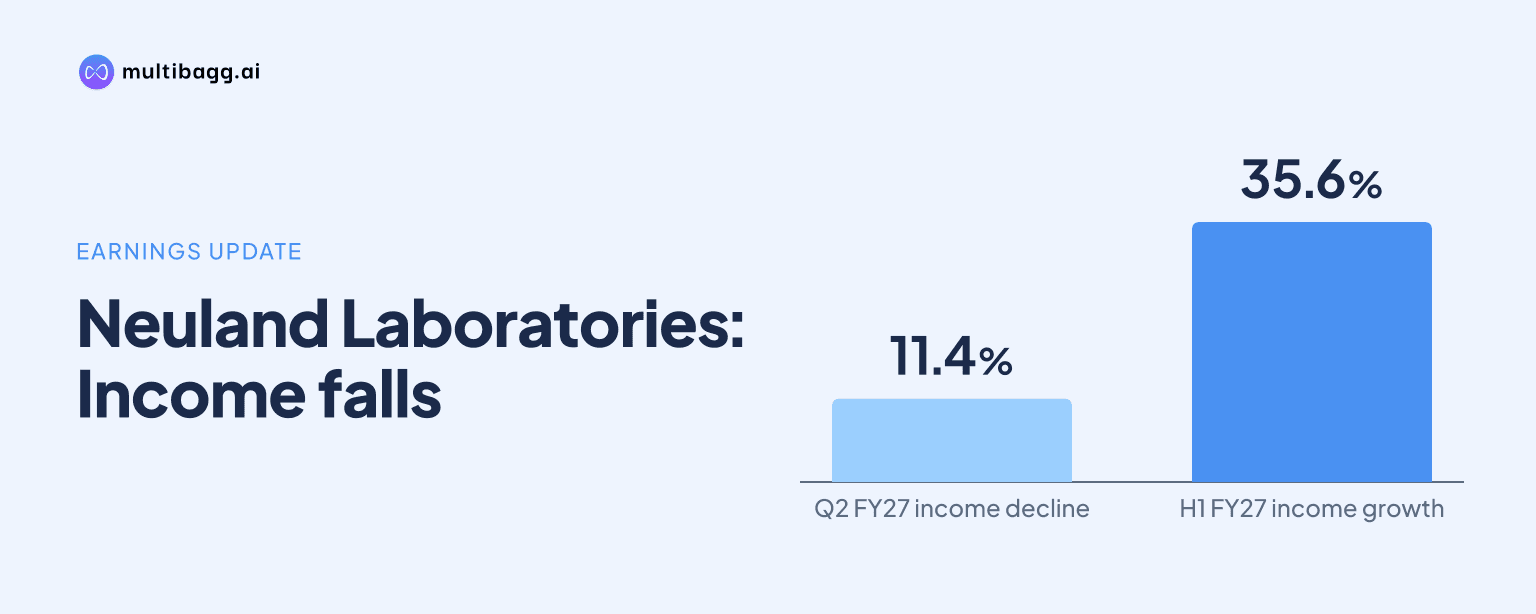
Neuland Laboratories Limited reported Q2 FY27 total income of INR 457.2 crore, down 11.4% from INR 516.1 crore a year earlier, while first-half income increased 35.6% to INR 1,107.2 crore. The quarterly decline was accompanied by a 47.0% fall in profit after tax, reflecting uneven commercial shipments and lower operating leverage.
Know Neuland Laboratories inside out
Results, valuation, peers and who's buying, in one view.
What did Neuland Laboratories report in Q2 FY27?
Neuland Laboratories reported total income of INR 457.2 crore for Q2 FY27, compared with INR 516.1 crore in Q2 FY26. EBITDA declined to INR 104.6 crore from INR 156.9 crore, while the EBITDA margin contracted to 22.9% from 30.4% in the year-earlier quarter. Profit after tax fell to INR 51.1 crore from INR 96.5 crore, and earnings per share stood at INR 39.85.
The company said commercial CMS molecules continued to make a meaningful contribution during the quarter. Its GDS business received contributions from the Prime and Specialty portfolios. Management reiterated that the timing of shipments and product mix can cause material movement between individual quarters, making longer reporting periods more relevant for evaluating business progression.
Why did Neuland Laboratories' quarterly profit decline?
Neuland Laboratories attributed the uneven quarter primarily to commercial timing and product-mix variability. The company has consistently indicated that its business can be lumpy because the timing of commercial shipments differs across products and customers. This variability affected Q2 income and operating leverage compared with the stronger base of Q2 FY26.
Input costs also rose during the first half. Management cited geopolitical conditions and ongoing conflicts in different regions as factors behind volatility in certain raw-material prices, along with higher freight and logistics costs. Gross margin declined modestly to 59.4%, while the larger reduction in EBITDA margin indicates that lower quarterly income also weighed on the absorption of operating costs.
Working capital stood at 104 days of sales in the quarter, compared with 84 days in the preceding quarter. The disclosed increase is a relevant operating metric for investors because it indicates more capital was tied up in the business at the end of the period. The company did not provide a quantified FY27 growth forecast or molecule-level revenue details during the call.
How did Neuland Laboratories perform in the first half?
Neuland Laboratories recorded total income of INR 1,107.2 crore in H1 FY27, up from INR 816.7 crore in H1 FY26. H1 profit after tax increased 80.2% to INR 198.5 crore, according to the investor presentation. Management described the first-half performance as being in line with its plan despite the softer second quarter.
The contrast between H1 growth and the Q2 decline illustrates management's point on quarterly shipment timing. The company said commercial CMS, or custom manufacturing solutions, remained a meaningful revenue contributor, while the GDS portfolio also contributed. It expects its business to be assessed over longer periods rather than through a single quarter's income or profitability.
Got a follow-up? Ask IRIS
What capacity investments is Neuland Laboratories making?
Neuland Laboratories has commissioned a new peptide block at Unit 1 and said it has seen encouraging traction. Management said the commissioning has increased its confidence and visibility as it plans subsequent modules of its peptide expansion. The company also plans to inaugurate a process R&D centre at Genome Valley in Hyderabad, which it expects to be fully operational by early next year.
Peptides were a key discussion point on the earnings call. Management acknowledged expectations of some capacity correction, particularly amid GLP-1-related enthusiasm and reports of excess capacity in China. However, it said India does not have the same scale of CDMO capacity in peptides as it has for small molecules, and described the domestic peptide market as significantly under-capacitated.
These investments are part of a broader strategy to add technical and manufacturing capability. The company also referred to a strong RFP pipeline, or requests for proposals, and commercial CMS opportunities as factors supporting its FY27 and FY28 growth expectations. It did not disclose investment amounts, capacity figures or customer-specific commitments for the new facilities.
What does the Q2 result mean for investors?
Neuland Laboratories' Q2 result shows that quarterly earnings remain sensitive to shipment scheduling, product mix and operating leverage. Total income fell 11.4% year-on-year, but H1 income increased 35.6%, making the half-year trend more favourable than the standalone second-quarter numbers. The fall in EBITDA margin to 22.9% also highlights the effect of lower income and higher input, freight and logistics costs.
For investors, the principal disclosed operating points are the expansion in peptide capability, the planned Hyderabad R&D centre and the increase in working-capital days to 104. The company maintained that H1 was on plan and referred to ongoing commercial CMS contributions and RFP activity. However, management did not provide quantified full-year guidance, so the pace and timing of commercial deliveries remain important variables in reported performance.
Conclusion
Neuland Laboratories delivered a weaker Q2 FY27 on income, EBITDA and profit, with total income at INR 457.2 crore and profit after tax at INR 51.1 crore. Its H1 FY27 performance was stronger, with income rising to INR 1,107.2 crore, while management continued to frame the business around longer-term shipment cycles rather than quarterly movements.
The next disclosed milestones are the planned full operationalisation of the Genome Valley process R&D centre by early next year and further peptide-expansion modules. Investors will also watch whether commercial CMS shipments, input-cost conditions and working-capital days improve in the remaining FY27 quarters.