










Neuland expects peptide PPQ revenue in six to nine months
Key highlights
- Neuland expects peptide PPQ revenue within 6 to 9 months of November 3, 2026.
- Management said commercial peptide sales in roughly 18 to 24 months were a reasonable expectation.
- Neuland expects to bear potential idle costs at the peptide facility for 1 to 1.5 years.
- Neuland acquired about 134 acres at Kakinada for long-term expansion.
powered by IRIS
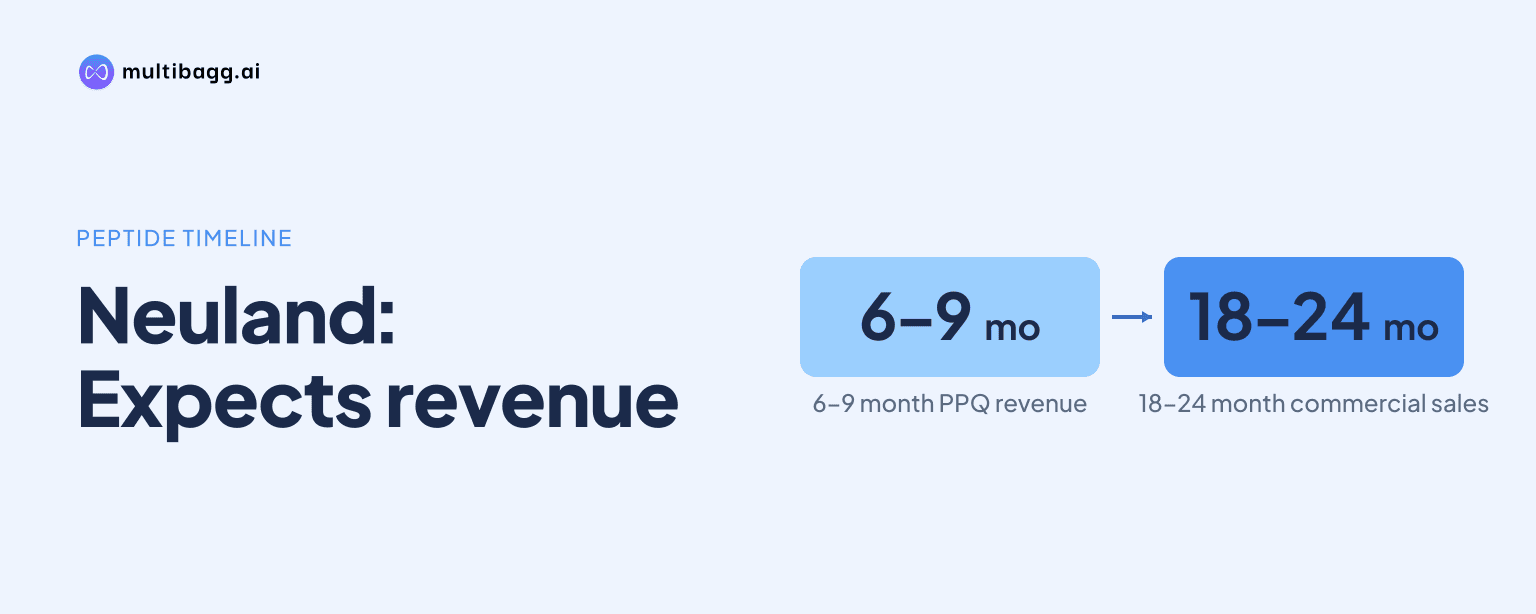
Neuland Laboratories Limited expects peptide process performance qualification, or PPQ, revenue within six to nine months of its November 3, 2026 earnings call, while management said commercial peptide sales in roughly 18 to 24 months were a reasonable expectation. The newly commissioned Unit One peptide block already generates development billing, although management said that revenue is not substantial.
Know Neuland Laboratories inside out
Results, valuation, peers and who's buying, in one view.
When will Neuland report peptide PPQ revenue?
Neuland expects PPQ-related peptide revenue to begin appearing within six to nine months of the November 3, 2026 call. Management said the company already bills customers for peptide development work, but described that revenue as not substantial. The next revenue milestone is PPQ work, potentially including completion and shipment of the first validation batch from the newly commissioned peptide block at Unit One.
The timetable applies to a couple of projects progressing in Neuland's current peptide portfolio, rather than representing a broad commercial ramp across the facility. Management said it built the facility for a portfolio of projects and did not disclose the value of expected PPQ billing, batch sizes or a quarterly revenue contribution target. This makes the six-to-nine-month window a project milestone rather than quantified financial guidance.
How does Neuland move from PPQ to commercial peptide supply?
Neuland moves from PPQ to commercial supply after validation is completed successfully and the customer enters a commercial supply agreement. Management said it uses master services agreements, or MSAs, for PPQ batches, which are validation batches. If the validation succeeds and a customer's drug programme progresses as expected, the relationship typically shifts from PPQ-focused development work to manufacturing under a supply agreement.
A PPQ shipment therefore does not equal recurring commercial sales. Management cited documentation, customer decision-making and other timing factors as variables in the transition, while retaining its six-to-nine-month expectation for PPQ activity. When an analyst suggested that commercial revenue could start roughly one-and-a-half to two years after the call, management described that as a reasonable expectation.
Module One has been configured around the needs of projects now in hand. Neuland said peptide production requires upstream work to make crude material and fragments, followed by downstream purification and isolation of the final active pharmaceutical ingredient, or API. The module includes purification columns and a lyophilizer, with equipment sizes selected for the current projects rather than larger vessels that could require batches beyond customer requirements.
Why could commercial peptide sales take 18 to 24 months?
Commercial peptide sales could take roughly 18 to 24 months because PPQ validation must be completed before commercial supply agreements and routine manufacturing can begin. Management did not describe this interval as certain or contractually fixed. It is based on current project requirements, customer documentation, customer decisions and the progression of the underlying drug programmes.
Neuland also flagged risks inherent in development programmes. Molecules may progress differently from initial expectations, customer timelines may move, and the timing of individual commercial shipments can affect results between quarters. For a contract development and manufacturing organisation, or CDMO, the customer's clinical, regulatory and launch progress determines when a peptide API advances from validation batches to regular commercial supply.
The company plans Modules Two, Three and Four only when Module One is occupied and it has visibility into projects expected to use later capacity. Management cited a database showing 1,000 synthetic peptides between investigational new drug, or IND, status and commercialisation. It also noted that required volumes vary substantially, from tens or hundreds of grams to kilograms and larger quantities, requiring modules to be configured for the applicable portfolio.
Got a follow-up? Ask IRIS
Who will bear idle costs at Neuland's peptide facility?
Neuland said it will bear idle costs at the peptide facility during the next one to one-and-a-half years if capacity is unused. Management said plant-running costs are generally not discussed with customers unless a site was built for a specific project. The Unit One facility was instead designed for a portfolio, leaving Neuland responsible for any idle capacity while projects move through PPQ and toward commercial supply.
Management said later peptide modules will be triggered by Module One occupancy. It also said it would not hold back peptide investment if its existing commercial business faced a negative impact, because it sees sustained demand for peptide APIs. That position separates the peptide programme from the company’s longer-term site-development choices, which management said could be adjusted according to business conditions.
During the quarter, Neuland acquired about 134 acres at Kakinada in Andhra Pradesh as a base for future expansion. Management said Kakinada could be slowed if there were a short- to medium-term impact on commercial products, while characterising peptide expansion as a continuing priority. The board also approved additional land around Unit One, extending the footprint of the site where the peptide block has been commissioned.
How does the peptide timeline fit Neuland's existing business?
The peptide timeline adds a future revenue source to a business currently driven by commercial molecules in contract manufacturing services, or CMS, and Prime portfolio products in generic drug substances, or GDS. Neuland said CMS revenue exceeded GDS revenue for the first time in FY2026. In the reported quarter, management said commercial-molecule revenue came from about five or six molecules, alongside smaller intermediates that can be ordered only once in two or three years.
Management said there had been no new launch in the prior two to three quarters, with the last launch occurring about a year earlier. It attributed the variation across the last three to four quarters to the uneven quantum and timing of commercial shipments, rather than the absence of a prior launch quantity. This shipment pattern means peptide PPQ billing would initially enter an existing revenue base that management has described as lumpy.
Peptides are not the only prospective source of growth beyond current commercial molecules. Management said it does not see significant patent expiries in meaningful markets for key molecules before 2030, and expects growth to come from peptides, complex small molecules and other products. It said FY2027 and FY2028 are expected to grow, but declined to provide a numerical growth range because of the business's shipment timing.
Conclusion
Neuland has set out a sequence rather than an immediate peptide revenue ramp: modest development billing is already in place, PPQ-related revenue is expected within six to nine months, and commercial supply could follow in roughly 18 to 24 months. The interval reflects the need for successful validation, customer agreements and continued progression of customer drug programmes.
The next disclosed milestones are whether the first PPQ batch is completed and shipped within the six-to-nine-month period, and whether Module One gains enough occupancy to trigger later modules. Investors will also watch utilisation over the next one to one-and-a-half years, when management expects Neuland to bear possible idle costs, and customer progress toward commercial supply agreements.