










Neuland outlines Rs 1,700-1,800 crore capex over three years
Key highlights
- Neuland indicated approximately Rs 1,700-1,800 crore of capex over the next three years.
- Neuland has spent about Rs 250 crore on peptide Module 1 so far.
- Neuland expects to finalise peptide Module 2’s configuration within three to six months of November 3, 2026.
- Neuland has committed to 134 acres at Kakinada, with potential to reach 200 acres over the next two years.
powered by IRIS
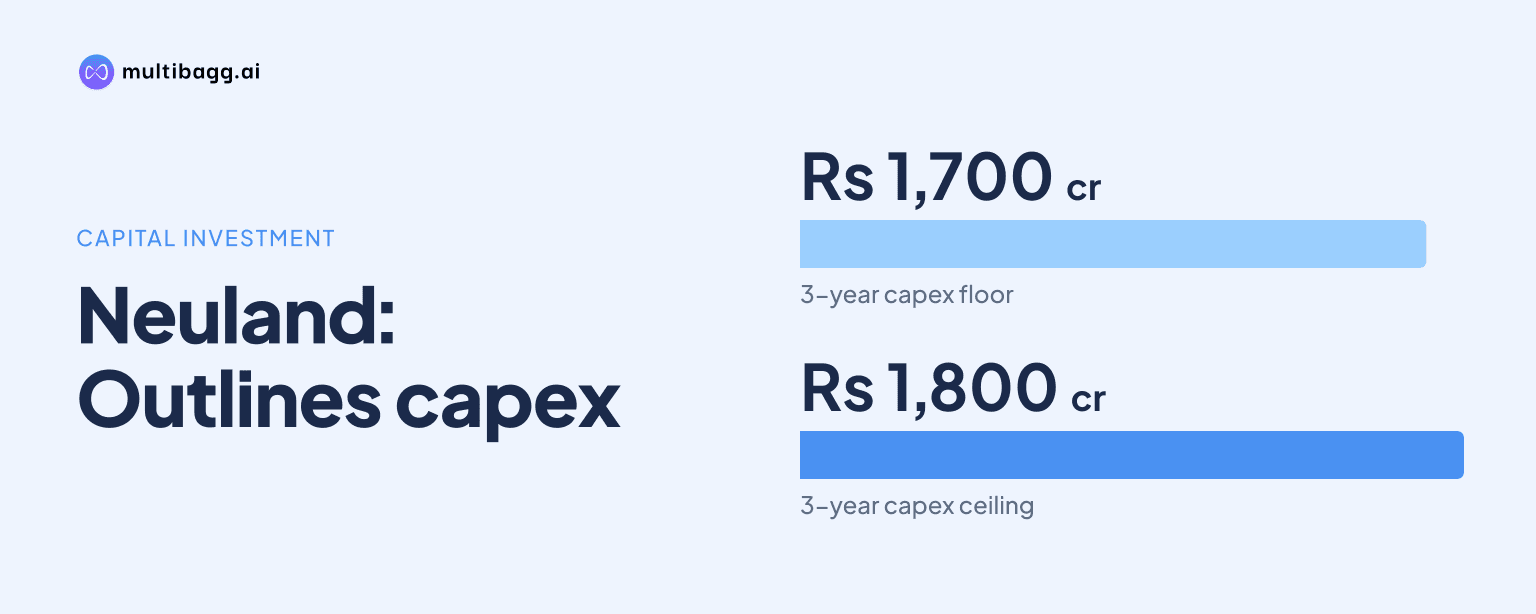
Neuland Laboratories Limited has indicated approximately Rs 1,700-1,800 crore of capital expenditure over the next three years, with about Rs 250 crore already spent on peptide Module 1. Neuland said the final configuration and investment cost for peptide Module 2 should be settled within three to six months of its November 3, 2026 call.
Know Neuland Laboratories inside out
Results, valuation, peers and who's buying, in one view.
What is Neuland’s three-year capex plan?
Neuland’s capex indication is approximately Rs 1,700-1,800 crore over the next three years. Management described the range as a broad figure rather than a fixed, project-by-project commitment, saying it is revisited as the Kakinada development and other requirements evolve.
The range has a Rs 100 crore difference between its lower and upper limits. Management separated this wider investment envelope from peptide Module 2, whose configuration and cost had not crystallised as of November 3, 2026, so no specific Module 2 budget was disclosed.
The Rs 250 crore spent on Module 1 is the only module-specific investment figure Neuland provided. Management said investors could make approximate calculations from that spending, but it did not state that Module 2 would use the same design, equipment set or capital amount.
When will Neuland disclose peptide Module 2’s cost?
Neuland expects to finalise peptide Module 2’s configuration and move forward within three to six months of the November 3, 2026 call. Management said it would communicate the investment amount once that design work is complete, leaving the project’s capital requirement unresolved.
The module sits within Neuland’s shift from peptide process development toward larger-scale production. Management said its largest good manufacturing practice, or GMP, solid-phase peptide synthesis reactor was previously 50 litres, is now 500 litres, and that the company is considering 1,000-litre capacity.
Neuland said it intends to manufacture finished active pharmaceutical ingredients, or APIs, while also making fragments used in API production. Management described peptide synthesis as potentially irreversible: while an impurity in small-molecule chemistry can sometimes be removed through reprocessing, a peptide manufacturing error may require discarding an entire reactor.
That risk is why Neuland said it needs specialised talent, systems and controls as peptide work moves to larger scale, particularly in downstream operations. The company also clarified that its offering includes upstream fragments, crude material, purification and final peptide API isolation, rather than only downstream purification.
How does Kakinada support Neuland’s expansion?
Neuland has committed to 134 acres at Kakinada and said the site could reach 200 acres over the next two years if business growth requires it. Management said it negotiated a first right of refusal on additional land rather than committing immediately to the larger footprint.
The committed Kakinada area of 134 acres is more than twice the combined 60 acres occupied by Neuland’s Unit I, Unit II and Unit III manufacturing sites. Management said the larger span is intended to let the company accept more molecules, although it cannot know at project entry whether a molecule will become a Rs 40 crore or Rs 400 crore opportunity.
Kakinada is therefore part of the wider capex envelope, but management did not allocate a defined share of the Rs 1,700-1,800 crore range to that site. Whether the landholding advances from 134 acres to 200 acres depends on business growth, according to management.
Got a follow-up? Ask IRIS
Why is Neuland expanding despite uneven revenue?
Neuland says it intends to increase the number of molecules in its commercial manufacturing services, or CMS, basket, even though bigger projects can sustain uneven revenue patterns. Management said customer orders for commercial molecules may come in one, two or three quarters rather than being distributed across all four quarters.
Management compared the current situation with about 10 years ago, when its largest product generated Rs 40 crore annually and CMS revenue was Rs 100 crore. It said the CMS business and its large contributors have both grown by roughly 10 times, meaning concentration has continued even as the business has expanded.
Neuland said unevenness could reduce if its contributor count rose from three or four molecules to 30 over five to 10 years without a matching increase in each molecule’s contribution. However, management said it now sees numerous Rs 100 crore molecule opportunities, compared with rarely seeing one until five years ago, and has also seen Rs 1,000 crore molecules.
The company is also building a new research and development centre for small molecules and peptides. Management said the facility will integrate process engineering, quality by design, flow chemistry and small-volume API production, reducing the earlier need to design a process in research and development and then find pilot capacity at one of Neuland’s three manufacturing sites.
What are the execution issues in Neuland’s peptide plan?
Neuland identifies process-development capability, specialised staffing and capacity discipline as the central execution issues for peptide investment. Management said Neuland has completed peptides with more than 40 amino acids, but added that India has generic-sector talent rather than enough talent specifically for contract development and manufacturing.
Management expects further headcount additions in regular research and development, the new research and development centre, peptide manufacturing and other API activities. The call did not provide hiring numbers, staff-cost targets or a timetable, but it indicated that the investment programme requires personnel alongside reactors and other equipment.
On the market backdrop, management said there were about 1,000 synthetic peptides between investigational new drug, or IND, status and commercial stages, compared with 500 in January 2025. It said the investment objective is to address a diverse set of those peptide drugs rather than depend on a single weight-loss drug or glucagon-like peptide-1, or GLP-1, product.
Management also said GLP-1 enthusiasm can result in excess capacity before a correction. It stated its view that India lacks peptide contract-development capacity comparable with its small-molecule capacity, while adding that China may have overcapacity based on information management had heard.
Conclusion
Neuland’s Rs 1,700-1,800 crore three-year capex indication combines spending already made on peptide Module 1 with investment flexibility for peptide, process-development and site capacity. The plan is designed to widen the company’s ability to take on more small-molecule and peptide projects, while management recognises that larger individual molecules can continue to make quarterly revenue uneven.
The next stated milestone is the finalisation of peptide Module 2’s configuration within three to six months of November 3, 2026, after which management said it would disclose the investment amount. Investors can also watch whether Kakinada remains at 134 acres or moves toward 200 acres over the next two years, and whether Neuland adds the specialised peptide and research staff it says the expansion requires.