










Neuland to bear peptide unit idle costs in 12-18-month ramp
Key highlights
- Neuland expects to bear peptide-unit idle costs for 12 to 18 months.
- Neuland expects PPQ-related peptide revenue in 6 to 9 months and commercial revenue in roughly 18 to 24 months.
- Neuland reported Q2 FY27 total income of Rs 457.2 crore and EBITDA margin of 22.9%.
- Neuland recorded Rs 261 crore of capital-expenditure outflow in H1 FY27 and net debt of negative Rs 208 crore.
powered by IRIS
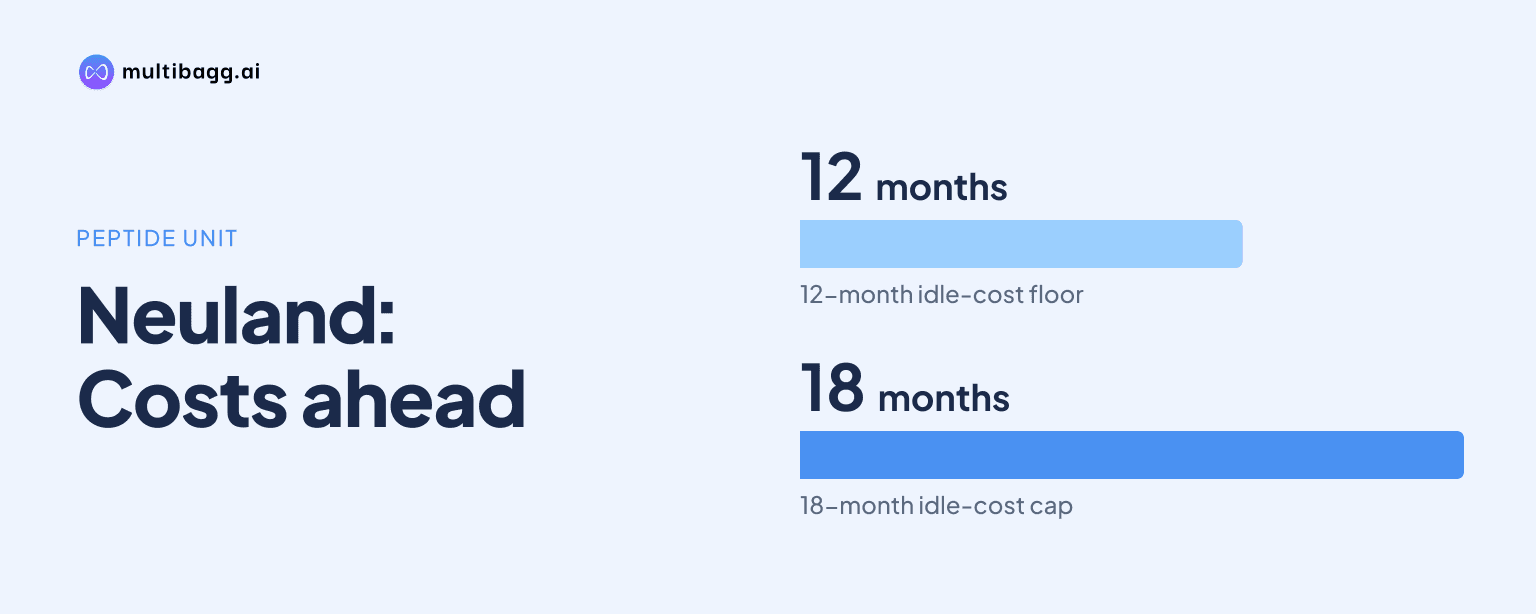
Neuland Laboratories Limited expects to absorb idle costs at its newly commissioned peptide unit for the next 12 to 18 months, because customer payments for unused capacity generally begin only after validation and commercial-supply arrangements progress. Neuland expects peptide validation-batch revenue in 6 to 9 months and commercial revenue in roughly 18 to 24 months.
Know Neuland Laboratories inside out
Results, valuation, peers and who's buying, in one view.
Who will bear Neuland's peptide-unit idle costs?
Neuland will bear the peptide unit's idle costs during the expected 12-to-18-month ramp-up. Chief Executive Officer and Managing Director Saharsh Davuluri said peptide customer work begins with process performance qualification, or PPQ, batches, with commercial supply agreements typically following successful validation and customer drug-programme progress.
Neuland said idle capacity and plant-running costs are generally not part of customer discussions during or after the move from PPQ work to commercial manufacturing, except where a facility is built for one specific project. The new unit was designed around a portfolio of projects rather than a dedicated single-product plant, so any unused capacity during the next 12 to 18 months will be a Neuland cost.
Management said a couple of peptide projects are progressing and are expected to use the facility. However, Neuland did not disclose the projects' names, capacity utilisation, investment in the commissioned module or the rupee value of idle costs, leaving the financial effect during FY27 and FY28 unspecified.
When will Neuland's peptide unit generate revenue?
Neuland expects PPQ-related peptide revenue to begin appearing in 6 to 9 months. The company already bills peptide development revenue, but Davuluri said those current receipts are not substantial, distinguishing development work from the validation batches needed before commercial supply.
After PPQ batches begin, a shift to commercial supply could require a further 6 to 9 months, according to management. That interval includes documentation, customer decisions and timing considerations, and Davuluri agreed with an analyst's assessment that commercial peptide revenue could take about one-and-a-half to two years from the November 3, 2026 call.
The timeline depends on successful validation and on customer drug programmes proceeding as expected. Neuland also noted that development molecules do not always advance through clinical trials or reach commercialisation, meaning the 18-to-24-month commercial-revenue expectation is management's current assessment rather than a contractual revenue commitment.
Why did Neuland size peptide equipment for current projects?
Neuland sized Module 1 around the projects currently in its peptide portfolio, rather than installing the largest possible equipment. Management described peptide manufacturing as an upstream process for crude material and fragments, followed by downstream purification and isolation that produces the final active pharmaceutical ingredient, or API.
The commissioned module includes purification columns and isolation equipment because Neuland intends to supply final peptide APIs, rather than only crude peptides or fragments. Management said the two purification columns, lyophiliser and synthesis configuration were selected for the batch sizes and purification needs of the projects now being executed.
Davuluri said a larger column could force a batch size beyond customer requirements, comparing a 5,000-litre reactor with a 1,000-litre customer need. Modules 2, 3 and 4 will be configured when Neuland has visibility on additional projects, their development stage and the scale of commercial demand.
Got a follow-up? Ask IRIS
How does the peptide ramp fit Neuland's Q2 FY27 financial position?
The peptide ramp follows a Q2 FY27 decline in total income to Rs 457.2 crore from Rs 516.1 crore in Q2 FY26, while H1 FY27 income increased to Rs 1,107.2 crore from Rs 816.7 crore in H1 FY26. Management said shipment timing and product mix can make individual quarters uneven, particularly as commercial orders become larger.
Earnings before interest, tax, depreciation and amortisation, or EBITDA, margin declined 7.5 percentage points year on year to 22.9% in Q2 FY27. Profit after tax fell by Rs 45.4 crore, while management cited higher input prices, freight and logistics costs amid geopolitical volatility; it did not quantify any peptide-unit idle-cost effect in the reported quarter.
Neuland reported capital-expenditure outflow of Rs 261 crore and free cash flow of Rs 99 crore in H1 FY27, with net debt at negative Rs 208 crore. Working capital increased to 104 days of sales in Q2 FY27 from 84 days in the prior quarter, as management continued to focus on inventory, collections and capital deployment.
How will Neuland sequence peptide and Kakinada investment?
Neuland said Modules 2, 3 and 4 would be triggered when Module 1 is occupied. Management said it would continue peptide investment even if current commercial or contract manufacturing services, or CMS, products faced a negative outcome, because it sees sustained demand for peptide APIs.
The company acquired about 134 acres at Kakinada, Andhra Pradesh, during Q2 FY27 and said its board had approved additional land around Unit One. Davuluri characterised Kakinada as a longer-term investment that could be moderated or deferred if commercial products faced a short-to-medium-term setback, unlike expansion linked to occupied peptide capacity.
FY26 was Neuland's first year in which CMS revenue exceeded generic drug services, or GDS, revenue. In Q2 FY27, commercial CMS molecules and Prime-portfolio GDS products were the main revenue contributors, while management said FY27 request-for-proposal activity had reached its strongest level to date.
Conclusion
Neuland's peptide project carries a stated near-term cost burden: the company expects to fund idle capacity for 12 to 18 months as portfolio projects complete PPQ work and move toward commercial supply. The plan adds peptide API capability while Q2 FY27 EBITDA margin was 22.9%, compared with 30.4% in Q2 FY26, and management has not quantified the unit's cost impact.
The next disclosed milestones are PPQ-related peptide revenue in 6 to 9 months and possible commercial revenue in about 18 to 24 months. Investors can also watch whether Module 1 occupancy triggers Modules 2 through 4, and whether Neuland moderates the approximately 134-acre Kakinada development as it assesses customer requirements and commercial-business conditions.