










Neuland Laboratories Limited sees peptide pipeline double
Key highlights
- Neuland cited 1,000 synthetic peptides between IND and commercial stages, up from 500 in January 2025.
- Management expects GLP-1-led peptide investment to create some excess capacity before a correction.
- Neuland said it had spent about Rs 250 crore on peptide Module 1.
- Neuland indicated broad capital expenditure of Rs 1,700 crore to Rs 1,800 crore over the next three years.
powered by IRIS
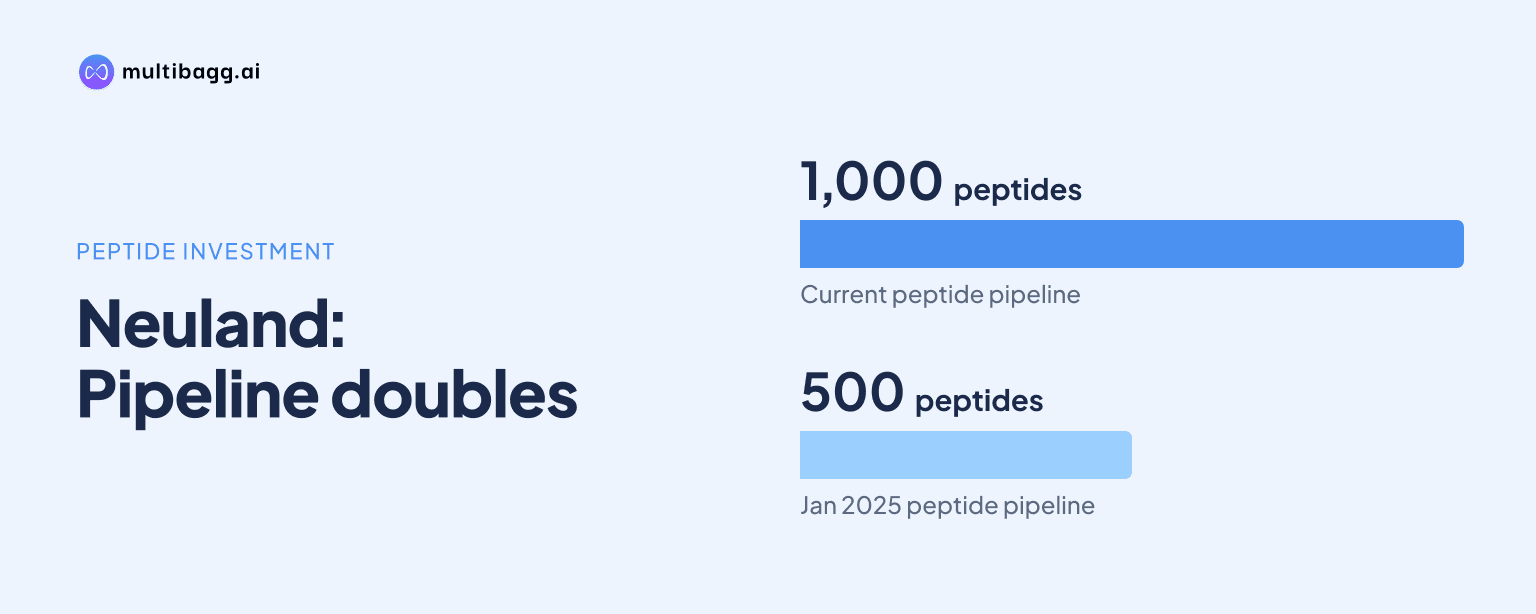
On November 3, 2026, Neuland Laboratories Limited said the synthetic peptide pipeline between Investigational New Drug (IND) and commercial stages had doubled to 1,000 from 500 in January 2025. Neuland also said glucagon-like peptide-1 (GLP-1)-led investment could create excess manufacturing capacity before a market correction.
Know Neuland Laboratories inside out
Results, valuation, peers and who's buying, in one view.
Is peptide demand growing beyond GLP-1 medicines?
Yes. Neuland said the number of synthetic peptides between IND and commercial stages had risen to 1,000 from 500 in January 2025, indicating that development activity extends beyond individual GLP-1 weight-loss medicines. Management attributed the increase to more innovator companies bringing peptides into mainstream drug discovery and development.
Neuland's management said peptides are viewed as natural molecules and more therapy-friendly than small molecules, which it described as chemicals. That stated preference is the mechanism behind its view that peptide contract development and manufacturing organisation (CDMO) demand has risen, rather than demand being confined to a single obesity treatment.
The comparison represents a doubling in the cited peptide pipeline over roughly 22 months. Neuland said its investment objective is to serve this diverse pool of 1,000 peptide drugs, rather than to build capacity for one weight-loss medicine or the next GLP-1 product.
How does Neuland position its peptide capability?
Neuland positions itself as a maker of the complete peptide active pharmaceutical ingredient (API), rather than as a downstream-only supplier. Management said its work can cover fragments, crude peptide, purification and isolation of the final peptide API, while columns and lyophilisation equipment form part of the downstream process.
The differentiator claimed by management is process development, not equipment alone. Neuland said several projects in its current peptide portfolio began as process-design assignments when it did not yet have a manufacturing facility, involving peptide sequencing, sequence design and production of gram-scale quantities before clients committed manufacturing work.
Neuland does not intend to produce every component associated with a peptide. Management listed amino acids, unnatural amino acids, resins, fragments and crude material as possible components, but said it will make those where its process-design, API-manufacturing and good manufacturing practice (GMP) capabilities create value. It identified fragment manufacturing as a core part of peptide production.
This approach also sets a boundary on the meaning of integration. Rather than pursuing all peptide inputs, Neuland said it will focus on areas where its scientific talent and GMP manufacturing are relevant. Management said suppliers adding reactors and relying on customer technology transfers may face greater difficulty if a customer leaves because equipment would remain without equivalent development capabilities.
Got a follow-up? Ask IRIS
Will peptide manufacturing face excess capacity?
Yes, management expects some excess capacity and a subsequent correction, even though it does not see India as currently overbuilt for peptide CDMO. Neuland said the enthusiasm generated by GLP-1 medicines is encouraging investment worldwide and that such euphoria can create capacity ahead of demand before testing and correction occur.
Neuland distinguished India from China in its assessment. Management said India does not yet have peptide CDMO capacity comparable with its small-molecule CDMO capacity, while adding that it had been told China may have excess capacity. It also acknowledged that Chinese overcapacity could affect global markets, including India.
The company's position is therefore not that supply risk is absent. Management said there will be some pain from overcapacity, but argued that Indian companies need to invest because the domestic peptide manufacturing base remains smaller than the country's small-molecule CDMO base. That is management's assessment, not a disclosed industry-wide capacity measurement.
Neuland also identified specialist talent as a constraint. Asked whether India has sufficient talent to meet a sudden surge in peptide demand, management said the country has talent for generic medicines but not enough for CDMO work. The company said it has so far manufactured peptide chains of more than 40 amino acids, identifying the chain length it has handled.
What capacity plans support Neuland's peptide strategy?
Neuland has indicated broad capital expenditure of about Rs 1,700 crore to Rs 1,800 crore over the next three years, while saying it will revisit that figure. The programme includes factors related to Kakinada and other moving parts, so management described the range as broad rather than a fixed commitment.
For peptide Module 1, Neuland said it had spent about Rs 250 crore. The configuration and investment for Module 2 had not been crystallised as of the November 3, 2026 call; management said its goal was to finalise the configuration and move forward within three to six months, then disclose the number.
The physical footprint is intended to expand the number of molecules Neuland can take on, according to management. Its three manufacturing sites, Unit I, Unit II and Unit III, cover 60 acres together, while Kakinada covers 134 acres. Neuland also has a first right of refusal on roughly 60 additional acres and said the Kakinada site could reach 200 acres over the next two years.
Management said the organisation's intent is to add more molecules to its basket, although it cannot predict whether a newly won project will become a Rs 40 crore or Rs 400 crore molecule. It said it now screens opportunities more selectively than 10 years ago and is seeing more Rs 100 crore opportunities, as well as some Rs 1,000 crore opportunities, than it did five years ago.
Conclusion
Neuland's outlook is that peptide demand is becoming broader, with the cited population of synthetic candidates rising from 500 in January 2025 to 1,000 by the November 3, 2026 call. At the same time, management expects GLP-1-led enthusiasm to bring a capacity correction and argues that process development, GMP execution and an ability to support multiple molecules will matter more than reactor capacity alone.
The next disclosed milestone is the planned finalisation of peptide Module 2's configuration within three to six months, after which Neuland said it would provide the investment figure. Investors can also watch how the broad Rs 1,700 crore to Rs 1,800 crore three-year capital-expenditure plan develops, including Kakinada's possible expansion from 134 acres to 200 acres over the next two years.