










NIIT AI-linked revenue reaches 12.4% as coaches add subscriptions
Key highlights
- NIIT said AI-linked revenue rose to 12.4% of Q2 FY27 sales from 9% in Q1 FY27.
- NIIT AI coaches are subscription services sold in addition to training fees.
- Enterprise BIPS revenue reached Rs 20 crore in Q2 FY27, up 17% year on year.
- NIIT reported Q2 FY27 EBITDA of Rs 2.7 crore, compared with a Rs 1.4 crore loss in Q1 FY27.
powered by IRIS
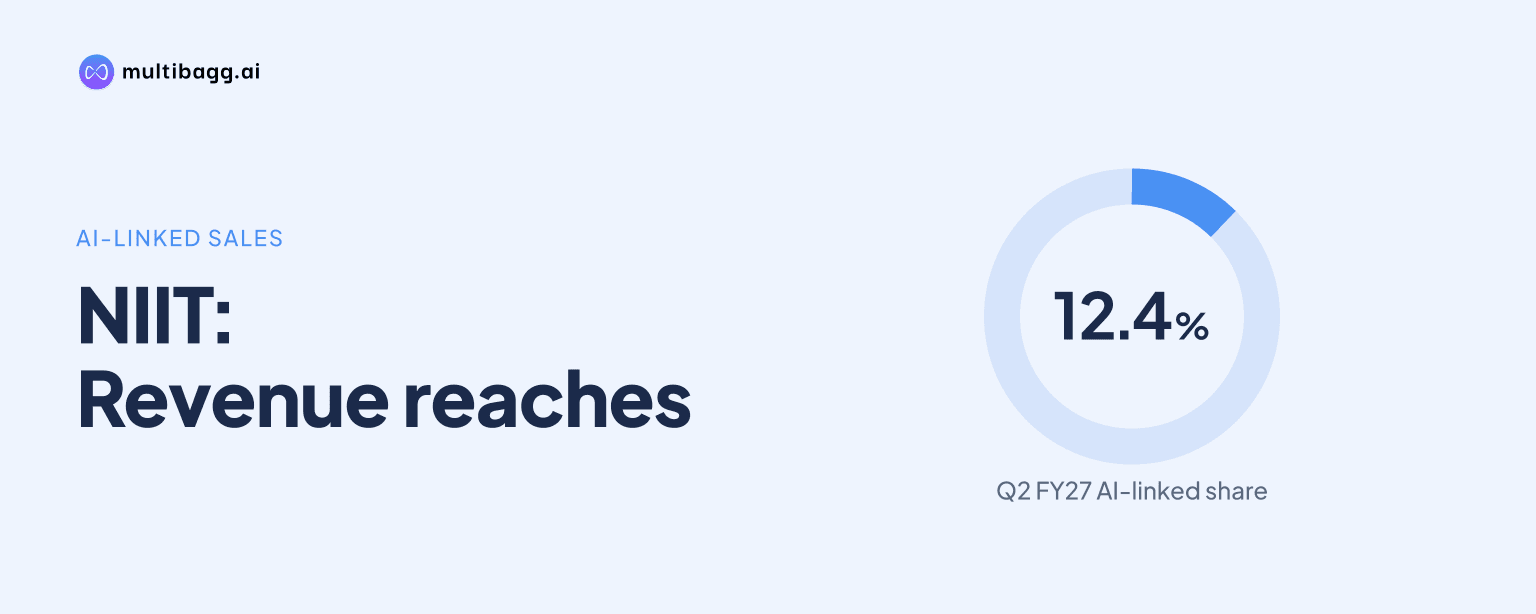
NIIT Limited said AI-linked revenue reached 12.4% of sales in Q2 FY27, up from 9% in Q1 FY27, as its AI coaches became live with more than one customer and added subscription fees to training engagements. NIIT said this recurring revenue stream remains small relative to total sales but represents a positive trend.
Know NIIT inside out
Results, valuation, peers and who's buying, in one view.
How is NIIT monetising AI coaches?
NIIT is monetising AI coaches through subscriptions charged on top of training fees, creating continuing revenue rather than relying solely on one-time training engagements. Management said the coaches can also bring delivery, content and learning management system, or LMS, services, extending learner engagement from the classroom into employees’ daily work.
NIIT identified two products in Q2 FY27: a wealth-management sales coach for bank relationship managers and wealth advisers, and DILOS, or Day in the Life of a Salesperson, for automotive and consumer sales teams. Both products allow salespeople to practise customer conversations with artificial intelligence, or AI, and receive coaching during the interaction.
Management said both AI coaches were live with more than one customer in Q2 FY27 and had contributed to customer operations as well as NIIT revenue. However, NIIT did not disclose subscriber numbers, contract values, renewal rates or the revenue generated specifically by these products, and management described the subscription stream as very small compared with overall sales.
How much of NIIT revenue is directly linked to AI?
NIIT said revenue directly contributed by AI increased to 12.4% of sales in Q2 FY27 from 9% in Q1 FY27. Management separated this measure from the wider portfolio, in which AI is embedded across programmes and used internally to improve efficiency and customer effectiveness.
The increase came as total revenue declined 6% year on year to Rs 98.2 crore in Q2 FY27, although revenue rose 3% quarter on quarter. The 12.4% measure therefore marks a larger directly AI-linked share of sales in a quarter of lower overall revenue, but NIIT did not say that all AI-linked revenue was subscription-based or recurring.
Management said generic AI training is becoming commoditised and that some customers are bringing it in-house. NIIT said its focus is specialised AI training, including programmes for leadership teams and offerings that demonstrate organisational productivity or effectiveness, which is the rationale it gave for role-specific sales coaches.
Which NIIT customer segments use AI-enabled programmes?
NIIT is using AI simulations and coaches in enterprise financial-services programmes, where Enterprise BIPS, or BFSI and Industry Performance Program, recorded all-time high revenue of Rs 20 crore in Q2 FY27. Enterprise BIPS revenue increased 17% year on year and 66% quarter on quarter, according to management.
During Q2 FY27, NIIT partnered with two large banks to establish wealth and sales academies for wealth relationship managers and sales associates. These programmes use immersive AI simulations and AI coaches to build role-specific capabilities and improve frontline effectiveness, linking the wealth-management coach to enterprise training programmes.
BIPS revenue was Rs 32.1 crore, up 11% year on year, while technology-program revenue declined 13% to Rs 66.1 crore as spending by global system integrators, or GSIs, compressed. Enterprise revenue fell 11% to Rs 62.5 crore, while consumer revenue rose 3% to Rs 35.7 crore, changing the enterprise-consumer mix to 64:36 from 67:33 a year earlier.
Got a follow-up? Ask IRIS
Can NIIT AI subscriptions offset pressure in core training?
NIIT’s AI subscriptions cannot yet offset pressure in its core training business because management said coach subscription revenue is very small relative to total sales of Rs 98.2 crore in Q2 FY27. Four of NIIT’s largest GSI clients reduced training consumption by Rs 10 crore year on year during the quarter.
Management attributed the GSI slowdown partly to lower onboarding in some cases, client cost pressures and greater use of internal resources instead of external training providers. It said GSIs are returning with more advanced requirements, but expects overall GSI volumes to remain under pressure for the next two quarters.
NIIT said the subscription mechanism can alter the composition of an individual client programme because workplace use of a coach can continue after the initial training engagement. Management also said coaches can add nonlinearity through attached content, delivery and LMS services, but it provided no target for AI subscription revenue or the AI-linked share of sales.
What does NIIT profitability indicate about AI investment?
NIIT reported earnings before interest, tax, depreciation and amortisation, or EBITDA, of Rs 2.7 crore in Q2 FY27, a 2.7% margin, compared with Rs 1.35 crore in Q2 FY26 and a loss of Rs 1.4 crore in Q1 FY27. Operating expenses fell 8% year on year, more than the 6% revenue decline, while management said it continued investment in new AI offerings and sales capabilities.
Management said its development work delivered efficiency gains of more than 50% and that it uses AI coaches and bots internally to improve sales efficiency. Employee count was 816 at the end of Q2 FY27, down by 50 from Q1 FY27 and by 124 year on year, reflecting un-replaced attrition and resource-optimisation measures.
Capital expenditure declined to Rs 4.4 crore in Q2 FY27 from Rs 6.9 crore in Q2 FY26. Management said investment had moderated because several earlier projects were being capitalised and delivering results, while adding that AI requires continued investment as technology and customer requirements change.
Conclusion
NIIT’s 12.4% AI-linked revenue share indicates that its AI investment is reaching commercial client programmes, especially in sales and wealth-management training. The material change is the use of subscriptions alongside training fees, content and LMS services, which can make client revenue more continuous, although NIIT has not disclosed the size or renewal profile of these subscriptions.
The next test is whether new BIPS engagements and AI programmes can grow while GSI demand stays subdued. Management expects revenue for the rest of FY27 to be broadly flat, expects GSI volumes to remain under pressure for the next two quarters, and plans to revisit its outlook next quarter as chief executive officer Anish Sarkar completes a portfolio, market and operating review.