










NIIT links Q2 revenue fall to Rs 10 crore GSI pullback
Key highlights
- NIIT Q2 FY27 revenue was Rs 98.2 crore, down 6% year-on-year but up 3% quarter-on-quarter.
- Spending by four of NIIT's largest GSI clients fell Rs 10 crore year-on-year in Q2 FY27.
- NIIT BIPS revenue rose 11% year-on-year to Rs 32.1 crore, while enterprise BIPS reached Rs 20 crore.
- NIIT reported Q2 FY27 EBITDA of Rs 2.7 crore and cash and cash equivalents of Rs 688.9 crore.
powered by IRIS
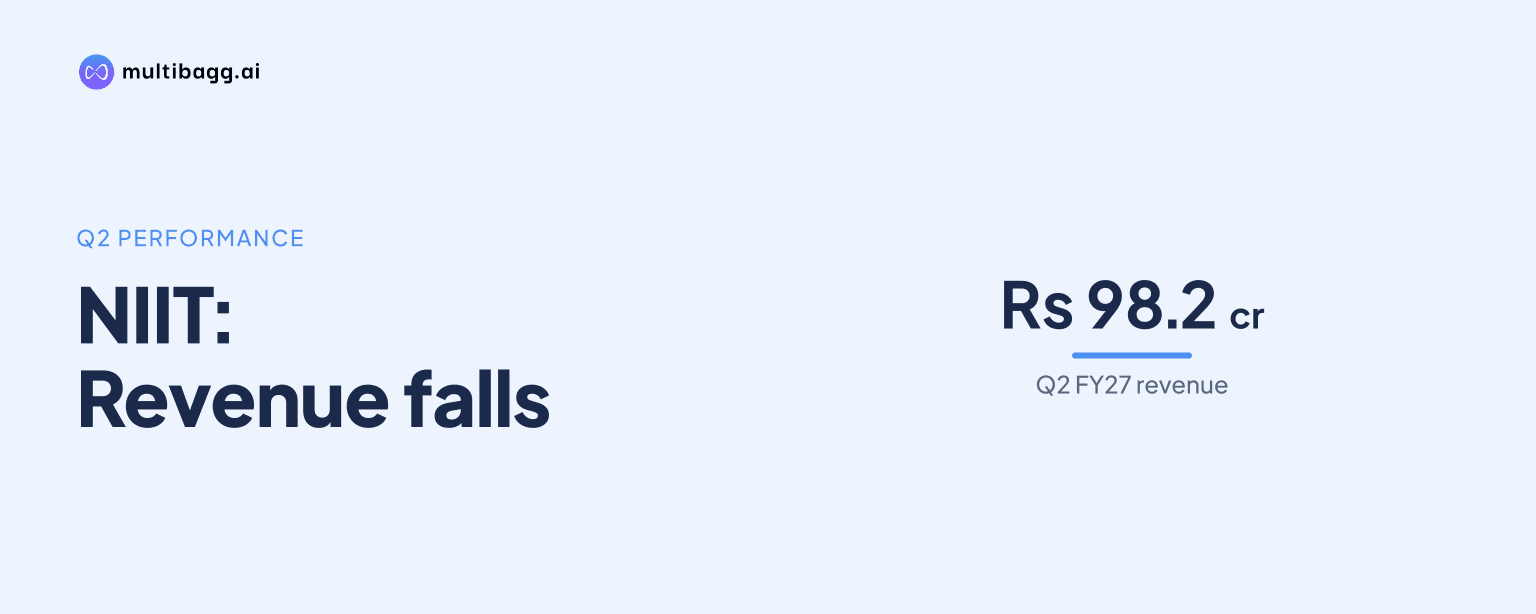
NIIT Limited said Q2 FY27 revenue fell 6% year-on-year to Rs 98.2 crore after consumption by four of its largest GSI clients declined by Rs 10 crore. Management said the pullback came in a quarter that traditionally carries higher GSI training spending, while the business outside those clients grew meaningfully.
Know NIIT inside out
Results, valuation, peers and who's buying, in one view.
Why did NIIT's Q2 FY27 revenue decline?
NIIT said the Rs 10 crore year-on-year decline in consumption from four large GSI clients was the main disclosed driver of its Q2 FY27 revenue fall. Revenue was Rs 98.2 crore for the quarter, down 6% from a year earlier but up 3% sequentially. For H1 FY27, revenue was Rs 193.9 crore, up 3% year-on-year, following a first quarter in which management said performance was on, or slightly ahead of, its projection.
Management described the GSI spending compression as broad across some large clients rather than confined to one account. It said lower onboarding could have contributed, while clients under cost-cutting pressure may have used in-house resources instead of external providers. Management cautioned that these were considerations rather than the only explanation for the Q2 FY27 change.
The concentration of the decline matters because management said the rest of NIIT grew meaningfully in Q2 FY27. The reported 6% company-level revenue decline therefore combined weaker consumption from a defined group of large GSI customers with growth elsewhere. NIIT also said Q2 is usually a period of significant GSI training consumption, making the pullback consequential for the quarter.
Which NIIT segments offset part of the GSI slowdown?
NIIT's enterprise BIPS, or BFSI and Industry Performance Program, reached an all-time quarterly revenue high of Rs 20 crore in Q2 FY27. Enterprise BIPS revenue rose 17% year-on-year and 66% quarter-on-quarter, according to management, as NIIT expanded beyond its top four private-bank relationships into wealth management, non-banking financial companies and insurance.
Enterprise revenue overall was Rs 62.5 crore, down 11% year-on-year because of GSI weakness. Consumer revenue was Rs 35.7 crore, up 3% year-on-year, with management reporting growth across its technology and BIPS portfolios. The enterprise-to-consumer revenue mix moved to 64:36 in Q2 FY27 from 67:33 in Q2 FY26, reflecting the larger year-on-year decline in enterprise revenue.
The product comparison showed the same pattern in Q2 FY27. Technology-program revenue fell 13% year-on-year to Rs 66.1 crore, which management attributed to GSI compression, while BIPS revenue rose 11% to Rs 32.1 crore on enterprise demand. During the quarter, NIIT partnered with two large banks to establish wealth and sales academies using immersive artificial intelligence, or AI, simulations and AI coaches.
How did the revenue decline affect NIIT's profitability and cash?
NIIT reported Q2 FY27 earnings before interest, tax, depreciation and amortisation, or EBITDA, of Rs 2.7 crore, equal to a 2.7% margin, despite the 6% revenue decline. This compared with EBITDA of Rs 1.35 crore in Q2 FY26 and negative Rs 1.4 crore in Q1 FY27. Management said operating expenses fell 8% year-on-year through cost optimisation, simplification and productivity measures while investment continued in go-to-market activity and AI offerings.
NIIT nevertheless recorded a Q2 net loss of Rs 2.2 crore, compared with profit after tax of Rs 1.4 crore a year earlier. Depreciation was Rs 10.3 crore, while net other income was Rs 6.5 crore, including treasury income of Rs 4.1 crore. NIIT said treasury income was below the Rs 17.5 crore reported in Q1 FY27 because rising interest rates created a mark-to-market effect.
Cash and cash equivalents stood at Rs 688.9 crore at the end of Q2 FY27. Capital expenditure was Rs 4.4 crore, down from Rs 6.9 crore in Q2 FY26. Billing and receivables days increased to 63 from 53 in Q1 FY27 because of delayed collections that management said were subsequently received in October. Headcount was 816, down 50 sequentially and 124 year-on-year after unreplaced attrition and resource optimisation.
Got a follow-up? Ask IRIS
What new demand indicators did NIIT report in Q2 FY27?
NIIT reported Q2 FY27 order intake of Rs 130.1 crore and added 10 new logos, comprising three technology clients, three higher-education institutions and four BIPS clients. It was also selected as learning-transformation partner by one of India’s top banks, although management said revenue would arise only in future quarters after the engagement’s scope, size and business model are defined.
AI-related revenue accounted for 12.4% of Q2 FY27 revenue, up from 9% in the preceding quarter. Management said this covered AI embedded across the portfolio as well as offerings whose contribution can be separately identified. NIIT cited a wealth-management sales coach and DILOS, or Day in the Life of a Salesperson, as AI coaching tools live with more than one customer.
NIIT said AI coaches operate as subscriptions on top of training fees and can bring delivery, content and learning-management-system business. Management characterised their current contribution as small compared with total revenue, but said the model can extend learner engagement beyond the classroom. The 12.4% AI revenue share was reported alongside Rs 32.1 crore of BIPS revenue, where NIIT identified demand for role-specific sales and relationship-management capability building.
What does NIIT expect from GSI clients and the wider business?
NIIT expects GSI volumes to remain under pressure for the next two quarters, even though some clients have returned with more advanced talent-transformation requirements. Management said GSIs are controlling external spending, assessing workforce needs and deciding which work to retain in-house and which to procure externally. It does not expect a significant revenue impact from revised GSI strategies during the next two quarters.
For the rest of FY27, NIIT assumes revenue will be broadly flat based on the Q2 FY27 experience and will revisit the outlook next quarter. Management expects a low single-digit EBITDA margin for the year, supported by existing cost measures. It said growth outside GSIs, including new logos and initiatives, could accelerate in coming quarters, while identifying economic uncertainty, rising interest rates and cybersecurity risks as market variables.
Conclusion
NIIT’s Q2 FY27 revenue decline was tied most clearly to a Rs 10 crore reduction in spending by four large GSI clients rather than a uniform contraction across its operations. Revenue of Rs 98.2 crore fell 6% year-on-year, while BIPS revenue rose 11% to Rs 32.1 crore, consumer revenue increased 3%, and lower operating expenses supported Rs 2.7 crore of EBITDA.
The next evidence point is NIIT’s next-quarter review of its broadly flat revenue outlook and low single-digit EBITDA-margin expectation for FY27. Management’s disclosed plans also leave investors watching whether GSI clients convert revised talent-transformation strategies into orders, whether the top-bank partnership receives a defined scope, and whether AI revenue rises from its 12.4% Q2 FY27 share.