










India's organised retail sector sees uneven Diwali demand
Key highlights
- Datum Intelligence estimates online festive sales of Rs 1.50-1.55 lakh crore, up 25-29% from Rs 1.2 lakh crore in 2025.
- Food and grocery grew 12% year on year in July and August, while apparel grew 10% in August.
- Sales of apparel, footwear and consumer durables rose more than 20% during Navratri-Dussehra, while air-conditioner sales grew more than 50%.
- Meesho reported about 75% year-on-year order growth on the first day of its Mega Blockbuster Sale.
powered by IRIS
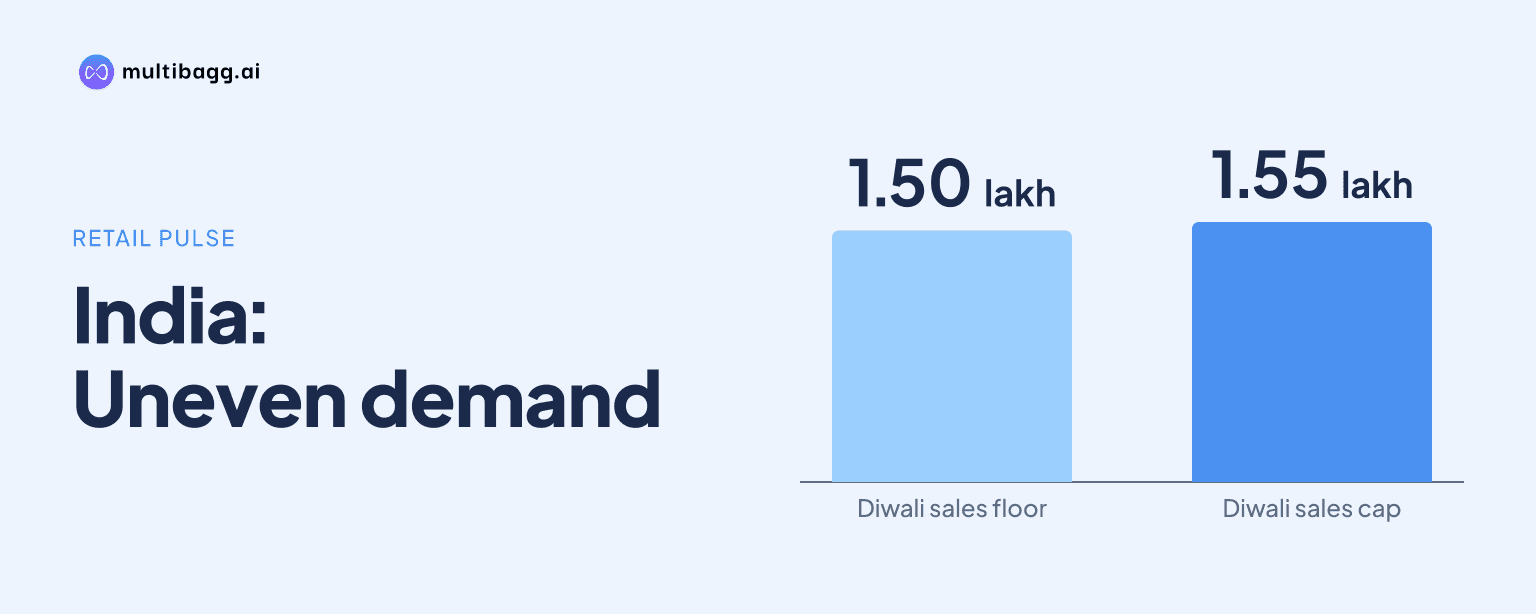
India's organised retail sector is seeing uneven Diwali demand, with Datum Intelligence estimating online festive sales of Rs 1.50-1.55 lakh crore, up 25-29% from Rs 1.2 lakh crore in 2025, while inflation, discounting and higher input costs may limit the earnings benefit. Demand is stronger in several categories, but the final outcome depends on Dhanteras and Diwali trading.
Why is organised retail seeing mixed Diwali demand?
Organised retail is seeing stronger shopping across fashion, ethnic wear, jewellery, electronics, beauty and home categories, but spending patterns remain uneven. Malls and retailers have reported encouraging momentum ahead of the peak Dhanteras-Diwali period, which is expected to determine the season's final performance. A value-conscious consumer and a festive calendar shift from the September quarter to the December quarter are shaping the comparison.
Available category data shows the divergence. Deloitte's Consumer Signals report recorded food and grocery growth of 12% year on year in July and August, apparel growth of 10% in August, and durables and electronics growth of 7% during those months. By contrast, Retailers Association of India data showed jewellery sales growth moderating from more than 8% in August to just over 4% in September.
Which retail categories are gaining festive traction?
Organised retail is gaining the clearest traction in appliances, apparel, online-led shopping and selected two-wheeler segments. Sales of apparel, footwear and consumer durables rose more than 20% during the Navratri-Dussehra period, while appliance demand was particularly strong, with air-conditioner sales up more than 50%. Online sales of big appliances are growing 25% as festive sales begin.
Demand is not confined to large cities or physical stores. Direct-to-consumer sales on GoKwik's network rose 64% year on year in the six days before Karwa Chauth, with festival-labelled products gaining demand in central, western and eastern India. Meesho said first-day orders in its Mega Blockbuster Sale grew about 75% year on year and transacting customers increased about 60%.
Is online shopping taking share from physical retailers?
Organised retail faces a clear shift towards online channels, where promotional events, wider selection and financing offers are drawing shoppers. Amazon said large-appliance sales in its Great Indian Festival were 2.5 times year-earlier levels, with smart TVs accounting for more than 50% of its total TV sales. The platform also reported higher purchases of air purifiers, furniture and clothing.
However, the online picture is not uniformly strong. Redseer Strategy Consultants estimated online festive sales exceeded $5 billion in the first four days from October 8 to 11, while fourth-day gross merchandise value rose 15% to 20% year on year and average order value fell 7% to 8%. Separately, an ET report cited Datum Intelligence estimates of Rs 29,800-30,900 crore of gross merchandise value in the first four days of Amazon's and Flipkart's events, below Rs 33,200 crore a year earlier.
Got a follow-up? Ask IRIS
Can stronger festive sales lift retail sector profits?
Organised retail may report better sales growth without an equivalent improvement in profits because higher costs and discounting are still material constraints. Rising oil and commodity prices are raising input-cost pressure, while higher prices for vegetables and sweets are reducing discretionary spending for some households. Retailers are responding through financing, exchange offers, redesigned products and wider entry-level choices rather than relying only on direct price cuts.
ICRA expects discounting to dilute part of the festive revenue gains, particularly in automobiles, apparel and online-led retail. Kotak Mutual Fund's Devender Singhal has similarly cautioned that sales growth could outpace profit growth. This distinction matters for investors because festive volume growth alone does not establish margin expansion or a corresponding share-price gain.
What does Diwali demand mean for consumer-facing stocks?
Organised retail offers a mixed read-through for consumer-facing stocks rather than a uniform sector signal. Research expectations cited in the discussion favour consumer durables, passenger vehicles, premium two-wheelers, organised retail and e-commerce, while mass FMCG, entry-level two-wheelers and value-oriented discretionary categories may remain subdued. Passenger vehicle demand also appears softer than two-wheelers, with Maruti Suzuki's October sales up 0.6% to 135,948 units while Bajaj Auto reported 33% growth in motorbike and scooter sales.
Investors therefore need to separate category momentum from company profitability. Packaged food and everyday essentials are reporting resilient demand, and Diwali gift packs have supported beverage sales. Yet higher commodity costs, memory-chip-related price pressure on smartphones and televisions, and elevated spending on food, travel and sweets could restrain purchasing in other discretionary categories.
Conclusion
Organised retail enters the Diwali peak with clear demand support in appliances, apparel, online shopping and selected consumption categories, but category-level growth remains uneven. The 25-29% estimate for online festive sales indicates continued digital momentum, while lower average order values, jewellery moderation and pressure on high-ticket purchases show that consumers remain selective.
The next key marker is the Dhanteras-Diwali trading period, which malls and retailers identify as decisive for the season's outcome. Investors will also watch whether financing and exchange offers sustain demand without excessive discounting, and whether rising commodity and operating costs prevent festive revenue growth from reaching profits.