










POCL targets over 100,000 tonnes of lead sales in FY28
Key highlights
- POCL said FY27 lead sales could come close to 75,000 tonnes, without making an exact commitment.
- POCL is targeting more than 100,000 tonnes of FY28 lead sales at about 25,000 tonnes per quarter.
- POCL recorded more than 30,000 tonnes of lead volume in the first two quarters of FY27.
- POCL expects lead EBITDA to return to about Rs 18,000 to Rs 20,000 per tonne as volumes improve.
powered by IRIS
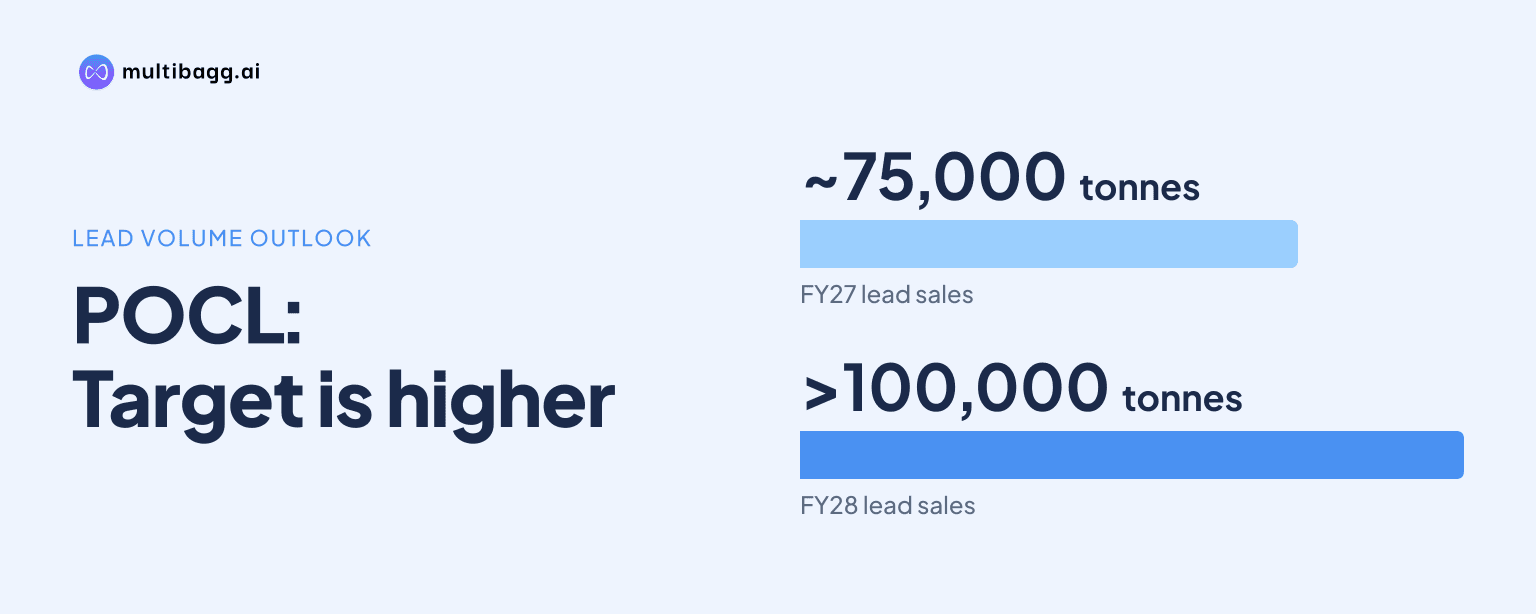
POCL is targeting more than 100,000 tonnes of lead sales in FY28 after saying FY27 sales could come close to 75,000 tonnes, compared with more than 30,000 tonnes recorded in the first two quarters. Management’s FY28 plan assumes lead sales of about 25,000 tonnes a quarter despite continuing supply-chain difficulties.
Know Pondy Oxides & Chemicals inside out
Results, valuation, peers and who's buying, in one view.
What is POCL’s lead-sales target for FY27 and FY28?
POCL said it could get close to 75,000 tonnes of lead sales in FY27, but management did not commit exactly to that volume. In response to a question on the full-year target, management said it could be closer to 75,000 tonnes and would try to reach it. This makes the FY27 number an objective rather than formal guidance.
POCL’s FY28 target is more than 100,000 tonnes of lead sales, based on a planned run rate of about 25,000 tonnes a quarter. Management described the 25,000-tonne quarterly level as its outlook for the next financial year. That annualised rate is about 100,000 tonnes, while the separately stated target is in excess of that level.
The stated FY27 objective is lower than the 125,000-tonne level referenced by an analyst as an earlier aim two quarters previously. Management did not confirm that 125,000 tonnes had been formal guidance. It instead focused on current sourcing constraints and said lead volumes had been around 15,000 to 16,000 tonnes in a quarter, as outlined in the analyst’s question.
Can POCL deliver 25,000 tonnes of lead sales each quarter?
POCL said 25,000 tonnes a quarter is manageable in FY28 even if conditions in West Asia remain unchanged. Management described this as a balanced view that assumes current difficulties continue, rather than an assumption that supply routes or freight conditions fully normalise. The outlook therefore incorporates the disruption that has constrained lead procurement.
The company said its sourcing model is being realigned and that the third quarter appeared somewhat better than the second quarter. Management expects the full turnaround in sourcing to occur by the fourth quarter. That timeline makes fourth-quarter lead volumes an important indication of whether the route to a 25,000-tonne quarterly FY28 run rate is being established.
POCL attributed supply disruption to international delays and gaps in material availability, while saying it has become selective about the grade and location of raw material purchased. Management also said domestic sourcing is slightly more expensive than international sourcing. The volume recovery therefore depends on both adequate scrap availability and procurement economics, rather than on physical material availability alone.
Management challenged an analyst’s view that peers had avoided similar pressure, saying the wider industry had also reported lower volumes. It cited standalone declines of 47% and more than 40% at peers, without naming them or giving the relevant periods. POCL did not provide its own year-on-year lead-volume decline in this exchange.
Got a follow-up? Ask IRIS
How is POCL changing lead procurement after shipping disruptions?
POCL is increasing tie-ups with larger yards, adding sourcing locations and strengthening its domestic supply chain rather than setting up overseas collection warehouses. Management said a warehouse focused on one metal would add holding, shipping and financial costs because suppliers generally handle multiple metals and shipments cannot be consolidated every day.
The company said it has specific exclusive tie-ups with certain larger yards and intends to expand those arrangements. Management prefers this model to deploying capital, manpower and recurring expenses across several yards in different geographies. It did not disclose the number of tied-up yards, volumes secured, or the expected split between domestic and international material.
POCL said higher shipping costs can make raw-material purchases non-viable at times, but it does not regard lower freight as the only path to renewed supply. Management’s view is that freight is an embedded raw-material cost and, if costs rise for smelters across the industry, selling prices can eventually adjust. The timing and extent of that adjustment remain unresolved in the transcript.
How will customer contracts and product mix affect lead earnings?
POCL is renegotiating customer contracts with variable and flexible terms to address higher freight, fuel, flux, additive and operating costs. Management said international negotiations had started, first-round quotations had been submitted, and second-round discussions were due before contracts that typically start in January and February. It said buyers had shown lower resistance because they too faced raw-material availability issues.
Management expects improving volume to help lead earnings before interest, tax, depreciation and amortisation, or EBITDA, return to about Rs 18,000 to Rs 20,000 per tonne. It said flux costs had reduced EBITDA by about Rs 2.5 per kg. Management pointed to improvement in the fourth quarter but did not give a firm date for reaching the Rs 18,000 to Rs 20,000-per-tonne range.
Lead product mix may also affect the earnings outcome. Value-added products accounted for 65% of the sales mix in the discussed quarter, compared with 82% in the preceding quarter cited by an analyst. POCL said its manufacturing capability was fully functional and could produce more value-added material, but the mix depends on contracted volumes, additional customer orders and specific customer requirements.
POCL manufactures about 80 to 100 alloys, and management put the average margin differential between value-added products and basic pure lead at 0.75% to 1.25%, depending on the blend. It said certain products can exceed a 1.5% to 1.75% differential. As a result, the FY28 volume target alone will not determine lead EBITDA per tonne; the composition of customer orders will also matter.
The company’s annual lead capacity is 204,000 tonnes, against more than 30,000 tonnes of volume in the first two quarters and a FY28 sales target above 100,000 tonnes. The FY28 objective would therefore remain below nameplate capacity. Management did not disclose expected capacity utilisation at the end of FY27 or FY28.
Conclusion
POCL has set a qualified FY27 lead-sales objective of close to 75,000 tonnes and a more explicit FY28 ambition of more than 100,000 tonnes, based on about 25,000 tonnes a quarter. The planned recovery depends on reorganised sourcing, larger-yard relationships, new procurement locations and customer contracts designed to pass through changing freight and operating costs.
The next milestone is the fourth quarter, when management expects the sourcing realignment to produce a fuller turnaround after a better third quarter than second quarter. Investors should also watch the outcome of international contract discussions before the January and February contract cycle, because management has linked the FY28 25,000-tonne quarterly plan to flexible pricing and continued scrap availability.