










Praruh targets Rs 50-70 crore of defence revenue in FY28
Key highlights
- Praruh management is targeting Rs 50-70 crore of defence revenue by FY27-28.
- Defence contributed an estimated 15% to 25% of Praruh’s business over the past five years.
- Praruh reported Rs 84 crore of H1 FY27 revenue and cited a Rs 154 crore confirmed order book as of 4 November.
- Management said approximately Rs 50-55 crore of H1 FY27 revenue came from PSU customers.
powered by IRIS
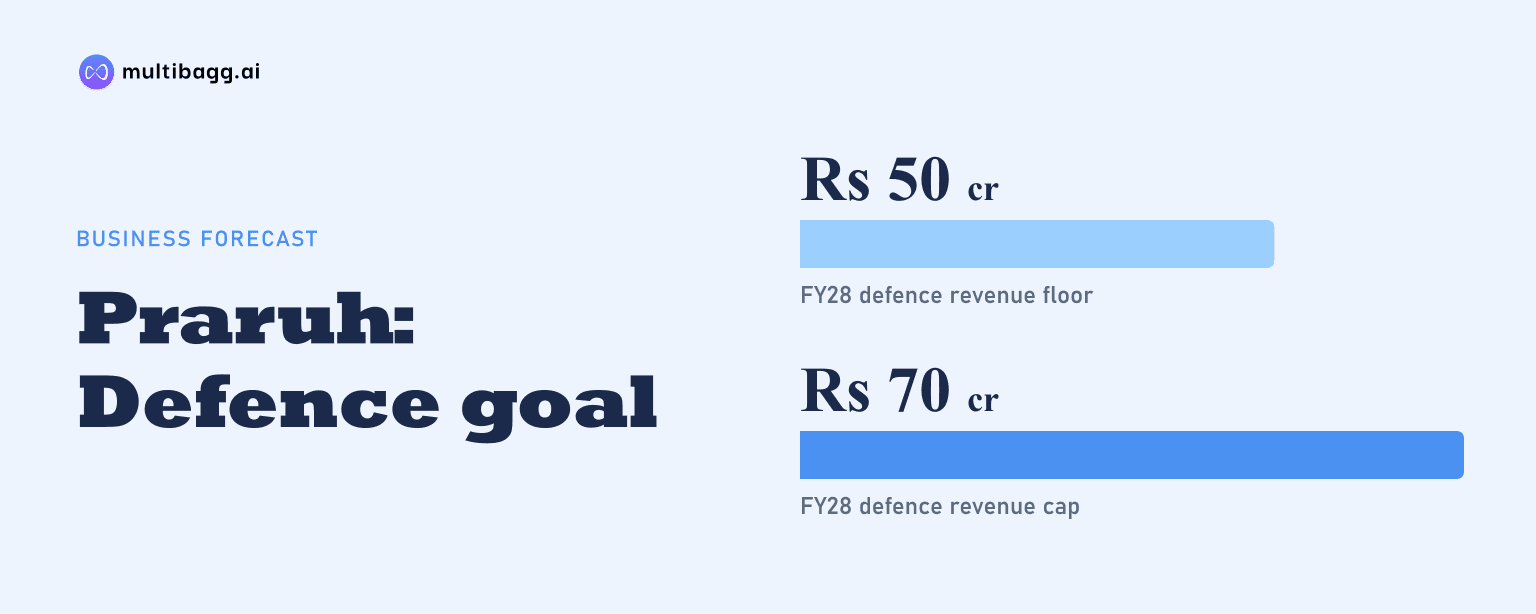
Praruh is targeting Rs 50-70 crore of defence revenue in FY27-28 through a dedicated vertical, after management estimated that defence had contributed 15% to 25% of business over the previous five years. The plan shifts Praruh from handling separate defence assignments to building a focused team for project reports, data centres and cybersecurity.
Know Praruh Technologies inside out
Results, valuation, peers and who's buying, in one view.
Why is Praruh setting up a dedicated defence vertical?
Praruh is setting up the vertical because its earlier defence work was delivered across separate technologies rather than through a focused business structure. Management said it had identified a senior defence-sector person to join as a consultant, expected from November or December, to lead the planned team. Praruh also intends to separate its enterprise, defence and software teams so that each can focus on a specific operating area.
The new structure is intended to pursue requirements across several categories rather than a single defence product. Management identified detailed project report, or DPR, services as the first focus, including reports for requirements beyond information technology. It said the opportunity set can include arms and ammunition, data-centre infrastructure and other defence-related systems, while Praruh would charge for DPR work.
Praruh has already undertaken defence-linked work, although management did not disclose a current order book for this vertical. It said the company had executed defence data-centre projects for the Indian Navy and Bharat Electronics Limited, or BEL, in earlier years. Management also cited completion of an optical-network project for the Indian Air Force through RailTel, with the Air Force as the end customer.
What is Praruh’s defence revenue target for FY28?
Praruh management is targeting Rs 50-70 crore of defence revenue by FY27-28 and said the business could later reach triple figures. This is a management target, not reported revenue or a confirmed defence order book. The call did not disclose defence revenue for H1 FY27, so the current contribution cannot be directly compared with the FY27-28 target.
Management estimated that defence had accounted for 15% to 25% of Praruh’s business over the last five years. That contribution came from work in defence data centres, enterprise networking and automation, while the dedicated vertical is meant to consolidate customer coverage, leadership and delivery. The stated change is therefore from project-by-project participation to a separate go-to-market operation.
The broader business base gives context for the target. Praruh reported Rs 84 crore of revenue in H1 FY27, with approximately Rs 50-55 crore coming from public-sector undertakings, or PSUs, including data-centre and technology work. Management said the balance came from enterprise services, equipment installation and allied services, and described the first half as historically slower than the second half.
Which defence opportunities will Praruh pursue first?
Praruh will initially pursue DPR services, according to management, because original equipment manufacturers, or OEMs, charge for project-report work. The company’s plan is to prepare DPRs for defence requirements rather than limiting that service to information-technology projects. This offers Praruh a services route into projects that may also require infrastructure, software or delivery capabilities.
Data centres and cybersecurity are the other stated routes into defence. Management said Praruh is already active in both areas and pointed to prior defence data-centre execution as evidence of its experience. It also said the company had participated in 24 tenders for cybersecurity services, though it did not disclose how many of those tenders were defence-related or their potential values.
Praruh has also bid for cybersecurity work involving Oil and Natural Gas Corporation, or ONGC, and RailTel, according to management. These bids were not described as confirmed orders, and management did not give award dates. The company said it provided cybersecurity products and services for 10 days during the G20 event in 2023, illustrating its existing activity in security operations outside the proposed dedicated defence structure.
Got a follow-up? Ask IRIS
How does NeuralOps support Praruh’s defence expansion?
NeuralOps could support defence customers because Praruh describes it as an artificial intelligence, or AI, enabled platform for managing IT infrastructure across defence, PSU and enterprise users. Management said the base framework was ready, while testing and research and development, or R&D, continued. The company planned a January launch with AI-based automation features under testing.
Praruh intends to offer NeuralOps through an outright sale or software as a service, or SaaS, model. Management said services connected with a customer deployment could continue for five to seven years, with the platform sitting in customer data centres to manage complex networks. The product is not exclusively for defence, but the planned vertical could use it alongside data-centre and cybersecurity offerings.
Management said the company is investing heavily in software development and intellectual property, and expects the investment to increase profit after tax, or PAT, by at least 5% to 10% in FY27-28. That is management’s expectation rather than a reported forecast. Praruh also cited an earnings before interest, taxes, depreciation and amortisation, or EBITDA, margin of 13% during the call, without disclosing a separate defence-margin target.
How does the defence plan fit Praruh’s wider revenue mix?
The defence initiative fits Praruh’s effort to build dedicated teams while serving government, PSU and enterprise clients through related technology capabilities. Of the Rs 84 crore reported in H1 FY27, management attributed about Rs 50-55 crore to PSU customers and the remainder to enterprise-oriented services and installations. The new defence team is intended to focus that operating capability on defence customers rather than replace the existing enterprise operation.
Praruh’s software plans also extend beyond NeuralOps. Management said it is developing security-operations software for different customer groups and sees SaaS as the first route for small and medium enterprises. It did not announce a launch date for that security product because management said testing must address backend vulnerabilities before release.
The comparison between the existing business and the planned defence line remains incomplete because Praruh did not provide standalone H1 FY27 defence revenue. What is disclosed is a historical 15% to 25% contribution across five years, compared with a management target of Rs 50-70 crore by FY27-28. Progress will depend on the planned consultant-led team and on converting opportunities in DPRs, data centres and cybersecurity into disclosed orders.
Conclusion
Praruh’s stated defence strategy combines prior project experience with a more formal operating model. The company has cited work for the Indian Navy, BEL and the Indian Air Force, while management’s Rs 50-70 crore FY27-28 target sets a revenue objective for a vertical that will pursue DPR services, data centres, cybersecurity, networking and automation.
The next points to watch are the planned arrival of the defence consultant from November or December, the formation of a separate defence team and any disclosed orders supporting the FY27-28 target. Management also plans to launch NeuralOps in January and is targeting Rs 175-200 crore of FY27 revenue, after reporting Rs 84 crore in H1 FY27 and citing a Rs 154 crore confirmed order book as of 4 November.