










Praruh plans January NeuralOps launch with outright, SaaS sales
Key highlights
- Praruh plans to launch the first phase of NeuralOps in January and start sales in January or February.
- NeuralOps has a completed base framework, while testing and R&D continue before launch.
- Praruh reported Rs 84 crore of revenue in H1 FY27, with management citing Rs 45 crore to Rs 55 crore from PSUs.
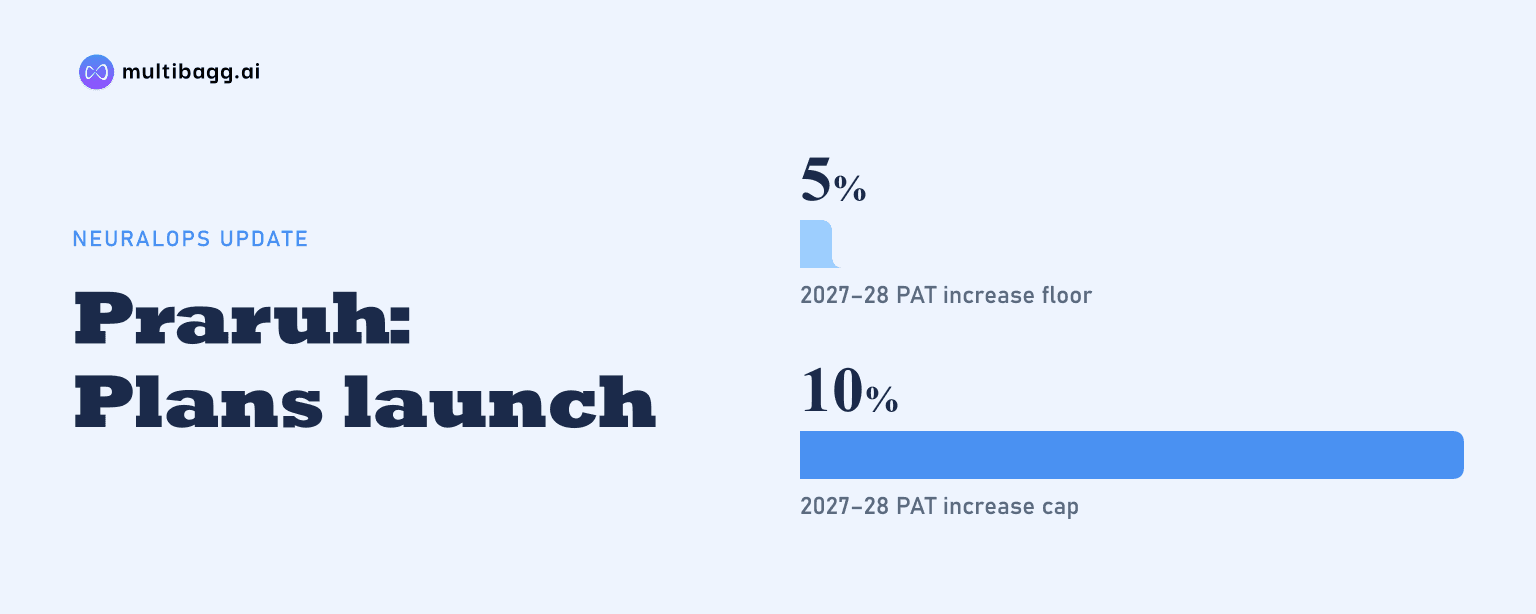
- Management expects NeuralOps could increase PAT by at least 5% to 10% in 2027-28.
powered by IRIS
Praruh Technologies plans to launch the first phase of NeuralOps in January and begin outright and software-as-a-service sales in January or February, after completing its base framework and continuing tests. Management said the internally developed, AI-enabled platform could increase profit after tax by at least 5% to 10% in 2027-28.
Know Praruh Technologies inside out
Results, valuation, peers and who's buying, in one view.
When will Praruh launch NeuralOps and begin sales?
Praruh is targeting a January launch for NeuralOps and expects sales to begin in January or February. Management described the release as the first phase of a new NeuralOps vertical, through which it intends to operate as an original equipment manufacturer, or OEM, alongside its existing technology-services business.
The timing is a plan rather than a disclosed revenue forecast. An analyst referred to a January 27 launch date during the call, but management said it expected to launch the software by January and start selling from January or February. Praruh did not disclose a launch-day order, a customer deployment, or a specific NeuralOps revenue target.
How far has Praruh developed NeuralOps?
Praruh said NeuralOps has a completed base framework, while testing and research and development remain under way before the January first-phase launch. Management said it is maturing the software and testing artificial intelligence, or AI, and machine-learning, or ML, use cases that could automate customer tasks.
The product is intended to manage a customer’s information-technology infrastructure, including complex networks and data-centre services. Management said the first phase would include AI-based automation where customers need it, distinguishing its proposed offering from software Praruh has previously bought from other OEMs for project delivery.
Praruh said its software purchases from other OEMs represented around 10% to 20% over the past five years, although it did not specify whether that range referred to project costs, revenue, or another measure. Its stated aim is to develop a Make-in-India alternative that it can use in projects and sell to customers and other system integrators.
How will Praruh sell NeuralOps?
Praruh plans to offer NeuralOps through two models: outright purchase and software as a service, or SaaS. Management said the SaaS option is intended for smaller enterprises that cannot bear the upfront cost of buying the software outright.
The commercial model combines product delivery with longer-running services. Management said Praruh could launch and deliver the software and then provide associated project services for five or seven years because the platform would operate in the customer’s data centre. This would retain legacy services while adding a software-led revenue line.
Praruh also expects other companies similar to itself to sell the product. Management said the company will sell NeuralOps directly, while other system integrators could also distribute it as Praruh seeks to build an OEM position. It did not disclose reseller terms, pricing, subscription fees, revenue-sharing arrangements, or the number of potential distributors.
Got a follow-up? Ask IRIS
Can NeuralOps change Praruh’s revenue and profit mix?
Management expects NeuralOps to add revenue and profit after tax, or PAT, but has not quantified product revenue. It said it is investing heavily in development, using an in-house team and undertaking intellectual-property work, and estimated that the software could increase PAT by at least 5% to 10% in 2027-28.
Praruh reported Rs 84 crore of revenue in H1 FY27. Management initially attributed about Rs 50 crore to Rs 55 crore to public sector undertakings, or PSUs, before later referring to a Rs 45 crore to Rs 55 crore PSU range, with data-centre and technology activity included in that category.
Management said Praruh was operating at a 13% earnings before interest, tax, depreciation and amortisation, or EBITDA, margin when discussing NeuralOps. It did not provide an FY28 EBITDA-margin target, instead linking its PAT expectation to reduced reliance on purchased OEM software and potential product and SaaS revenue.
Which customers and sectors can Praruh target with NeuralOps?
Praruh intends NeuralOps to serve data centres, cybersecurity, defence, PSUs and enterprises. Management said the platform could automate the work of managing networks and services from data centres, building on assignments where Praruh already provides technology, security or network-related services.
Management cited projects for the Indian Navy’s Mumbai Data Center Division and other locations, including an upgrade to an application supporting pension and salary data. It also cited management of Delhi Metro Rail Corporation data-centre applications, security and network services for RailTel’s data centre, and monitoring systems for ONGC’s oil-exploration process.
These assignments show where management expects to position NeuralOps, but no NeuralOps contract with the Indian Navy, Delhi Metro Rail Corporation, RailTel or ONGC was disclosed. Management said it plans to deploy the platform across the government, PSU and enterprise verticals it currently serves, ranging from smaller enterprises to larger public-sector customers.
Conclusion
Praruh is seeking to add a product and subscription layer to a business that generated Rs 84 crore in H1 FY27 revenue, including a management-stated Rs 45 crore to Rs 55 crore from PSUs. NeuralOps remains in testing, but its base framework is ready and the proposed outright-purchase and SaaS models would supplement project delivery and longer-term services.
The next scheduled milestone is the planned January first-phase launch, followed by management’s expected start of sales in January or February. Progress will depend on whether Praruh completes testing of its AI and ML automation use cases and converts its existing data-centre, government, PSU and enterprise relationships into product customers.