










Praruh says NeuralOps could lift PAT 5%-10% in 2027-28
Key highlights
- Praruh says NeuralOps could increase PAT by at least 5%-10% in the coming 2027-28 period.
- Praruh is targeting a January first-phase launch for NeuralOps, whose base framework is ready but remains in testing.
- Praruh reported approximately Rs 84 crore of revenue in H1 FY27, including about Rs 50 crore to Rs 55 crore from public-sector undertakings.
- Praruh reported a confirmed order book of Rs 154 crore as of 4 November and guided for Rs 175 crore to Rs 200 crore of turnover.
powered by IRIS
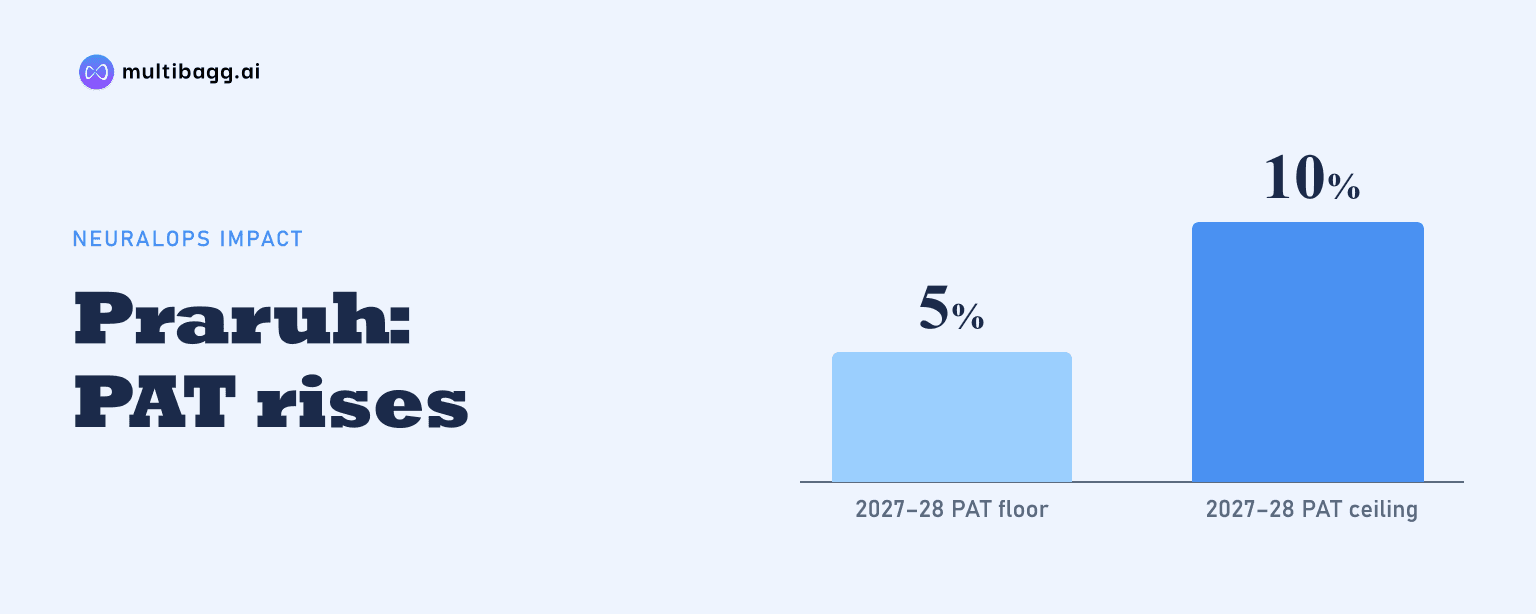
Praruh says NeuralOps could increase profit after tax, or PAT, by at least 5%-10% in the coming 2027-28 period as it moves from buying software from original equipment manufacturers to selling its own platform. Management said the product requires heavy upfront investment, but plans to launch its first phase in January.
Know Praruh Technologies inside out
Results, valuation, peers and who's buying, in one view.
What PAT contribution does Praruh expect from NeuralOps?
Praruh expects NeuralOps to raise PAT by at least 5%-10% in the coming 2027-28 period, according to Rahul Sharma. The statement followed an analyst's reference to a current earnings before interest, tax, depreciation and amortisation, or EBITDA, margin of 13% and a question on the margin effect once the software begins contributing.
Management did not disclose a PAT base, a NeuralOps revenue target, or a revised EBITDA-margin target. The 5%-10% figure is therefore management's expected PAT uplift rather than a quantified margin forecast. Sharma said software development involves upfront expenditure, with Praruh investing heavily in an in-house team and intellectual-property work.
The stated mechanism is a change in the company's software sourcing and sales model. Praruh said it has been buying relevant software through different original equipment manufacturers, or OEMs, and now intends to provide its own software to customers. Management expects that transition to add both software revenue and PAT in upcoming years, without quantifying any reduction in third-party software costs.
How will Praruh sell NeuralOps as an OEM product?
Praruh plans to sell NeuralOps through outright purchases and software as a service, or SaaS, while licensing the software to other companies as part of its OEM strategy. Sharma confirmed that the company's OEM ambition includes selling or licensing its own software rather than only supplying third-party technology.
For government, public-sector undertaking and large-enterprise customers, Praruh described a model in which the product is deployed in a customer data centre to manage complex networks. The company said it would also provide delivery and project-related services for five to seven years, creating a service component alongside the initial software sale.
For smaller enterprises that cannot make an outright purchase, Praruh plans to provide NeuralOps as SaaS. Management said its development team and service team would support this model, giving customers a choice between a one-time product purchase and a recurring service arrangement. The company did not disclose pricing, contract values or a target number of SaaS customers.
When will Praruh launch NeuralOps and what stage is it at?
Praruh is targeting a January launch for the first phase of NeuralOps, whose base framework is ready but remains in testing and research and development. Amar Deep Sharma said the product had been developed and was being matured through testing of artificial intelligence, or AI, and machine-learning, or ML, use cases.
Management said the first-phase product would include AI-enabled automation where customers require it. Praruh is testing use cases intended to automate network-management tasks and simplify daily operations for customers. It described this AI capability as a differentiator, but did not disclose completed customer deployments, pilot outcomes or booked NeuralOps orders.
The platform is intended to operate in customer data centres and support complex-network management. Praruh said this approach can be applied across its existing government, public-sector undertaking and enterprise customer verticals. The January plan applies to the initial launch phase, and management gave no timetable for wider adoption or a full commercial rollout.
Got a follow-up? Ask IRIS
How does NeuralOps fit Praruh's FY27 revenue base?
Praruh reported approximately Rs 84 crore of revenue in H1 FY27, of which management attributed about Rs 50 crore to Rs 55 crore to public-sector undertakings, including data-centre and technology work. The balance, implied at about Rs 29 crore to Rs 34 crore, came from enterprise services, equipment installation and allied activities.
The H1 FY27 mix shows that NeuralOps is being introduced alongside a project-led business rather than replacing it. Management said its industry has historically generated lower turnover in H1 and higher turnover in H2, while adding that Rs 84 crore in H1 had not been achieved previously. This compares a higher first-half revenue base with the company's stated historical seasonal pattern.
As of 4 November, Praruh said it had a confirmed order book of Rs 154 crore and gave a turnover range of Rs 175 crore to Rs 200 crore. Management also said software could contribute 20% of revenue in upcoming years and potentially 30% or more once Praruh operates as an OEM. These are management plans rather than reported software revenue or dated annual targets.
What investments and adjacent businesses could affect the software plan?
Praruh plans separate enterprise, defence and software teams so that each can focus on its respective operations. Management said defence contributed about 15% to 25% of business over the last five years and cited past data-centre work involving the Indian Navy and Bharat Electronics, along with an optical-network project for the Indian Air Force through RailTel.
Management also described a plan to establish defence as a dedicated vertical, supported by a prospective consultant. Sharma said Praruh was targeting Rs 50 crore to Rs 70 crore of defence revenue by 2027-28, followed by a three-digit crore figure. The company did not disclose contracts or an order pipeline supporting that defence target.
Separately, Praruh is developing cybersecurity software for small and medium enterprises, with SaaS identified as the initial route to market. Management said the cybersecurity product remains in testing because backend vulnerabilities must be addressed before launch. It also said Praruh was participating in 24 cybersecurity-service tenders, but gave no launch date or revenue forecast for that product.
Conclusion
Praruh's NeuralOps strategy combines a planned January first-phase launch with a move from buying external software to licensing, selling and servicing its own product. Management's at-least-5%-10% expected PAT uplift for 2027-28 depends on converting that software development investment into customer adoption, while the current revenue base remains led by public-sector, data-centre, enterprise and installation work.
The next disclosed milestones are the targeted January NeuralOps launch, the FY27 turnover range of Rs 175 crore to Rs 200 crore, and execution against the Rs 154 crore confirmed order book reported on 4 November. Management's longer-term software ambition is for a 20% revenue contribution in upcoming years, potentially rising to 30% or more as Praruh develops its OEM model.