










Pyramid targets 11–12% EBITDA margin with FY27 levers
Key highlights
- Pyramid targets an 11–12% EBITDA margin in FY27, compared with 9.0% in H1FY27 and 8.6% in FY26.
- Q2FY27 EBITDA per tonne rose 33% year on year to Rs 13,718 as utilisation reached 70%.
- Pyramid expects its 14.25-megawatt solar programme to reduce annual costs by Rs 15 crore after the final 1-megawatt phase.
- The recycling plant earned Rs 33 lakh of EBITDA profit in Q2FY27 and is estimated to generate about Rs 2 crore in FY27.
powered by IRIS
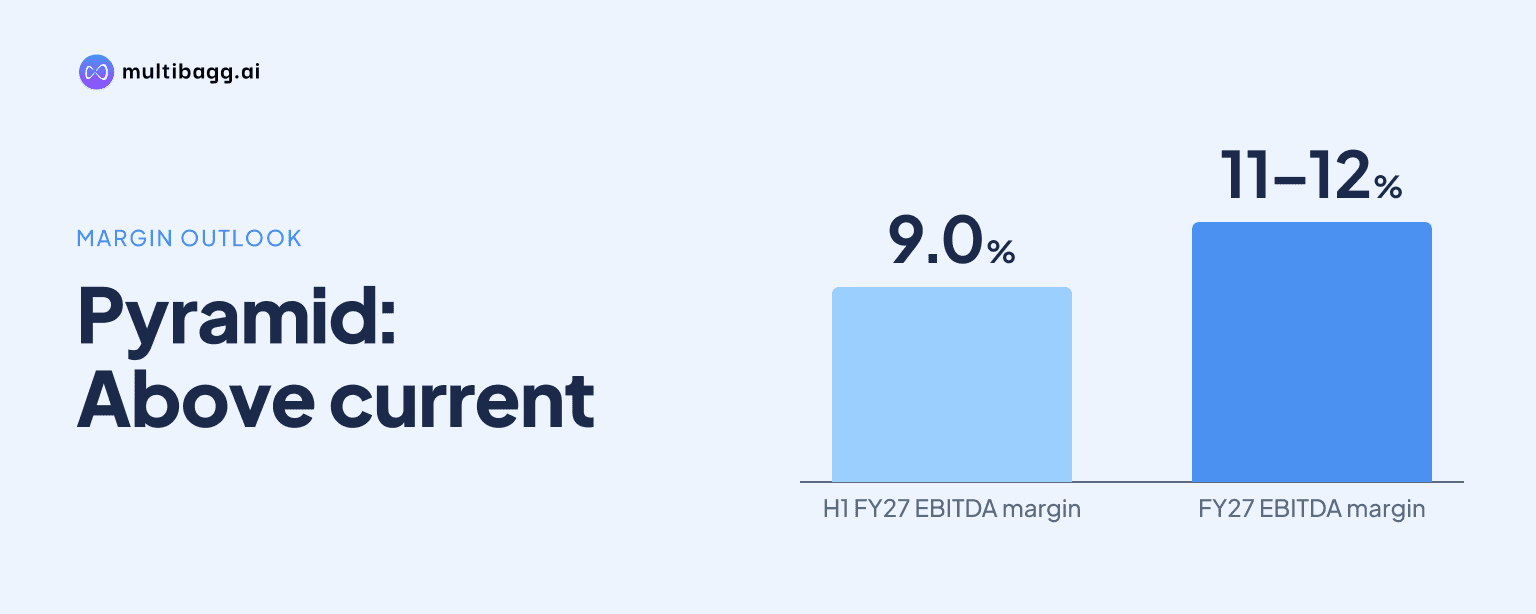
Pyramid Technoplast Limited is targeting an 11–12% EBITDA margin in FY27, compared with 9.0% in H1FY27 and 8.6% in FY26, through captive solar power, recycling, Wada operating leverage and product mix. The company’s solar plan identifies Rs 15 crore of annual cost reduction after the final 1 megawatt phase is deployed.
Know Pyramid Technoplast inside out
Results, valuation, peers and who's buying, in one view.
How does Pyramid plan to reach an 11–12% EBITDA margin?
Pyramid plans to reach its FY27 EBITDA, or earnings before interest, tax, depreciation and amortisation, margin guidance through solar power, its recycling plant, higher Wada utilisation and product mix. Its 9.0% H1FY27 margin was 0.4 percentage points above the FY26 margin of 8.6%, while Q2FY27 margin was 8.5%, versus 7.8% in Q2FY26.
The 11–12% guidance is 2.0 to 3.0 percentage points above the H1FY27 result and 2.4 to 3.4 percentage points above FY26. Pyramid identifies the operating levers behind the target, but does not disclose the separate margin contribution expected from solar, recycling, Wada utilisation or product mix.
Q2FY27 operating data show higher output alongside better unit profitability. Volume rose 21% year on year to 14,798 metric tonnes (MT), revenue rose 48% to Rs 238 crore, and EBITDA including other income increased 61% to Rs 20.3 crore. EBITDA per tonne rose 33% to Rs 13,718, while utilisation reached 70%, compared with 62% in Q2FY26.
How much can solar power reduce Pyramid’s costs?
Pyramid expects its 14.25 megawatt solar programme to reduce annual costs by Rs 15 crore after the remaining 1 megawatt phase at Bharuch is deployed. The company commissioned 6 megawatts on October 30, 2025, commenced an additional 5 megawatts at Bharuch in February 2026, and started 2.25 megawatts in Maharashtra.
The solar project generated Rs 3.89 crore of savings in H1FY27. Pyramid states that total investment in the project exceeds Rs 60 crore and gives a payback period of nearly four years, linking the project to lower energy costs rather than an unquantified revenue assumption.
The completed 13.25 megawatts of commissioned solar capacity is part of an efficiency programme already in operation, with the final 1 megawatt listed as the next phase. Pyramid places this energy initiative alongside its 70% Q2FY27 overall utilisation, indicating that cost reduction and higher production are both components of its stated margin plan.
What can Pyramid’s recycling plant add to EBITDA?
Pyramid’s recycling plant has 5,000 MT of annual capacity, which the company says can meet 10–12% of its raw-material needs through in-house use or sale of recycled plastic. Unit 9 was commissioned on October 3, 2025, following investment of Rs 8–10 crore.
The plant generated EBITDA profit of Rs 33 lakh in Q2FY27, and management estimates about Rs 2 crore of EBITDA from the facility during FY27. Pyramid gives the recycling project a payback period of about two to three years, although the presentation does not specify the assumptions behind that estimate.
Pyramid currently uses 30,000 tonnes of high-density polyethylene, or HDPE, in production. The plant’s 5,000-tonne recycling capacity equals about one-sixth of that HDPE usage, while the company’s stated raw-material coverage estimate is 10–12%, leaving the precise mix of recycled input and sales undisclosed.
Got a follow-up? Ask IRIS
Why does Wada utilisation matter to Pyramid’s target?
Wada matters because Pyramid expects the facility to reach about 80% utilisation during FY27 after operating at 70–77% in Q1FY27. The plant is producing across HDPE, intermediate bulk container, or IBC, and mild-steel drum lines, providing the volume base for the operating-leverage element of the margin plan.
Wada produced 905 tonnes of HDPE, 1,238 tonnes of IBCs and 1,440 tonnes of mild-steel drums in Q2FY27, a combined 3,583 tonnes. Pyramid assigns revenue potential of Rs 200 crore to Phase 1 and Rs 400 crore to Phase 3 over three to four years, but does not provide the timing, capacity split or margins for those phases.
Wada also has an approved subsidy of Rs 24.9 crore for 10 years, with sanction expected by March 2027. Pyramid says the subsidy would reduce effective capital expenditure and improve return on capital employed, internal rate of return and cash-generation visibility; the sanction remains an upcoming milestone rather than a reported receipt.
How much revenue can existing Pyramid capacity support?
Pyramid estimates that every 10-percentage-point increase in utilisation can add about Rs 135 crore of revenue at current realisations. The illustration is based on existing capacity of 83,971 MT per annum and a Q2FY27 realisation of about Rs 1.61 lakh per tonne.
The 70% illustration of Rs 952 crore is the Q2FY27 run-rate, compared with FY26 revenue of Rs 681 crore at 67% utilisation. Pyramid also reported Q2FY27 volume growth of 14% quarter on quarter, but says realisations move with polymer prices, so the revenue scenarios are illustrative rather than forecasts.
Pyramid expects to commission its Kutch IBC plant in March 2027 with capacity of 10,000 units a month and planned investment of Rs 20–25 crore. Management cites lower freight, faster deliveries and improved service in Kutch and western India as intended operating benefits from the addition.
Conclusion
Pyramid’s margin target combines reported early progress with projects that have either been commissioned or are scheduled for completion. The H1FY27 margin of 9.0%, Q2FY27 EBITDA per tonne of Rs 13,718 and 70% utilisation are the reported starting points, while solar savings, recycled material and Wada throughput are the disclosed mechanisms for further expansion.
The next items to watch are deployment of the remaining 1 megawatt solar phase, Wada’s Rs 24.9 crore subsidy sanction by March 2027 and commissioning of the Kutch IBC plant in March 2027. Progress toward Wada’s approximately 80% FY27 utilisation target and the recycling plant’s estimated FY27 EBITDA of Rs 2 crore will also indicate execution against the plan.